KB-1344

H183L072-hIgG1

×
Please enable JavaScript in your browser to complete this form.
12287
Home » Antibodies » H183L072-hIgG1

Background of H183L072-hIgG1

Cluster of differentiation 3 (CD3) is a protein complex, historically known as the T3 complex. It consists of four distinct polypeptide chains: epsilon (ε), gamma (γ), delta (δ), and zeta (ζ). These chains assemble and function as three pairs of dimers (εγ, εδ, ζζ). The CD3 complex acts as a co-receptor for T cells and noncovalently associates with the T cell receptor (TCR) (Smith-Garvin et al. 2009). The CD3 protein complex is a characteristic feature of the T cell lineage, making anti-CD3 antibodies effective as T cell markers.

Specifications

Catalog NumberKB-1344
Antibody NameH183L072-hIgG1
IsotypeHuman IgG1,kappa
TargetCD3
Species ReactivityHuman
Host Cell LineEXPI CHO
Purification MethodAffinity purified
Concentration>2 mg/mL
Formulation50 mM sodium citrate,150mM NaCl,pH5.5
Purity>95% by SDS-PAGE and SEC-HPLC
ValidationELISA
Endotoxin Level<0.2 EU/mg as determined by the LAL method
Sterility0.2μm filtered
StorageIt is recommended that the protein should be aliquoted for optimal storage.
Avoid repeated freeze-thaw cycles.
StabilityStable for twelve months from date of receipt when stored at -20°C to -80°C;
Stored at 2-8°C for one month without detectable loss of activity.

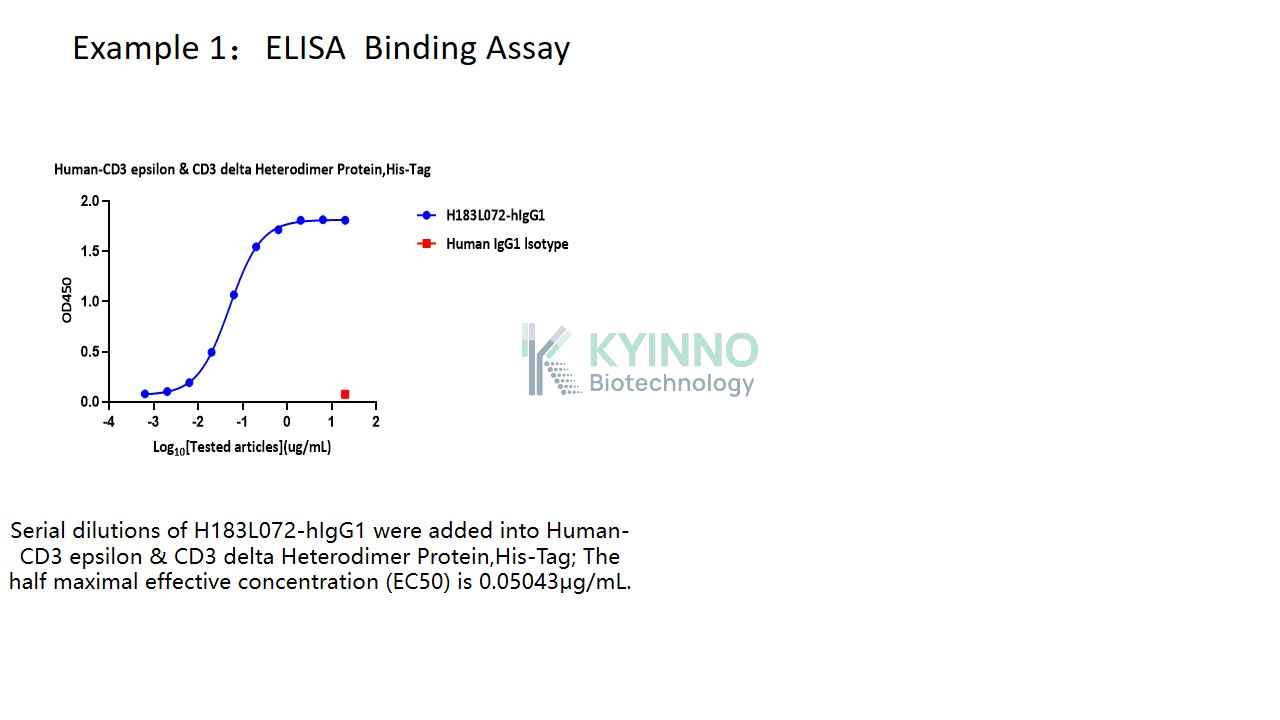
Characterization

Application

References

  1. Alarcon B et al. (1988) Assembly of the human T cell receptor CD3 complex takes place in the endoplasmic reticulum and involves intermediary complexes between the CD3γ, δ, ε core and single T-cell receptor a or b chains. Journal of Biological Chemistry 263, 2953-2961.
  2. Clayton LK et al. (1991) CD3 eta and CD3 zeta are alternatively spliced products of a common genetic locus and are transcriptionally and/or post-translationally regulated during T-cell development. Proceedings of the National Academy of Sciences of the USA 88, 5202-5206.
Please enable JavaScript in your browser to complete this form.