KC-0136

T47D-ERBB2-Cell-Line

×
Please enable JavaScript in your browser to complete this form.
19901
Home » 细胞系 » T47D-ERBB2-Cell-Line

Background of T47D-ERBB2-Cell-Line

HER2, also named ERBB2, is a cell-surface receptor tyrosine kinase, ERBB2 overexpression or overactivity have associated with a number of cancers, especially the breast cancer. The identification of ERBB2 as a driver gene has led to the development of anticancer therapeutics agents, including lapatinib, Neratinib and Herceptin.

Specifications

Catalog NumberKC-0136
Cell Line NameT47D-ERBB2-Cell-Line
Host Cell LineHuman T-47D cell line
DescriptionStable T47D cell clone expressing exogenous HER2 gene.
QuantityTwo vials of frozen cells (≥2-106/vial)
StabilityStable in culture over a minimum of 10 passages
ApplicationDrug screening and biological assays
Freezing Medium70% RPMI1640+20% FBS+10% DMSO
Propagation MediumRPMI1640+10%FBS+0.2 Units/mL Insulin+500µg/mL G418
Selection MarkerNeomycin
MorphologyEpithelial
SubcultureSplit saturated culture 1:3-1:5 every 3 days; seed out at about 1-3 × 10⁵ cells/mL
Incubation37 °C with 5% CO2
StorageLiquid nitrogen immediately upon receiving
Doubling TimeApproximately 30 hours
Mycoplasma StatusNegative
In Vivo ValidationNA

Cell Line Generation

T47D HER2 cell Line was generated using plasmid vector expressing human HER2 sequence.

Characterization

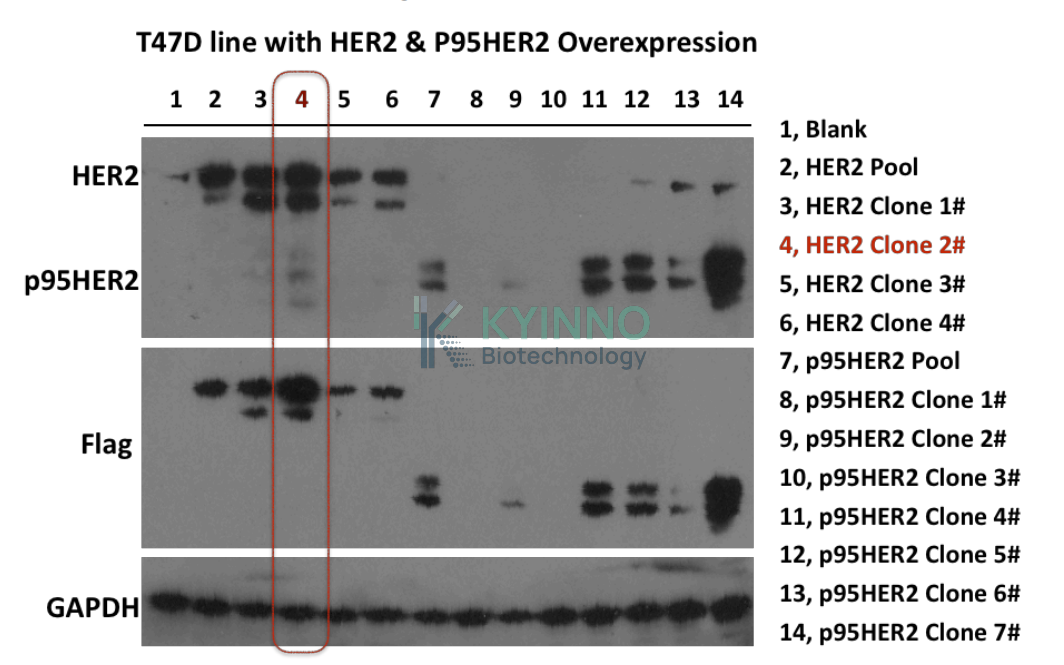
Figure: Characterization of HER2 and its mutants overexpressing in T47D stable clones using Western Blot.

Cell Resuscitation

  1. Prewarm culture medium (RPMI1640 + 10% FBS + 0.2Units/mL Insulin + 500µg/mL G418)in a 37°C water bath.
  2. Thaw the frozen vial in a 37°C water bath for 1-2 minutes.
  3. Transfer the vial into biosafety cabinet, and wipe the surface with 70% ethanol.
  4. Unscrew the top of the vial and transfer the cell suspension gently into a sterile centrifuge tube containing 9.0mL complete culture medium.
  5. Spin at ~ 125 × g for 5-7 minutes at room temperature, and discard the supernatant without disturbing the pellet.
  6. Resuspend cell pellet with the appropriate volume of complete medium and transfer the cell suspension into a T25 culture flask.
  7. Incubate the flask at 37°C, 5% CO2 incubator.
  8. Split saturated culture 1:3-1:5 every 3 days; seed out at about 1-3 × 10⁵ cells/mL.

Cell Freezing

  1. Prepare the freezing medium (70% RPMI-1640 + 20% FBS + 10% DMSO) fresh immediately before use.
  2. Keep the freezing medium on ice and label cryovials.
  3. Transfer cells to a sterile, conical centrifuge tube, and count the cells.
  4. Centrifuge the cells at 250×g for 5 minutes at room temperature and carefully aspirate off the medium.
  5. Resuspend the cells at a density of at least 3×10⁶ cells/mL in chilled freezing medium.
  6. Aliquot 1 mL of the cell suspension into each cryovial.
  7. Freeze cells in the CoolCell freezing container overnight in a -80°C freezer.
  8. Transfer vials to liquid nitrogen for long-term storage

References

  1. Wang, Shizhen Emily, Archana Narasanna, Marianela Perez-Torres, Bin Xiang, Frederick Y Wu, Seungchan Yang, Graham Carpenter, Adi F Gazdar, Senthil K Muthuswamy, and Carlos L Arteaga. 2006. ¡ùHER2 Kinase Domain Mutation Results in Constitutive Phosphorylation and Activation of HER2 and EGFR and Resistance to EGFR Tyrosine Kinase Inhibitors..¡ì Cancer Cell 10 (1). Elsevier: 25ÿ38.
  2. Robichaux, Jacqulyne P, Yasir Y Elamin, Zhi Tan, Brett W Carter, Shuxing Zhang, Shengwu Liu, Shuai Li, et al. 2018. ¡ùMechanisms and Clinical Activity of an EGFR and HER2 Exon 20ÿSelective Kinase Inhibitor in NonÿSmall Cell Lung Cancer.¡ì Nature Medicine, April. Springer US, 1ÿ15.
Please enable JavaScript in your browser to complete this form.