KC-1078

CHOK1-PVR Cell Line

×
Please enable JavaScript in your browser to complete this form.
21495
Home » CHOK1-PVR Cell Line

Background of CHOK1-PVR Cell Line

The poliovirus receptor PVR, also known as CD155 or NECL-5. PVR mediates natural killer cell adhesion and triggers its effector function, participates in mediating tumor cell infiltration and migration, and is the attachment receptor of poliovirus. PVR is expressed in monocytes, macrophages, thymocytes and neurons of the central nervous system. PVR is able to bind CD226, DNAX accessory molecule-1 (DNAM-1), T Cell-Activated Increased Late Expression Protein, TACTILE (CD96), and T Cell Immunoreceptor with Ig and ITIM domains (TIGIT). PVR expression was associated with an unfavorable prognosis in solid tumors such as colon cancer, breast cancer, lung adenocarcinoma, pancreatic cancer, melanoma, and glioblastoma. Nectin Therapeutics is developing a CD155 antibody, NTX-1088, in clinical phase.

Specifications

Catalog NumberKC-1078
Cell Line NameCHOK1-PVR Cell Line
Host Cell LineCHOK1
DescriptionStable CHOK1 cell line expressing exogenous human PVR gene
QuantityTwo vials of frozen cells (≥2-106/vial)
StabilityStable in culture over a minimum of 10 passages
ApplicationDrug screening and biological assays
Freezing MediumRPMI1640 + 20% FBS + 10% DMSO
Propagation MediumRPMI1640 + 10% FBS + 5ug/ml Puromycin
Selection MarkerPuromycin
MorphologyFibroblastoid cells growing as a monolayer
SubcultureF12K + 10% FBS + 5μg/ml Puromycin
Incubation37 °C with 5% CO2
StorageLiquid nitrogen immediately upon receiving
Doubling TimeApproximately 30 hours
Mycoplasma StatusNegative
In Vivo ValidationNA

Cell Line Generation

CHOK1 PVR cell line was generated using a lentiviral vector expressing the human PVR sequence.

Characterization

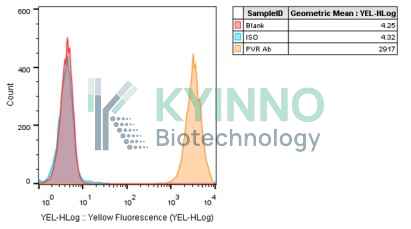
Figure: Characterization of PVR overexpression in CHOK1 stable clones using FACS.

Cell Resuscitation

1. Prewarm culture medium (F12K supplemented with 10% FBS and 5μg/mL Puromycin)in a 37°C water bath.
2. Thaw the frozen vial in a 37°C water bath for 1-2 minutes.
3. Transfer the vial into biosafety cabinet, and wipe the surface with 70% ethanol.
4. Unscrew the top of the vial and transfer the cell suspension gently into a sterile centrifuge tube containing 9.0mL complete culture medium.
5. Spin at ~ 125 × g for 5-7 minutes at room temperature, and discard the supernatant without disturbing the pellet.
6. Resuspend cell pellet with the appropriate volume of complete medium and transfer the cell suspension into a T25 culture flask.
7. Incubate the flask at 37°C, 5% CO2 incubator.
8. Split saturated culture 1:4-1:8 every 2-3 days; seed out at about 1-3 × 10⁵ cells/mL.

Cell Freezing

1. Prepare the freezing medium (F12K + 20% FBS + 10% DMSO) fresh immediately before use.
2. Keep the freezing medium on ice and label cryovials.
3. Transfer cells to a sterile, conical centrifuge tube, and count the cells.
4. Centrifuge the cells at 250×g for 5 minutes at room temperature and carefully aspirate off the medium.
5. Resuspend the cells at a density of at least 3×10⁶ cells/mL in chilled freezing medium.
6. Aliquot 1 mL of the cell suspension into each cryovial.
7. Freeze cells in the CoolCell freezing container overnight in a -80°C freezer.
8. Transfer vials to liquid nitrogen for long-term storage.

References

1.CD155/SRC complex promotes hepatocellular carcinoma progression via inhibiting the p38 MAPK signalling pathway and correlates with poor prognosis.Jin AL, et al. Clin Transl Med, 2022 Apr. PMID 35384345.
2.Immunohistochemical analysis of CD155 expression in triple-negative breast cancer patients.Yoshikawa K, et al. PLoS One, 2021. PMID 34115802.
3.CD155-Prognostic and Immunotherapeutic Implications Based on Multiple Analyses of Databases Across 33 Human Cancers.Zhang H, et al. Technol Cancer Res Treat, 2021 Jan-Dec. PMID 33576304.
Please enable JavaScript in your browser to complete this form.