KC-1238

CHOK1-cyno-FOLR1 Cell Line

×
Please enable JavaScript in your browser to complete this form.
21771
Home » CHOK1-cyno-FOLR1 Cell Line

Background of CHOK1-cyno-FOLR1 Cell Line

FOLR1 (Folate Receptor Alpha) is a Protein Coding gene. Members of this gene family bind folic acid and its reduced derivatives, and transport 5-methyltetrahydrofolate into cells. Treatment with 5-formylTHF can bring CSF folate levels into the normal range for the age of the individual. The folate receptors FOLR1 and FOLR2 are overexpressed in multiple cancers. Diseases associated with FOLR1 include Neurodegeneration Due To Cerebral Folate Transport Deficiency and Neurodegenerative Syndrome Due To Cerebral Folate Transport Deficiency.

Specifications

Catalog NumberKC-1238
Cell Line NameCHOK1-cyno-FOLR1 Cell Line
Clone NumberNA
Host Cell LineCHOK1
DescriptionStable CHOK1 clone expressing exogenous cyno FOLR1 gene
QuantityTwo vials of frozen cells (≥2-106/vial)
StabilityStable in culture over a minimum of 10 passages
ApplicationDrug screening and biological assays
Freezing Medium70% RPMI1640 + 20% FBS + 10% DMSO
Propagation MediumRPMI1640 + 10% FBS + 10μg/mL Puromycin
Selection MarkerPuromycin
MorphologyEpithelial
SubcultureSplit saturated culture 1:4-1:8 every 2-3 days; seed out at about 1-3 × 10⁵ cells/mL
Incubation37 °C with 5% CO2
StorageLiquid nitrogen immediately upon receiving
Doubling TimeApproximately 24 hours
Mycoplasma StatusNegative
In Vivo ValidationNA

Cell Line Generation

CHOK1-cyno-FOLR1 cell line was generated using a lentiviral vector expressing the cyno FOLR1 sequence.

Characterization

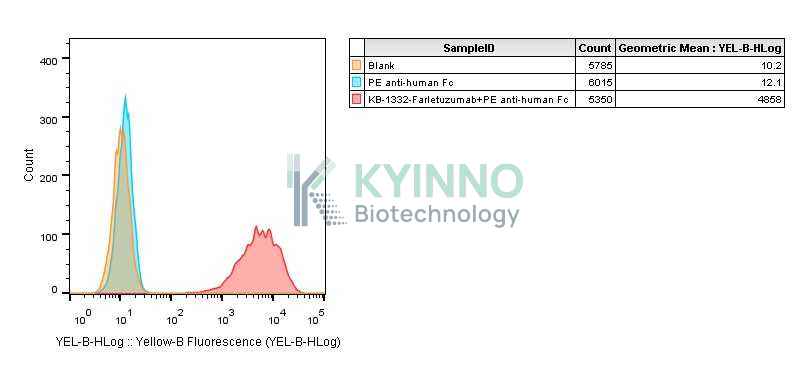
Figure 1: Characterization of cyno FOLR1 overexpression in the CHOK1 cyno FOLR1 stable clone using FACS.(Kyinno, Cat#KB-1332)

Figure 2: Characterization of cyno FOLR1 and its mutants overexpressing in CHOK1 stable clones using PCR sequencing.

Cell Resuscitation

1. Prewarm culture medium (RPMI1640 supplemented with 10% FBS and 10μg/mL puromycin)in a 37°C water bath.
2. Thaw the frozen vial in a 37°C water bath for 1-2 minutes.
3. Transfer the vial into biosafety cabinet, and wipe the surface with 70% ethanol.
4. Unscrew the top of the vial and transfer the cell suspension gently into a sterile centrifuge tube containing 9.0mL complete culture medium.
5. Spin at ~ 125 × g for 5-7 minutes at room temperature, and discard the supernatant without disturbing the pellet.
6. Resuspend cell pellet with the appropriate volume of complete medium and transfer the cell suspension into a T25 culture flask.
7. Incubate the flask at 37°C, 5% CO2 incubator.
8. Split saturated culture 1:4-1:8 every 2-3 days; seed out at about 1-3 × 10⁵ cells/mL.

Cell Freezing

1. Prepare the freezing medium (70% RPMI1640 + 20% FBS + 10% DMSO) fresh immediately before use.
2. Keep the freezing medium on ice and label cryovials.
3. Transfer cells to a sterile, conical centrifuge tube, and count the cells.
4. Centrifuge the cells at 250×g for 5 minutes at room temperature and carefully aspirate off the medium.
5. Resuspend the cells at a density of at least 3×10⁶ cells/mL in chilled freezing medium.
6. Aliquot 1 mL of the cell suspension into each cryovial.
7. Freeze cells in the CoolCell freezing container overnight in a -80°C freezer.
8. Transfer vials to liquid nitrogen for long-term storage.

References

1. Nawaz FZ, Kipreos ET. Emerging roles for folate receptor FOLR1 in signaling and cancer. Trends Endocrinol Metab. 2022 Mar;33(3):159-174. doi: 10.1016/j.tem.2021.12.003. Epub 2022 Jan 31. PMID: 35094917; PMCID: PMC8923831.
2. Varaganti P, Buddolla V, Lakshmi BA, Kim YJ. Recent advances in using folate receptor 1 (FOLR1) for cancer diagnosis and treatment, with an emphasis on cancers that affect women. Life Sci. 2023 Aug 1;326:121802. doi: 10.1016/j.lfs.2023.121802. Epub 2023 May 25. PMID: 37244363.
3. Leung YY, Llaurado-Fernandez M, Cameron A, Da-Anoy A, Cook LC, Hoenisch J, Ghesquiere C, Gaillard S, Schmid J, Dawson A, Bittner M, Kim H, Wong NKY, Dhillion G, Tinker AV, Carey MS, Köbel M. FOLR1 as a therapeutic target in platinum-resistant ovarian carcinoma: unique expression patterns across ovarian carcinoma histotypes and molecular subtypes of low-grade serous carcinoma. J Gynecol Oncol. 2025 Mar 10. doi: 10.3802/jgo.2025.36.e74. Epub ahead of print. PMID: 40150910.

Please enable JavaScript in your browser to complete this form.