KC-1313

CT26-TPBG(5T4)-Flag-Cell-Line

×
Please enable JavaScript in your browser to complete this form.
21907
Home » CT26-TPBG(5T4)-Flag-Cell-Line

Background of CT26-TPBG(5T4)-Flag-Cell-Line

TPBG, also known as 5T4, is a type I transmembrane glycoprotein that may be involved in cell adhesion, which is an antagonist of Wnt/β-catenin signalling pathway. TPBG is expressed on trophoblasts, tumor cells, ovarian cuboidal epithelium and embryonic stem cells, and impacts cell adhesion and motility. TPBG has very limited expression in normal tissue but is widespread in malignant tumours throughout their development. Its confined expression appears to give TPBG the potential to be a target for T cells in cancer immunotherapy.

Specifications

Catalog NumberKC-1313
Cell Line NameCT26-TPBG(5T4)-Flag-Cell-Line
Host Cell LineCT26
DescriptionStable CT26 cell line expressing exogenous human TPBG gene
QuantityTwo vials of frozen cells (≥2-106/vial)
StabilityStable in culture over a minimum of 10 passages
ApplicationDrug screening and biological assays
Freezing Medium70% DMEM + 20% FBS + 10% DMSO
Propagation MediumDMEM+10%FBS+10µg/mL Puromycin
Selection MarkerPuromycin
MorphologyFibroblast
SubcultureSplit saturated culture 1:4-1:5 every 2-3 days; seed out at about 1-3 × 10⁵ cells/mL
Incubation37 °C with 5% CO2
StorageLiquid nitrogen immediately upon receiving
Doubling TimeApproximately 30 hours
Mycoplasma StatusNegative
In Vivo ValidationYes

Cell Line Generation

CT26 human TPBG cell line was generated using a lentiviral vector expressing the human TPBG sequence.

Characterization

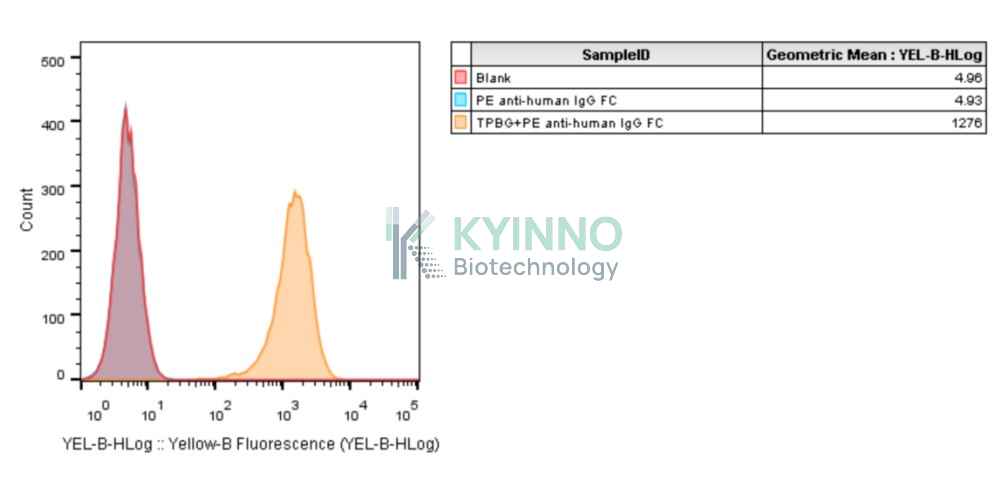
Figure: Characterization of TPBG overexpression in CT26 stable clones using FACS.

Cell Resuscitation

  1. Prewarm culture medium (DMEM supplemented with 10% FBS and 10ug/ml puromycin)in a 37°C water bath.
  2. Thaw the frozen vial in a 37°C water bath for 1-2 minutes.
  3. Transfer the vial into biosafety cabinet, and wipe the surface with 70% ethanol.
  4. Unscrew the top of the vial and transfer the cell suspension gently into a sterile centrifuge tube containing 9.0mL complete culture medium.
  5. Spin at ~ 125 × g for 5-7 minutes at room temperature, and discard the supernatant without disturbing the pellet.
  6. Resuspend cell pellet with the appropriate volume of complete medium and transfer the cell suspension into a T25 culture flask.
  7. Incubate the flask at 37°C, 5% CO2 incubator.
  8. Split saturated culture 1:4-1:5 every 2-3 days; seed out at about 1-3 × 10⁵ cells/mL.

Cell Freezing

  1. Prepare the freezing medium (70% DMEM + 20% FBS + 10% DMSO) fresh immediately before use.
  2. Keep the freezing medium on ice and label cryovials.
  3. Transfer cells to a sterile, conical centrifuge tube, and count the cells.
  4. Centrifuge the cells at 250×g for 5 minutes at room temperature and carefully aspirate off the medium.
  5. Resuspend the cells at a density of at least 3×10⁶ cells/mL in chilled freezing medium.
  6. Aliquot 1 mL of the cell suspension into each cryovial.
  7. Freeze cells in the CoolCell freezing container overnight in a -80°C freezer.
  8. Transfer vials to liquid nitrogen for long-term storage

References

  1. Entrez Gene: TPBG trophoblast glycoprotein.
  2. Zhao Y, Malinauskas T, Harlos K, Jones EY (Apr 2014). Structural insights into the inhibition of Wnt signaling by
  3. cancer antigen 5T4/Wnt-activated inhibitory factor 1. Structure. 22 (4): 612–20. doi:10.1016/j.str.2014.01.009.
  4. PMC 3988984. PMID 24582434.
  5. Starzynska T, Rahi V, Stern PL (Nov 1992). The expression of 5T4 antigen in colorectal and gastric carcinoma.
  6. British Journal of Cancer. 66 (5): 867–9. doi:10.1038/bjc.1992.375. PMC 1977963. PMID 1419629.
  7. Awan A, Lucic MR, Shaw DM, Sheppard F, Westwater C, Lyons SA, Stern PL (Jan 2002). 5T4 interacts with TIP2/GIPC,
  8. a PDZ protein, with implications for metastasis. Biochemical and Biophysical Research
  9. Communications. 290 (3): 1030–6. doi:10.1006/bbrc.2001.6288. PMID 11798178.
Please enable JavaScript in your browser to complete this form.