KC-2019

NCI-H358-SOS2-KO-1B4-Cell-Line

×
Please enable JavaScript in your browser to complete this form.
23241
Home » NCI-H358-SOS2-KO-1B4-Cell-Line

Background of NCI-H358-SOS2-KO-1B4-Cell-Line

The SOS2 gene is a widely studied gene type in bioinformatics. It encodes a protein critical in potassium ion absorption and stress response in plant cells. SOS2 gene was first identified in Arabidopsis thaliana and has since been found in many other plants. The protein encoded by the SOS2 gene can interact with the SOS3 protein to regulate cellular potassium ion homeostasis. The SOS2 gene can also respond to external environmental stress, such as drought and high salt, to regulate potassium ion absorption and allocation. Studying the SOS2 gene can provide a deeper understanding of plant potassium metabolism and stress response mechanisms, as well as an important theoretical basis for the genetic improvement of plants.

Specifications

Catalog NumberKC-2019
Cell Line NameNCI-H358-SOS2-KO-1B4-Cell-Line
DescriptionNCI-H358-SOS2-KO Cell Line
QuantityTwo vials of frozen cells (≥2-106/vial)
StabilityStable in culture over a minimum of 10 passages
ApplicationDrug screening and biological assays
Freezing Medium70% RPMI1640+20% FBS+10% DMSO
Propagation MediumRPMI1640+10%FBS
MorphologyEpithelial
SubcultureSplit saturated culture 1:3-1:6 every 3 days; seed out at about 1-3 × 10⁵ cells/mL
Incubation37 °C with 5% CO2
StorageLiquid nitrogen immediately upon receiving
Doubling TimeApproximately 38 hours
Mycoplasma StatusNegative
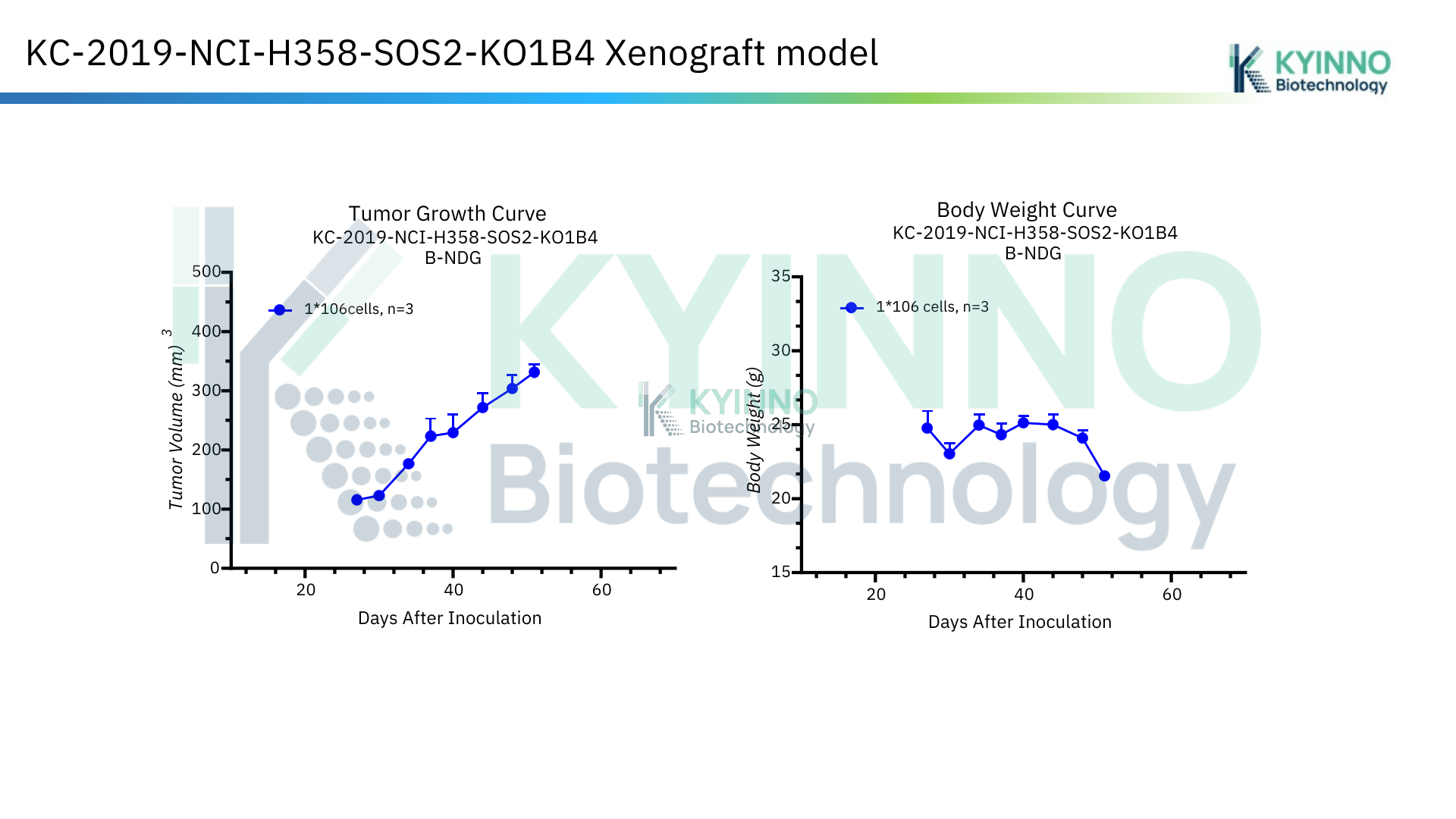
In Vivo ValidationNA

Cell Line Generation

NCI-H358 cell line stable clone with SOS2 gene knockout

Characterization

Cell Resuscitation

  1. Prewarm culture medium (RPMI1640 + 10%FBS) in a 37°C water bath.
  2. Thaw the frozen vial in a 37°C water bath for 1-2 minutes.
  3. Transfer the vial into biosafety cabinet, and wipe the surface with 70% ethanol.
  4. Unscrew the top of the vial and transfer the cell suspension gently into a sterile centrifuge tube containing 9.0mL complete culture medium.
  5. Spin at ~ 125 × g for 5-7 minutes at room temperature, and discard the supernatant without disturbing the pellet.
  6. Resuspend cell pellet with the appropriate volume of complete medium and transfer the cell suspension into a T25 culture flask.
  7. Incubate the flask at 37°C, 5% CO2 incubator.
  8. Split saturated culture 1:3-1:6 every 3 days; seed out at about 1-3 × 10⁵ cells/mL.

Cell Freezing

  1. Prepare the freezing medium (70% RPMI-1640 + 20% FBS + 10% DMSO) fresh immediately before use.
  2. Keep the freezing medium on ice and label cryovials.
  3. Transfer cells to a sterile, conical centrifuge tube, and count the cells.
  4. Centrifuge the cells at 250×g for 5 minutes at room temperature and carefully aspirate off the medium.
  5. Resuspend the cells at a density of at least 3×10⁶ cells/mL in chilled freezing medium.
  6. Aliquot 1 mL of the cell suspension into each cryovial.
  7. Freeze cells in the CoolCell freezing container overnight in a -80°C freezer.
  8. Transfer vials to liquid nitrogen for long-term storage

References

  1. Shi, H., Ishitani, M., Kim, C., & Zhu, J. K. (2000). The Arabidopsis thaliana salt tolerance gene SOS2 encodes a protein kinase regulator of ion homeostasis. Proceedings of the National Academy of Sciences, 97(13), 6896- 6901.
  2. Quan, R., Wang, J., & Yang, D. (2017). Transcriptome profiling analysis of Arabidopsis thaliana treated with SOS2 inhibitor. Plant Signaling & Behavior, 12(8), e1356154.
  3. Guo, Y., Halfter, U., Ishitani, M., & Zhu, J. K. (2001). Molecular characterization of functional domains in the protein kinase SOS2 that is required for plant salt tolerance. Plant Cell, 13(6), 1383-1400.
Please enable JavaScript in your browser to complete this form.