KC-2056

293T-SRE-Luc2

×
Please enable JavaScript in your browser to complete this form.
23314
Home » 细胞系 » 293T-SRE-Luc2

Background of 293T-SRE-Luc2

The serum response element (SRE) pathway is primarily stimulated by G-stimulated α13 protein-coupled receptors. SRE reporter genes are mainly used to detect the activity of SRF-regulated signaling pathways in cells, drug research, and phenotype analysis of gene overexpression and RNA. Accumulating evidence suggests that the serum response factor cofactor megakaryoblastic leukemia (MKL)/myocardin-related transcription factor (MRTF) has critical roles in many physiological and pathological processes in various cell types. MKL/MRTF molecules comprise MKL1/MRTFA and MKL2/MRTFB, which possess actin-binding motifs at the N-terminus, and SRF-binding domains and a transcriptional activation domain (TAD) at the C-terminus. Moreover, serum response factor, another transcription factor regulating the expression pattern of over 200 genes, was observed to be hypermethylated in gastric carcinoma metastasis, signifying its function as an attractive biomarker for predicting gastric carcinoma metastasis and prognosis.

Specifications

Catalog NumberKC-2056
Cell Line Name293T-SRE-Luc2
Host Cell LineHuman HEK293T cell line
DescriptionStable 293T cell line expressing exogenous luciferase gene under the control of serum response element
QuantityTwo vials of frozen cells (≥2-106/vial)
StabilityStable in culture over a minimum of 10 passages
ApplicationDrug screening and biological assays
Freezing Medium70% DMEM+20% FBS+10% DMSO
Propagation MediumDMEM+10%FBS+150µg/mL Hygromycin B
Selection MarkerHygromycin B
MorphologyEpithelial
SubcultureSplit saturated culture 1:3-1:6 every 3 days; seed out at about 1-3 × 10⁵ cells/mL
Incubation37 °C with 5% CO2
StorageLiquid nitrogen immediately upon receiving
Doubling TimeApproximately 30 hours
Mycoplasma StatusNegative
In Vivo ValidationNA

Cell Line Generation

293T-SRE-luciferase cell line was generated using lentivirus methods.

Characterization

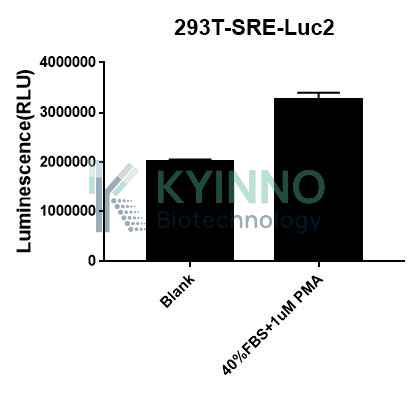
Figure: 293T-SRE-Luc2 cell line was seed into the 96-well plate, and treated with DMEM and DMEM+40%FBS+1uM PMA for 6 hours, then readout with Bright-Glo system.

Cell Resuscitation

  1. Prewarm culture medium (DMEM + 10%FBS + 150µg/mL Hygromycin B) in a 37°C water bath.
  2. Thaw the frozen vial in a 37°C water bath for 1-2 minutes.
  3. Transfer the vial into biosafety cabinet, and wipe the surface with 70% ethanol.
  4. Unscrew the top of the vial and transfer the cell suspension gently into a sterile centrifuge tube containing 9.0mL complete culture medium.
  5. Spin at ~ 125 × g for 5-7 minutes at room temperature, and discard the supernatant without disturbing the pellet.
  6. Resuspend cell pellet with the appropriate volume of complete medium and transfer the cell suspension into a T25 culture flask.
  7. Incubate the flask at 37°C, 5% CO2 incubator.
  8. Split saturated culture 1:3-1:6 every 3 days; seed out at about 1-3 × 10⁵ cells/mL.

Cell Freezing

  1. Prepare the freezing medium (70% DMEM + 20% FBS + 10% DMSO) fresh immediately before use.
  2. Keep the freezing medium on ice and label cryovials.
  3. Transfer cells to a sterile, conical centrifuge tube, and count the cells.
  4. Centrifuge the cells at 250×g for 5 minutes at room temperature and carefully aspirate off the medium.
  5. Resuspend the cells at a density of at least 3×10⁶ cells/mL in chilled freezing medium.
  6. Aliquot 1 mL of the cell suspension into each cryovial.
  7. Freeze cells in the CoolCell freezing container overnight in a -80°C freezer.
  8. Transfer vials to liquid nitrogen for long-term storage

References

  1. Tabuchi A, Ihara D. Regulation of Dendritic Synaptic Morphology and Transcription by the SRF Cofactor MKL/MRTF. Front Mol Neurosci. 2021 Nov 2;14:767842.
  2. Treisman R. The SRE: a growth factor responsive transcriptional regulator. Semin Cancer Biol. 1990 Feb;1(1):47- 58. PMID: 2133110.
  3. Liu Z, Zhang J, Gao Y, et al. Large-scale characterization of DNA methylation changes in human gastric carcinomas with and without metastasis. Clin Cancer Res. 2014;20(17):4598ÿ4612.
Please enable JavaScript in your browser to complete this form.