KC-2291

CHOK1-CLDN9-Cell-Line

×
Please enable JavaScript in your browser to complete this form.
23768
Home » CHOK1-CLDN9-Cell-Line

Background of CHOK1-CLDN9-Cell-Line

CLDN9, also known as claudin 9, belongs to the claudin family. CLDN9 is expressed in the inner ear, olfactory epithelium, and anterior pituitary gland and is involved in hearing. CLDN9 creates charge specific channels in the paracellular space, plays a major role in tight junction-specific obliteration of the intercellular space, through calcium-independent cell-adhesion activity, is required to preserve sensory cells in the hearing organ because CLDN9-defective tight junctions fail to shield the basolateral side of hair cells from the K+-rich endolymph. Its ion barrier function is essential in the cochlea, but appears to be dispensable in other organs. Is one of the entry cofactors for hepatitis C virus; it enables HCV entry into target cells just as efficiently as CLDN1.

Specifications

Catalog NumberKC-2291
Cell Line NameCHOK1-CLDN9-Cell-Line
Clone Number6#
Host Cell LineCHOK1
DescriptionStable CHOK1 cell line expressing exogenous human CLDN9 gene
QuantityTwo vials of frozen cells (≥2-106/vial)
StabilityStable in culture over a minimum of 10 passages
ApplicationDrug screening and biological assays
Freezing Medium70% RPMI1640 + 20% FBS + 10% DMSO
Propagation MediumRPMI1640 + 10% FBS + 10μg/ml Puromycin
Selection MarkerPuromycin
MorphologyEpithelial
SubcultureSplit saturated culture 1:4-1:6 every 2-3 days; seed out at about 1-3 × 10⁵ cells/ml
Incubation37 °C with 5% CO2
StorageLiquid nitrogen immediately upon receiving
Doubling TimeApproximately 30 hours
Mycoplasma StatusNegative
In Vivo ValidationNA

Cell Line Generation

CHOK1 human CLDN9 cell line was generated using a lentiviral vector expressing the human CLDN9 sequence.

Characterization

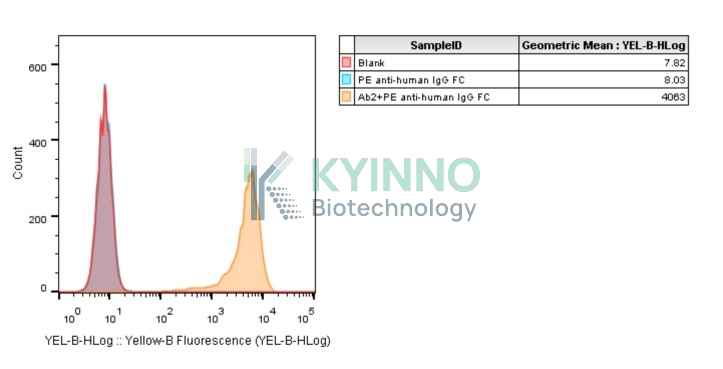
Figure: Characterization of CLDN9 overexpression in the CHOK1-CLDN9 stable clone using FACS.

Cell Resuscitation

1. Prewarm culture medium (RPMI1640 supplemented with 10% FBS and 10μg/mL Puromycin)in a 37°C water bath.
2. Thaw the frozen vial in a 37°C water bath for 1-2 minutes.
3. Transfer the vial into biosafety cabinet, and wipe the surface with 70% ethanol.
4. Unscrew the top of the vial and transfer the cell suspension gently into a sterile centrifuge tube containing 9.0mL complete culture medium.
5. Spin at ~ 125 × g for 5-7 minutes at room temperature, and discard the supernatant without disturbing the pellet.
6. Resuspend cell pellet with the appropriate volume of complete medium and transfer the cell suspension into a T25 culture flask.
7. Incubate the flask at 37°C, 5% CO2 incubator.
8. Split saturated culture 1:4-1:6 every 2-3 days; seed out at about 1-3 × 10⁵ cells/mL.

Cell Freezing

1. Prepare the freezing medium (70% RPMI1640 + 20% FBS + 10% DMSO) fresh immediately before use.
2. Keep the freezing medium on ice and label cryovials.
3. Transfer cells to a sterile, conical centrifuge tube, and count the cells.
4. Centrifuge the cells at 250×g for 5 minutes at room temperature and carefully aspirate off the medium.
5. Resuspend the cells at a density of at least 3×10⁶ cells/mL in chilled freezing medium.
6. Aliquot 1 mL of the cell suspension into each cryovial.
7. Freeze cells in the CoolCell freezing container overnight in a -80°C freezer.
8. Transfer vials to liquid nitrogen for long-term storage

References

1. Higashi AY, Higashi T, Furuse K, Ozeki K, Furuse M, Chiba H (Nov 2021). "Claudin-9 constitutes tight junctions of folliclo-stellate cells in the anterior pituitary gland". Scientific Reports. 11 (1): 21642. Bibcode:2021NatSR..1121642H.
2. Gene discovery reveals a critical protein's function in hearing
3. Nakano Y, Kim SH, Kim HM, Sanneman JD, Zhang Y, Smith RJ, Marcus DC, Wangemann P, Nessler RA, Bánfi B (Aug 2009). "A claudin-9-based ion permeability barrier is essential for hearing". PLOS Genetics. 5 (8): e1000610.

Please enable JavaScript in your browser to complete this form.