KC-3343-DW

HCC827-ERBB3 Cell Line

×
Please enable JavaScript in your browser to complete this form.
26629
Home » HCC827-ERBB3 Cell Line

Background of HCC827-ERBB3 Cell Line

This gene encodes a member of the epidermal growth factor receptor (EGFR) family of receptor tyrosine kinases. This membrane-bound protein has a neuregulin binding domain but not an active kinase domain. It therefore can bind this ligand but not convey the signal into the cell through protein phosphorylation. However, it does form heterodimers with other EGF receptor family members which do have kinase activity. Heterodimerization leads to the activation of pathways which lead to cell proliferation or differentiation. Amplification of this gene and/or overexpression of its protein have been reported in numerous cancers, including prostate, bladder, and breast tumors. Alternate transcriptional splice variants encoding different isoforms have been characterized. One isoform lacks the intermembrane region and is secreted outside the cell. This form acts to modulate the activity of the membrane-bound form. Additional splice variants have also been reported, but they have not been thoroughly characterized.

Specifications

Catalog NumberKC-3343-DW
Cell Line NameHCC827-ERBB3 Cell Line
Clone Number1#
Host Cell LineHCC827
DescriptionStable HCC827 cell line expressing exogenous ERBB3 gene
QuantityTwo vials of frozen cells (≥2-106/vial)
StabilityStable in culture over a minimum of 10 passages
ApplicationDrug screening and biological assays
Freezing Medium70% RPMI1640 + 20% FBS + 10% DMSO
Propagation MediumRPMI1640 + 10% FBS + 2μg/ml Puromycin
Selection MarkerPuromycin
MorphologyEpithelial
SubcultureSplit saturated culture 1:3-1:4 every 3-4 days; seed out at about 1-3 × 10⁵ cells/ml
Incubation37 °C with 5% CO2
StorageLiquid nitrogen immediately upon receiving
Doubling TimeApproximately 48 hours
Mycoplasma StatusNegative
In Vivo ValidationYes

Cell Line Generation

HCC827 ERBB3 cell line was generated using a lentiviral vector expressing the ERBB3 sequence.

Characterization

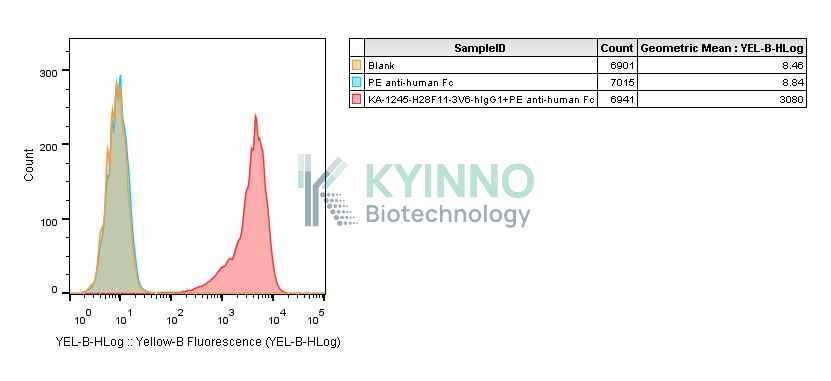
Figure 1: Characterization of ERBB3 overexpression in the HCC827 ERBB3 stable clone using FACS.

Cell Resuscitation

  1. Prewarm culture medium (RPMI1640 supplemented with 10% FBS and 2μg/mL Puromycin)in a 37°C water bath.
  2. Thaw the frozen vial in a 37°C water bath for 1-2 minutes.
  3. Transfer the vial into biosafety cabinet, and wipe the surface with 70% ethanol.
  4. Unscrew the top of the vial and transfer the cell suspension gently into a sterile centrifuge tube containing 9.0mL complete culture medium.
  5. Spin at ~ 125 × g for 5-7 minutes at room temperature, and discard the supernatant without disturbing the pellet.
  6. Resuspend cell pellet with the appropriate volume of complete medium and transfer the cell suspension into a T25 culture flask.
  7. Incubate the flask at 37°C, 5% CO2 incubator.
  8. Split saturated culture 1:3-1:4 every 3-4 days; seed out at about 1-3 × 10⁵ cells/mL.

Cell Freezing

  1. Prepare the freezing medium (70% RPMI1640 + 20% FBS + 10% DMSO) fresh immediately before use.
  2. Keep the freezing medium on ice and label cryovials.
  3. Transfer cells to a sterile, conical centrifuge tube, and count the cells.
  4. Centrifuge the cells at 250×g for 5 minutes at room temperature and carefully aspirate off the medium.
  5. Resuspend the cells at a density of at least 3×10⁶ cells/mL in chilled freezing medium.
  6. Aliquot 1 mL of the cell suspension into each cryovial.
  7. Freeze cells in the CoolCell freezing container overnight in a -80°C freezer.
  8. Transfer vials to liquid nitrogen for long-term storage.

References

  1. Trocmé E, Mougiakakos D, Johansson CC, All-Eriksson C, Economou MA, Larsson O, Seregard S, Kiessling R, Lin Y. Nuclear HER3 is associated with favorable overall survival in uveal melanoma. Int J Cancer. 2012 Mar 1;130(5):1120-7. doi: 10.1002/ijc.26118. Epub 2011 Jun 18. PMID: 21484789.
  2. Amler LC. HER3 mRNA as a predictive biomarker in anticancer therapy. Expert Opin Biol Ther. 2010 Sep;10(9):1343-55. doi: 10.1517/14712598.2010.512003. PMID: 20695834.
Please enable JavaScript in your browser to complete this form.