KC-3548

293T-mouse-TM4SF1 Cell Line

×
Please enable JavaScript in your browser to complete this form.
34488
Home » 细胞系 » 293T-mouse-TM4SF1 Cell Line

Background of 293T-mouse-TM4SF1 Cell Line

TM4SF1 (Transmembrane 4 L Six Family Member 1) also known as L6, it is a Protein Coding gene and it belongs to a family of integral membrane proteins implicated in cell growth and tumor progression. It functions as a signal transducer to regulate tumor cell behaviors. The protein encoded by this gene is a member of the transmembrane 4 superfamily, also known as the tetraspanin family. Most of these members are cell-surface proteins that are characterized by the presence of four hydrophobic domains. The proteins mediate signal transduction events that play a role in the regulation of cell development, activation, growth and motility. This encoded protein is a cell surface antigen and is highly expressed in different carcinomas.

Specifications

Catalog NumberKC-3548
Cell Line Name293T-mouse-TM4SF1 Cell Line
Host Cell Line293T
DescriptionStable 293T clone expressing exogenous mouse TM4SF1 gene
QuantityTwo vials of frozen cells (≥2-106/vial)
StabilityStable in culture over a minimum of 10 passages
ApplicationDrug screening and biological assays
Freezing Medium70% DMEM + 20% FBS + 10% DMSO
Propagation MediumDMEM + 10% FBS + 1μg/mL Puromycin
Selection MarkerPuromycin
MorphologyEpithelial
SubcultureSplit saturated culture 1:4-1:8 every 2-3 days; seed out at about 1-3 × 10⁵ cells/mL
Incubation37 °C with 5% CO2
StorageLiquid nitrogen immediately upon receiving
Doubling TimeApproximately 30 hours
Mycoplasma StatusNegative
In Vivo ValidationNA

Cell Line Generation

293T-mouse-TM4SF1 cell line was generated using a lentiviral vector expressing the mouse TM4SF1 sequence.

Characterization

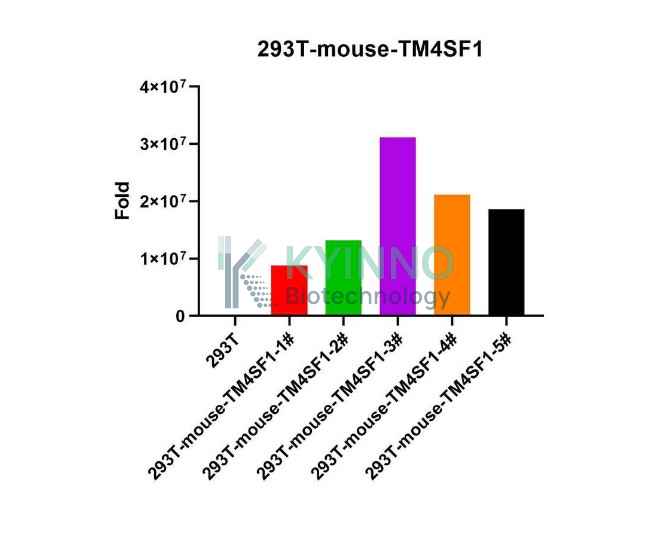
Figure 1: Characterization of mouse TM4SF1 overexpression in the 293T mouse TM4SF1 stable clone using QPCR.

Figure 2: Characterization of mouse TM4SF1 in the 293T mouse TM4SF1 stable clone using PCR sequencing.

Cell Resuscitation

1. Prewarm culture medium (DMEM supplemented with 10% FBS and 1μg/mL puromycin)in a 37°C water bath. 2. Thaw the frozen vial in a 37°C water bath for 1-2 minutes. 3. Transfer the vial into biosafety cabinet, and wipe the surface with 70% ethanol. 4. Unscrew the top of the vial and transfer the cell suspension gently into a sterile centrifuge tube containing 9.0mL complete culture medium. 5. Spin at ~ 125 × g for 5-7 minutes at room temperature, and discard the supernatant without disturbing the pellet. 6. Resuspend cell pellet with the appropriate volume of complete medium and transfer the cell suspension into a T25 culture flask. 7. Incubate the flask at 37°C, 5% CO2 incubator. 8. Split saturated culture 1:4-1:8 every 2-3 days; seed out at about 1-3 × 10⁵ cells/mL.

Cell Freezing

1. Prepare the freezing medium (70% DMEM + 20% FBS + 10% DMSO) fresh immediately before use. 2. Keep the freezing medium on ice and label cryovials. 3. Transfer cells to a sterile, conical centrifuge tube, and count the cells. 4. Centrifuge the cells at 250×g for 5 minutes at room temperature and carefully aspirate off the medium. 5. Resuspend the cells at a density of at least 3×10⁶ cells/mL in chilled freezing medium. 6. Aliquot 1 mL of the cell suspension into each cryovial. 7. Freeze cells in the CoolCell freezing container overnight in a -80°C freezer. 8. Transfer vials to liquid nitrogen for long-term storage.

References

1. Hou S, Hao X, Li J, Weng S, Wang J, Zhao T, Li W, Hu X, Deng B, Gu J, Hang Q. TM4SF1 promotes esophageal squamous cell carcinoma metastasis by interacting with integrin α6. Cell Death Dis. 2022 Jul 14;13(7):609. doi: 10.1038/s41419-022-05067-2. PMID: 35835740; PMCID: PMC9283456. 2. Zheng YW, Wang M, Zhong ZM, Wu GQ, Zhang T, Chen LL, Li M. TM4SF1 promotes glioma malignancy through multiple mechanisms. Neoplasma. 2022 Jul;69(4):859-867. doi: 10.4149/neo_2022_211009N1427. Epub 2022 May 9. PMID: 35532297. 3. Yang SB, Zhou ZH, Lei J, Li XW, Chen Q, Li B, Zhang YW, Ge YZ, Zuo S. TM4SF1 upregulates MYH9 to activate the NOTCH pathway to promote cancer stemness and lenvatinib resistance in HCC. Biol Direct. 2023 Apr 17;18(1):18. doi: 10.1186/s13062-023-00376-8. PMID: 37069693; PMCID: PMC10111829.

Please enable JavaScript in your browser to complete this form.