KC-3797

293T-CRE-Luc2-RAMP2-CALCRL Cell Line

×
Please enable JavaScript in your browser to complete this form.
34796
Home » 293T-CRE-Luc2-RAMP2-CALCRL Cell Line

Background of 293T-CRE-Luc2-RAMP2-CALCRL Cell Line

Receptor activity-modifying proteins (RAMPs) are mammalian accessory proteins that interact allosterically with the vast majority of GPCRs. Their actions are wide-reaching and highly variable, but include modulation of receptor trafficking, changes to ligand specificity and alteration of intracellular responses to receptor activation. As RAMPs interact with their cognate GPCRs in a complex lipid membrane environment, their effects on receptor function vary depending on the cell type in which they are studied.G-protein-coupled receptors (GPCRs) have been reported to participate in the occurrence and development of avariety of human cancers. CALCR is one of the hundreds of GPCRs. Calcitonin gene-related peptide (CGRP) is a 37-amino acid peptide, which is primarily localized to C and A sensory fibers. These fibers display a wide innervation throughout the body, with extensive perivascular localization, and have a dual role in sensory (nociceptive) and efferent (effector) function.

Specifications

Catalog NumberKC-3797
Cell Line Name293T-CRE-Luc2-RAMP2-CALCRL Cell Line
Clone Number3#
Host Cell Line293T-CRE-Luc2
DescriptionStable 293T cell line expressing exogenous luciferase gene under the control of RAMP2 signaling pathway
QuantityTwo vials of frozen cells (≥2-106/vial)
StabilityStable in culture over a minimum of 10 passages
ApplicationDrug screening and biological assays
Freezing Medium70% DMEM+20% FBS+10% DMSO
Propagation MediumDMEM+10%FBS+1µg/mL Puromycin+150µg/mL Hygromycin B
Selection MarkerPuromycin | Hygromycin B
MorphologyEpithelial
SubcultureSplit saturated culture 1:4-1:5 every 2-3 days; seed out at about 1-3 × 10⁵ cells/mL
Incubation37 °C with 5% CO2
StorageLiquid nitrogen immediately upon receiving
Doubling TimeApproximately 30 hours
Mycoplasma StatusNegative
In Vivo ValidationNA

Cell Line Generation

293T-CRE-Luc2-RAMP2-CALCRL cell line was generated using lentivirus expressing RAMP2&CALCRL sequence.

Characterization

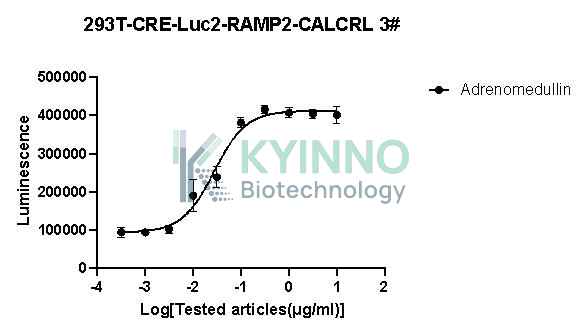
Figure 1. 293T-CRE-Luc2-RAMP2-CALCRL cell line was seed into the 96-well plate, and treated with Adrenomedullin at a maximum concentration 10μg/mL diluted 10-fold for 6 hours, then readout with Bright-Glo system.

Cell Resuscitation

1. Prewarm culture medium (DMEM supplemented with 10%FBS, 150µg/mL Hygromycin B, 1µg/mL Puromycin)in a 37°C water bath.
2. Thaw the frozen vial in a 37°C water bath for 1-2 minutes.
3. Transfer the vial into biosafety cabinet, and wipe the surface with 70% ethanol.
4. Unscrew the top of the vial and transfer the cell suspension gently into a sterile centrifuge tube containing 9.0mL complete culture medium.
5. Spin at ~ 125 × g for 5-7 minutes at room temperature, and discard the supernatant without disturbing the pellet.
6. Resuspend cell pellet with the appropriate volume of complete medium and transfer the cell suspension into a T25 culture flask.
7. Incubate the flask at 37°C, 5% CO2 incubator.
8. Split saturated culture 1:4-1:5 every 2-3 days; seed out at about 1-3 × 10⁵ cells/mL.

Cell Freezing

1. Prepare the freezing medium (70% DMEM + 20% FBS + 10% DMSO) fresh immediately before use.
2. Keep the freezing medium on ice and label cryovials.
3. Transfer cells to a sterile, conical centrifuge tube, and count the cells.
4. Centrifuge the cells at 250×g for 5 minutes at room temperature and carefully aspirate off the medium.
5. Resuspend the cells at a density of at least 3×10⁶ cells/mL in chilled freezing medium.
6. Aliquot 1 mL of the cell suspension into each cryovial.
7. Freeze cells in the CoolCell freezing container overnight in a -80°C freezer.
8. Transfer vials to liquid nitrogen for long-term storage.

References

1.McGlone ER, Manchanda Y, Jones B, Pickford P, Inoue A, Carling D, Bloom SR, Tan T, Tomas A. Receptor Activity-Modifying Protein 2 (RAMP2) alters glucagon receptor trafficking in hepatocytes with functional effects on receptor signalling. Mol Metab. 2021 Nov;53:101296. doi: 10.1016/j.molmet.2021.101296. Epub 2021 Jul 13. PMID: 34271220; PMCID: PMC8363841.
2.Russell FA, King R, Smillie SJ, Kodji X, Brain SD. Calcitonin gene-related peptide: physiology and pathophysiology. Physiol Rev. 2014 Oct;94(4):1099-142. doi: 10.1152/physrev.00034.2013. PMID: 25287861; PMCID: PMC4187032.

Please enable JavaScript in your browser to complete this form.