Growth Differentiation Factor 15 (GDF-15), also called Macrophage inhibitory cytokine-1 (MIC-1), is a divergent member of the transforming growth factor beta (TGF-beta) superfamily. GFRAL (GDNF receptor-alpha-like) is a functional receptor of GDF15, facilitating weight-loss functions of the protein through c-Ret downstream signaling. GDF-15 and GFRAL signaling pathway is implicated in diet-based obesity and insulin resistance.
Specifications
Catalog Number
KC-3880
Cell Line Name
293T-mouse-GFRAL Cell Line
Clone Number
22
Host Cell Line
293T
Description
Stable 293T cell line expressing exogenous mouse-GFRAL gene
Quantity
One vial of frozen cells (≥2-106/vial)
Stability
Stable in culture over a minimum of 10 passages
Application
Drug screening and biological assays
Freezing Medium
70% DMEM+20% FBS+10% DMSO
Propagation Medium
DMEM+10% FBS +1μg/mL Puromycin
Selection Marker
Puromycin
Morphology
Epithelial
Subculture
Split saturated culture 1:4-1:8 every 2-3 days; seed out at about 1-3 × 10⁵ cells/mL
Incubation
37 °C with 5% CO2
Storage
Liquid nitrogen immediately upon receiving
Doubling Time
Approximately 30 hours
Mycoplasma Status
Negative
In Vivo Validation
NA
Cell Line Generation
293T-mouse-GFRAL cell line was generated using lentivirus expressing mouse-GFRAL sequence.
Characterization
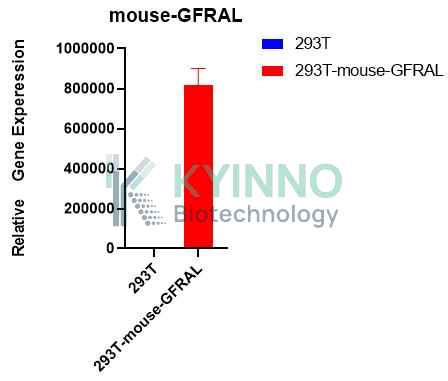
Figure 1. Characterization of mouse-GFRAL over-expression in the 293T-mouse-GFRAL stable clone using qPCR.
Figure 2. Characterization of mouse-GFRAL over-expression in the 293T-mouse-GFRAL stable clone using PCR.
Cell Resuscitation
Prewarm culture medium (DMEM supplemented with 10% FBS, 1μg/mL Puromycin)in a 37°C water bath.
Thaw the frozen vial in a 37°C water bath for 1-2 minutes.
Transfer the vial into biosafety cabinet, and wipe the surface with 70% ethanol.
Unscrew the top of the vial and transfer the cell suspension gently into a sterile centrifuge tube containing 9.0mL complete culture medium.
Spin at ~ 125 × g for 5-7 minutes at room temperature, and discard the supernatant without disturbing the pellet.
Resuspend cell pellet with the appropriate volume of complete medium and transfer the cell suspension into a T25 culture flask.
Incubate the flask at 37°C, 5% CO2 incubator.
Split saturated culture 1:4-1:8 every 2-3 days; seed out at about 1-3 × 10⁵ cells/mL.
Cell Freezing
Prepare the freezing medium (70% DMEM + 20% FBS + 10% DMSO) fresh immediately before use.
Keep the freezing medium on ice and label cryovials.
Transfer cells to a sterile, conical centrifuge tube, and count the cells.
Centrifuge the cells at 250×g for 5 minutes at room temperature and carefully aspirate off the medium.
Resuspend the cells at a density of at least 3×10⁶ cells/mL in chilled freezing medium.
Aliquot 1 mL of the cell suspension into each cryovial.
Freeze cells in the CoolCell freezing container overnight in a -80°C freezer.
Transfer vials to liquid nitrogen for long-term storage.
References
Bootcov MR, Bauskin AR, Valenzuela SM, Moore AG, Bansal M, He XY, et al.(October 1997). MIC-1, a novel macrophage inhibitory cytokine, is a divergent member of the TGF-beta superfamily. Proceedings of the National Academy of Sciences of the United States of America. 94 (21): 11514–9.
Zimmers TA, Jin X, Hsiao EC, McGrath SA, Esquela AF, Koniaris LG (June 2005).Growth differentiation factor-15/macrophage inhibitory cytokine-1 induction after kidney and lung injury. Shock. 23 (6): 543–8.
Use License Agreement
Research Use Only.
Not for use in diagnostic procedures or therapeutic applications.
Redistribution of the cell line or its derivatives is prohibited without prior written permission from Kyinno Biotechnology.