KC-4191

293T-GRE-Luc2 Reporter Cell Line

×
Please enable JavaScript in your browser to complete this form.
42620
Home » 293T-GRE-Luc2 Reporter Cell Line

Background of 293T-GRE-Luc2 Reporter Cell Line

Glucocorticoids (GCs) and their analogs regulate downstream gene expression through the glucocorticoid receptor (GR, also known as NR3C1), which is a member of the nuclear receptor superfamily of ligand-activated transcription factors. GCs diffuse into the cytoplasm, bind to GR, and are then translocated to the nucleus, where they bind to glucocorticoid response elements (GREs) in the promoters of target genes, thereby activating or repressing gene expression. GCs also modulate gene expression via non-GR pathways, such as through cAMP response element-binding (CREB) protein, activator protein (AP)-1, and NF-κB. These receptors have several major domains, including an amino-terminal activation domain, a central zinc-finger DNA-binding domain, and a carboxy-terminal ligand-binding domain. This system can be used to study the activation levels of glucocorticoid-mediated signaling pathways, drug research, and gene overexpression and RNAi phenotypic analysis.

Specifications

Catalog NumberKC-4191
Cell Line Name293T-GRE-Luc2 Reporter Cell Line
Clone Number7-9#
Host Cell Line293T
DescriptionStable 293T cell line expressing exogenous luciferase gene under the control of glucocorticoid response element signaling pathway
QuantityTwo vials of frozen cells (≥2-106/vial)
StabilityStable in culture over a minimum of 10 passages
ApplicationDrug screening and biological assays
Freezing Medium70% DMEM+20% FBS+10% DMSO
Propagation MediumDMEM+10% FBS +150μg/mL Hygromycin B
Selection MarkerHygromycin B
MorphologyEpithelial
SubcultureSplit saturated culture 1:4-1:8 every 2-3 days; seed out at about 1-3 × 10⁵ cells/mL
Incubation37 °C with 5% CO2
StorageLiquid nitrogen immediately upon receiving
Doubling TimeApproximately 30 hours
Mycoplasma StatusNegative
In Vivo ValidationNA

Cell Line Generation

293T-GRE-Luc2 reporter cell line was generated using a lentiviral vector expressing the glucocorticoid response element sequence.

Characterization

Figure 1: 293T-GRE-Luc2 cell line was seeded into the 96-well plate, and treated with Budesonide at a maximum concentration 1μg/mL for 16 hours, then readout with Bright-Glo system.

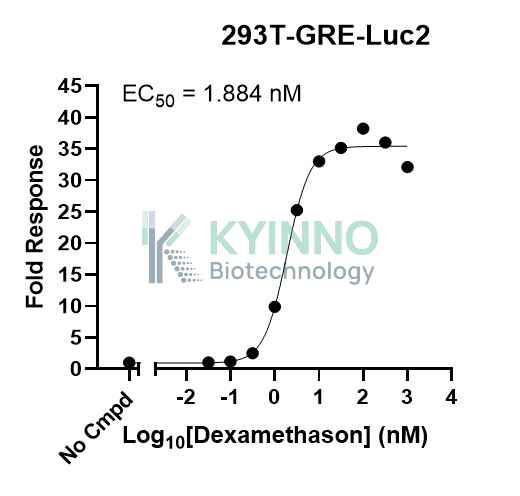
Figure 2: 293T-GRE-Luc2 cell line was seeded into the 96-well plate, and treated with Dexamethasone at a maximum concentration 1μg/mL for 24 hours, then readout with Bright-Glo system.

Cell Resuscitation

  1. Prewarm culture medium (DMEM supplemented with 10% FBS and 150μg/mL Hygromycin)in a 37°C water bath.
  2. Thaw the frozen vial in a 37°C water bath for 1-2 minutes.
  3. Transfer the vial into biosafety cabinet, and wipe the surface with 70% ethanol.
  4. Unscrew the top of the vial and transfer the cell suspension gently into a sterile centrifuge tube containing 9.0mL complete culture medium.
  5. Spin at ~ 125 × g for 5-7 minutes at room temperature, and discard the supernatant without disturbing the pellet.
  6. Resuspend cell pellet with the appropriate volume of complete medium and transfer the cell suspension into a T25 culture flask.
  7. Incubate the flask at 37°C, 5% CO2 incubator.
  8. Split saturated culture 1:4-1:8 every 2-3 days; seed out at about 1-3 × 10⁵ cells/mL.

Cell Freezing

  1. Prepare the freezing medium (70% DMEM + 20% FBS + 10% DMSO) fresh immediately before use.
  2. Keep the freezing medium on ice and label cryovials.
  3. Transfer cells to a sterile, conical centrifuge tube, and count the cells.
  4. Centrifuge the cells at 250×g for 5 minutes at room temperature and carefully aspirate off the medium.
  5. Resuspend the cells at a density of at least 3×10⁶ cells/mL in chilled freezing medium.
  6. Aliquot 1 mL of the cell suspension into each cryovial.
  7. Freeze cells in the CoolCell freezing container overnight in a -80°C freezer.
  8. Transfer vials to liquid nitrogen for long-term storage.

References

  1. Liu B, Zhang TN, Knight JK, Goodwin JE. The Glucocorticoid Receptor in Cardiovascular Health and Disease. Cells. 2019 Oct 9;8(10):1227. doi: 10.3390/cells8101227. PMID: 31601045; PMCID: PMC6829609.
  2. Wu T, Shao Y, Li X, Wu T, Yu L, Liang J, Zhang Y, Wang J, Sun T, Zhu Y, Chang X, Wang S, Chen F, Han X. NR3C1/Glucocorticoid receptor activation promotes pancreatic β-cell autophagy overload in response to glucolipotoxicity. Autophagy. 2023 Sep;19(9):2538-2557. doi: 10.1080/15548627.2023.2200625. Epub 2023 Apr 20. PMID: 37039556; PMCID: PMC10392762.
  3. Oakley RH, Cidlowski JA. The biology of the glucocorticoid receptor: new signaling mechanisms in health and disease. J Allergy Clin Immunol. 2013 Nov;132(5):1033-44. doi: 10.1016/j.jaci.2013.09.007. Epub 2013 Sep 29. PMID: 24084075; PMCID: PMC4084612.
Please enable JavaScript in your browser to complete this form.