KC-4572

293T-STAT6-Luc2-Cell-Line

×
Please enable JavaScript in your browser to complete this form.
47027
Home » 293T-STAT6-Luc2-Cell-Line

Background of 293T-STAT6-Luc2-Cell-Line

The protein encoded by this gene is a member of the STAT family of transcription factors. In response to cytokines and growth factors, STAT family members are phosphorylated by the receptor associated kinases, and then form homo- or heterodimers that translocate to the cell nucleus where they act as transcription activators. This protein plays a central role in exerting IL4 mediated biological responses. It is found to induce the expression of BCL2L1/BCL-X(L), which is responsible for the anti-apoptotic activity of IL4. Knockout studies in mice suggested the roles of this gene in differentiation of T helper 2 (Th2) cells, expression of cell surface markers, and class switch of immunoglobulins. Alternative splicing results in multiple transcript variants.STAT6 (Signal Transducer And Activator Of Transcription 6) is a Protein Coding gene. Diseases associated with STAT6 include Hyper-Ige Syndrome 6, Autosomal Dominant, With Recurrent Infections and Hemangiopericytoma, Malignant. Among its related pathways are IL-9 Signaling Pathways and CNTF Signaling.

Specifications

Catalog NumberKC-4572
Cell Line Name293T-STAT6-Luc2-Cell-Line
Host Cell Line293T
DescriptionStable 293T cell line expressing exogenous luciferase gene under the control of STAT6 signaling pathway.
QuantityTwo vials of frozen cells (≥2-106/vial)
StabilityStable in culture over a minimum of 10 passages
ApplicationDrug screening and biological assays
Freezing Medium70% DMEM+20% FBS+10% DMSO
Propagation MediumDMEM+10% FBS +150μg/mL Hygromycin
Selection MarkerHygromycin B
MorphologyEpithelial
SubcultureSplit saturated culture 1:4-1:5 every 2-3 days; seed out at about 1-3 × 10⁵ cells/mL
Incubation37 °C with 5% CO2
StorageLiquid nitrogen immediately upon receiving
Doubling TimeApproximately 30 hours
Mycoplasma StatusNegative

Cell Line Generation

293T-STAT6-Luc2 cell line was generated using lentivirus expressing STAT6-Luc2 and STAT6 sequence.

Characterization

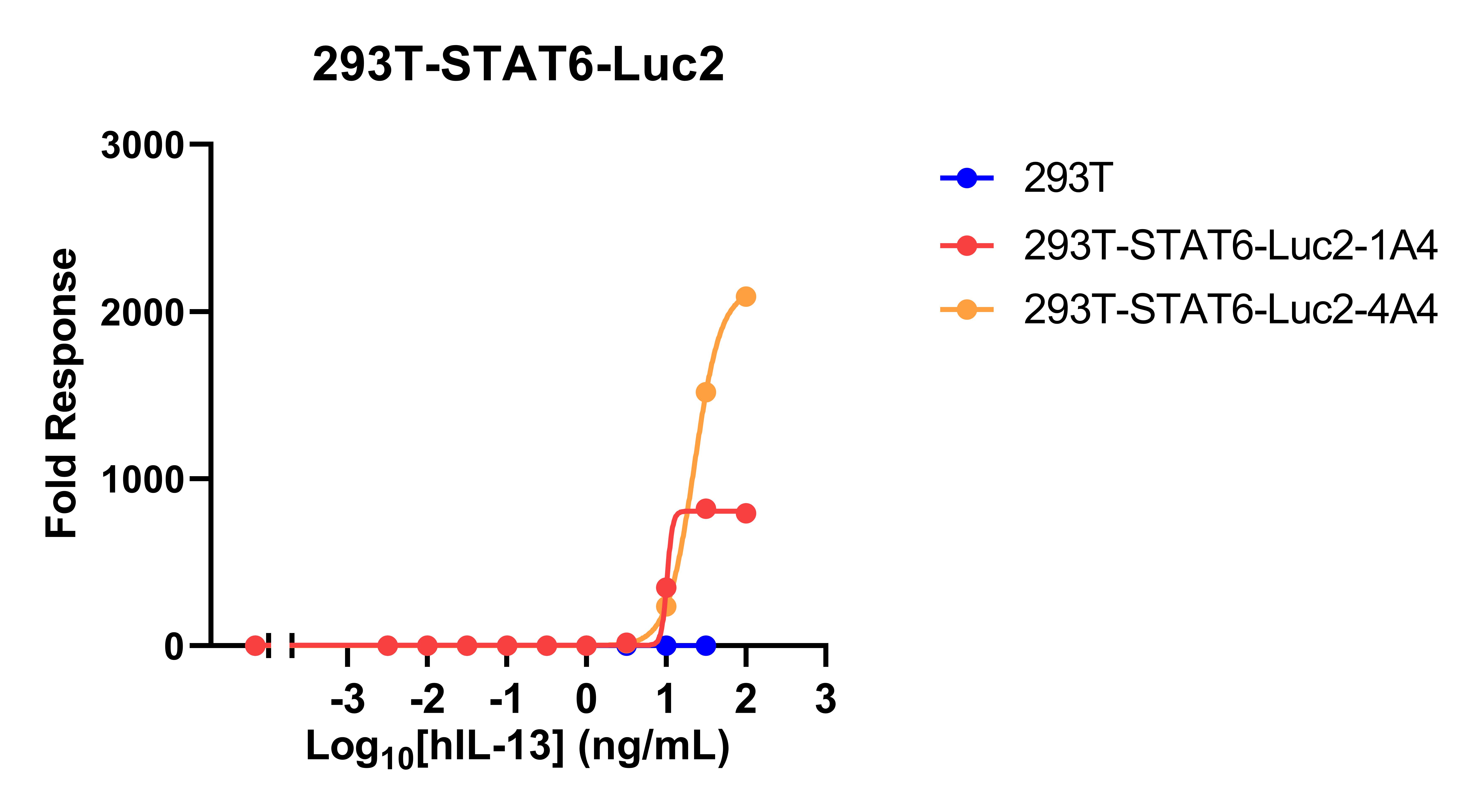
Figure 1: 293T-STAT6-Luc2 cells were seeded into the 96-well plate, treated with hIL-13 16 hours, then readout with Bright-lite™ Luciferase Assay system.

Cell Resuscitation

  1. Prewarm culture medium (DMEM supplemented with 10% FBS, 150μg/mL Hygromycin B)in a 37°C water bath.
  2. Thaw the frozen vial in a 37°C water bath for 1-2 minutes.
  3. Transfer the vial into biosafety cabinet, and wipe the surface with 70% ethanol.
  4. Unscrew the top of the vial and transfer the cell suspension gently into a sterile centrifuge tube containing 9.0mL complete culture medium.
  5. Spin at ~ 125 × g for 5-7 minutes at room temperature, and discard the supernatant without disturbing the pellet.
  6. Resuspend cell pellet with the appropriate volume of complete medium and transfer the cell suspension into a T25 culture flask.
  7. Incubate the flask at 37°C, 5% CO2 incubator.
  8. Split saturated culture 1:4-1:8 every 2-3 days; seed out at about 1-3 × 10⁵ cells/mL.

Cell Freezing

  1. Prepare the freezing medium (70% DMEM + 20% FBS + 10% DMSO) fresh immediately before use.
  2. Keep the freezing medium on ice and label cryovials.
  3. Transfer cells to a sterile, conical centrifuge tube, and count the cells.
  4. Centrifuge the cells at 250×g for 5 minutes at room temperature and carefully aspirate off the medium.
  5. Resuspend the cells at a density of at least 3×10⁶ cells/mL in chilled freezing medium.
  6. Aliquot 1 mL of the cell suspension into each cryovial.
  7. Freeze cells in the CoolCell freezing container overnight in a -80°C freezer.
  8. Transfer vials to liquid nitrogen for long-term storage

References

  1. Petrovic A, Obéric A, Moulin A, Hamedani M. Ocular adnexal (orbital) solitary fibrous tumor: nuclear STAT6 expression and literature review. Graefes Arch Clin Exp Ophthalmol. 2015 Sep;253(9):1609-17. doi: 10.1007/s00417-015-2975-5. Epub 2015 Mar 13. PMID: 25761539.
  2. Chmielecki J, Crago AM, Rosenberg M, O'Connor R, Walker SR, Ambrogio L, Auclair D, McKenna A, Heinrich MC, Frank DA, Meyerson M. Whole-exome sequencing identifies a recurrent NAB2-STAT6 fusion in solitary fibrous tumors. Nat Genet. 2013 Feb;45(2):131-2. doi: 10.1038/ng.2522. Epub 2013 Jan 13. PMID: 23313954; PMCID: PMC3984043.
  3. Minskaia E, Maimaris J, Jenkins P, Albuquerque AS, Hong Y, Eleftheriou D, Gilmour KC, Grace R, Moreira F, Grimbacher B; NIHR Bioresource-Rare Diseases Consortium; Morris EC, Burns SO. Autosomal Dominant STAT6 Gain of Function Causes Severe Atopy Associated with Lymphoma. J Clin Immunol. 2023 Oct;43(7):1611-1622. doi: 10.1007/s10875-023-01530-7. Epub 2023 Jun 14. PMID: 37316763; PMCID: PMC10499697.
Please enable JavaScript in your browser to complete this form.