KC-4720

MIAPaCa-KRAS-G12C-H95C-KI-1A3 Cell Line

×
Please enable JavaScript in your browser to complete this form.
52302
Home » MIAPaCa-KRAS-G12C-H95C-KI-1A3 Cell Line

Background of MIAPaCa-KRAS-G12C-H95C-KI-1A3 Cell Line

KRAS-G12C-H95C represents a novel double mutation in the KRAS oncogene, combining the well-studied G12C mutation with the rare H95C variant. The G12C mutation, frequently observed in non-small cell lung cancer (NSCLC), colorectal cancer, and pancreatic cancer, locks KRAS in an active GTP-bound state by impairing GTPase activity, driving uncontrolled cell proliferation and survival. The H95C mutation, located in the α3-helix of KRAS, is less characterized but may influence protein conformation and interactions with regulators such as GEFs (guanine nucleotide exchange factors) and GAPs (GTPase-activating proteins). Preliminary structural analyses suggest that H95C could alter the stability of KRAS or its binding affinity to downstream effectors, potentially modulating signaling pathways like MAPK/ERK and PI3K/AKT. The co-occurrence of G12C and H95C raises questions about their combined effects on KRAS function, drug binding, and therapeutic response, particularly to G12C-specific inhibitors such as sotorasib and adagrasib. Investigating this double mutation could provide insights into resistance mechanisms and inform the design of next-generation KRAS inhibitors. Further studies are needed to elucidate the biochemical and clinical implications of KRAS-G12C-H95C, including its role in tumorigenesis and potential as a therapeutic target.

Specifications

Catalog NumberKC-4720
Cell Line NameMIAPaCa-KRAS-G12C-H95C-KI-1A3 Cell Line
Host Cell LineMIAPaCa
DescriptionStable MIAPaCa clone expressing exogenous KRAS gene bearing H95C mutations, No.1A3
QuantityTwo vials of frozen cells (≥2-106/vial)
StabilityStable in culture over a minimum of 10 passages
ApplicationDrug screening and biological assays
Freezing Medium70% DMEM+20% FBS+10% DMSO
Propagation MediumDMEM+10% FBS+2.5%HS
Selection MarkerN/A
MorphologyEpithelial
SubcultureSplit saturated culture 1:3-1:6 every 2-3 days; seed out at about 1-3 × 10⁵ cells/mL
Incubation37 °C with 5% CO2
StorageLiquid nitrogen immediately upon receiving
Doubling TimeApproximately 30 hours
Mycoplasma StatusNegative

Cell Line Generation

MIAPaCa-KRAS-G12C-H95C-KI-1A3 cell line was generated using the CRISPR method.

Characterization

Figure 1: Characterization of MIAPaCa-KRAS-G12C-H95C-KI-1A3 cell line stable clone using PCR sequencing.

Figure 2: Characterization of MIAPaCa-KRAS-G12C-H95C-KI-1A3 cell line stable clone using RT-PCR sequencing.

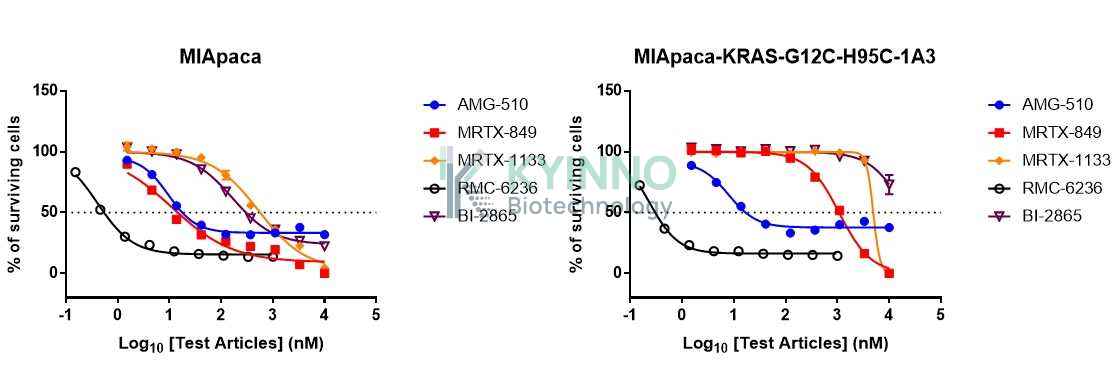
Figure 3. Characterization of dose-response curves for KRAS inhibitors on MIAPaCa and MIAPaCa-KRAS-G12C-H95C-KI-1A3 cells.

Cell Resuscitation

1. Prewarm culture medium (DMEM+10% FBS+2.5%HS)in a 37°C water bath.
2. Thaw the frozen vial in a 37°C water bath for 1-2 minutes.
3. Transfer the vial into biosafety cabinet, and wipe the surface with 70% ethanol.
4. Unscrew the top of the vial and transfer the cell suspension gently into a sterile centrifuge tube containing 9.0mL complete culture medium.
5. Spin at ~ 125 × g for 5-7 minutes at room temperature, and discard the supernatant without disturbing the pellet.
6. Resuspend cell pellet with the appropriate volume of complete medium and transfer the cell suspension into a T25 culture flask.
7. Incubate the flask at 37°C, 5% CO2 incubator.
8. Split saturated culture 1:3-1:6 every 2-3 days; seed out at about 1-3 × 10⁵ cells/mL.

Cell Freezing

1. Prepare the freezing medium (70% DMEM + 20% FBS + 10% DMSO) fresh immediately before use.
2. Keep the freezing medium on ice and label cryovials.
3. Transfer cells to a sterile, conical centrifuge tube, and count the cells.
4. Centrifuge the cells at 250×g for 5 minutes at room temperature and carefully aspirate off the medium.
5. Resuspend the cells at a density of at least 3×10⁶ cells/mL in chilled freezing medium.
6. Aliquot 1 mL of the cell suspension into each cryovial.
7. Freeze cells in the CoolCell freezing container overnight in a -80°C freezer.
8. Transfer vials to liquid nitrogen for long-term storage.

References

1.Ostrem, J. M., & Shokat, K. M. (2016). Direct small-molecule inhibitors of KRAS: from structural insights to mechanism-based design. Nature Reviews Drug Discovery, 15(11), 771-785.
2.Canon, J., et al. (2019). The clinical KRAS(G12C) inhibitor AMG 510 drives anti-tumour immunity. Nature, 575(7781), 217-223.
3.Moore, A. R., et al. (2020). RAS-targeted therapies: is the undruggable drugged? Nature Reviews Drug Discovery, 19(8), 533-552.
Please enable JavaScript in your browser to complete this form.