KC-4723

MIAPaCa-KRAS-G12C-R68S-KI-1B4 Cell Line

×
Please enable JavaScript in your browser to complete this form.
52306
Home » MIAPaCa-KRAS-G12C-R68S-KI-1B4 Cell Line

Background of MIAPaCa-KRAS-G12C-R68S-KI-1B4 Cell Line

KRAS-G12C-R68S is a rare double mutation in the KRAS oncogene, combining the well-characterized G12C mutation with the less studied R68S variant. The G12C mutation, commonly found in non-small cell lung cancer (NSCLC), colorectal cancer, and pancreatic cancer, confers constitutive activation of KRAS by impairing GTP hydrolysis, leading to sustained oncogenic signaling. The R68S mutation, located in the switch II region of KRAS, may further modulate protein dynamics and interactions with downstream effectors such as RAF and PI3K. Preliminary studies suggest that the R68S mutation could alter the conformational stability of KRAS, potentially influencing its responsiveness to targeted therapies, including G12C-specific inhibitors like sotorasib and adagrasib. However, the functional and clinical implications of the double mutation remain poorly understood due to its rarity and the complexity of KRAS signaling networks. Further research is needed to elucidate the mechanistic interplay between G12C and R68S, their combined impact on tumorigenesis, and their potential as therapeutic targets. Understanding this dual mutation could provide insights into resistance mechanisms and guide the development of more effective KRAS-targeted therapies.

Specifications

Catalog NumberKC-4723
Cell Line NameMIAPaCa-KRAS-G12C-R68S-KI-1B4 Cell Line
Host Cell LineMIAPaCa
DescriptionStable MIAPaCa clone expressing exogenous KRAS gene bearing R68S mutations, No.1B4
QuantityTwo vials of frozen cells (≥2-106/vial)
StabilityStable in culture over a minimum of 10 passages
ApplicationDrug screening and biological assays
Freezing Medium70% DMEM+20% FBS+10% DMSO
Propagation MediumDMEM+10% FBS+2.5%HS
Selection MarkerN/A
MorphologyEpithelial
SubcultureSplit saturated culture 1:3-1:6 every 2-3 days; seed out at about 1-3 × 10⁵ cells/mL
Incubation37 °C with 5% CO2
StorageLiquid nitrogen immediately upon receiving
Doubling TimeApproximately 30 hours
Mycoplasma StatusNegative

Cell Line Generation

MIAPaCa-KRAS-G12C-R68S-KI-1B4 cell line was generated using the CRISPR method.

Characterization

Figure 1: Characterization of MIAPaCa-KRAS-G12C-R68S-KI-1B4 cell line stable clone using PCR sequencing.

Figure 2: Characterization of MIAPaCa-KRAS-G12C-R68S-KI-1B4 cell line stable clone using RT-PCR sequencing.

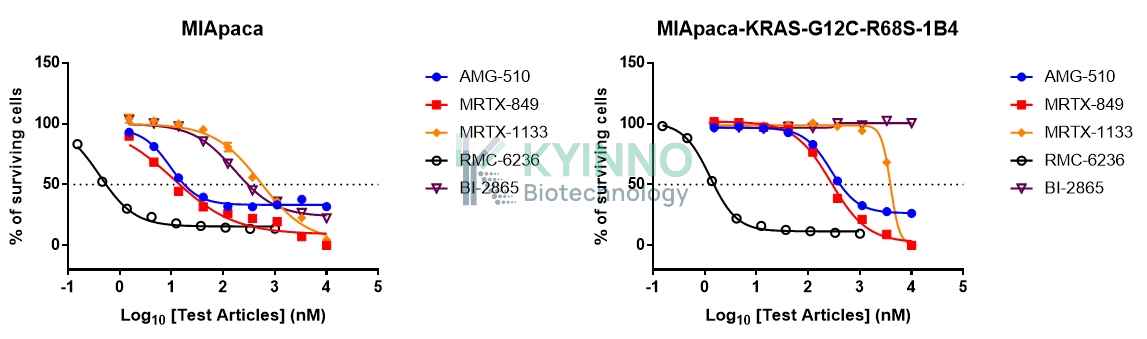
Figure 3. Characterization of dose-response curves for KRAS inhibitors on MIAPaCa and MIAPaCa-KRAS-G12C-R68S-KI-1B4 cells.

Cell Resuscitation

1. Prewarm culture medium (DMEM+10% FBS+2.5%HS)in a 37°C water bath.
2. Thaw the frozen vial in a 37°C water bath for 1-2 minutes.
3. Transfer the vial into biosafety cabinet, and wipe the surface with 70% ethanol.
4. Unscrew the top of the vial and transfer the cell suspension gently into a sterile centrifuge tube containing 9.0mL complete culture medium.
5. Spin at ~ 125 × g for 5-7 minutes at room temperature, and discard the supernatant without disturbing the pellet.
6. Resuspend cell pellet with the appropriate volume of complete medium and transfer the cell suspension into a T25 culture flask.
7. Incubate the flask at 37°C, 5% CO2 incubator.
8. Split saturated culture 1:3-1:6 every 2-3 days; seed out at about 1-3 × 10⁵ cells/mL.

Cell Freezing

1. Prepare the freezing medium (70% DMEM + 20% FBS + 10% DMSO) fresh immediately before use.
2. Keep the freezing medium on ice and label cryovials.
3. Transfer cells to a sterile, conical centrifuge tube, and count the cells.
4. Centrifuge the cells at 250×g for 5 minutes at room temperature and carefully aspirate off the medium.
5. Resuspend the cells at a density of at least 3×10⁶ cells/mL in chilled freezing medium.
6. Aliquot 1 mL of the cell suspension into each cryovial.
7. Freeze cells in the CoolCell freezing container overnight in a -80°C freezer.
8. Transfer vials to liquid nitrogen for long-term storage.

References

1.Ostrem, J. M., & Shokat, K. M. (2016). Direct small-molecule inhibitors of KRAS: from structural insights to mechanism-based design. Nature Reviews Drug Discovery, 15(11), 771-785.
2.Canon, J., et al. (2019). The clinical KRAS(G12C) inhibitor AMG 510 drives anti-tumour immunity. Nature, 575(7781), 217-223.
3.Moore, A. R., et al. (2020). RAS-targeted therapies: is the undruggable drugged? Nature Reviews Drug Discovery, 19(8), 533-552.
Please enable JavaScript in your browser to complete this form.