KC-5672

HCT116-WRN-F730L-KI Cell Line

×
Please enable JavaScript in your browser to complete this form.
57686
Home » HCT116-WRN-F730L-KI Cell Line

Background of HCT116-WRN-F730L-KI Cell Line

The WRN gene encodes a member of the RecQ helicase family, which plays a critical role in maintaining genomic stability through its involvement in DNA repair, replication, recombination, and telomere maintenance. Mutations in WRN are associated with Werner syndrome (WS), a rare autosomal recessive disorder characterized by premature aging, genomic instability, and increased cancer susceptibility. The WRN protein possesses 3′→5′ helicase and 3′→5′ exonuclease activities, both of which are essential for its function in DNA metabolism. Given its importance in preserving genomic integrity, understanding the functional consequences of WRN mutations is crucial for elucidating the molecular mechanisms underlying WS and related disorders.The F730L mutation in WRN is a missense variant that substitutes phenylalanine (F) with leucine (L) at position 730 within the helicase domain.While the exact functional impact of this mutation remains under investigation, structural and biochemical studies suggest that residue F730 may play a role in maintaining the stability or catalytic activity of the helicase domain. Given that other mutations in the helicase domain have been shown to impair WRN’s enzymatic activity and contribute to WS pathogenesis, the F730L variant warrants further characterization to determine its potential effects on WRN function and cellular phenotypes.

Specifications

Catalog NumberKC-5672
Cell Line NameHCT116-WRN-F730L-KI Cell Line
Clone Number2A3
Host Cell LineHCT116
DescriptionStable HCT116 clone expressing endogenous WRN gene bearing F730L mutations
QuantityTwo vials of frozen cells (≥2-106/vial)
StabilityStable in culture over a minimum of 10 passages
ApplicationDrug screening and biological assays
Freezing Medium70% RPMI1640 + 20% FBS + 10% DMSO
Propagation MediumRPMI1640 + 10% FBS
Selection MarkerNA
MorphologyFibroblastoid cells growing as a monolayer
SubcultureSplit the saturated culture at a ratio of 1:4-1:5 every 2~3 days; seed out at about 1-3 x 10⁵ cells/mL
Incubation37 °C with 5% CO2
StorageLiquid nitrogen immediately upon receiving
Doubling TimeApproximately 30 hours
Mycoplasma StatusNegative

Cell Line Generation

HCT116-WRN-F730L-KI cell line was generated using the CRISPR method.

Characterization

Figure 1: Characterization of HCT116-WRN-F730L-KI Cell Line stable clone using PCR sequencing.

Figure 2: Characterization of HCT116-WRN-F730L-KI Cell Line stable clone using RT-PCR sequencing.

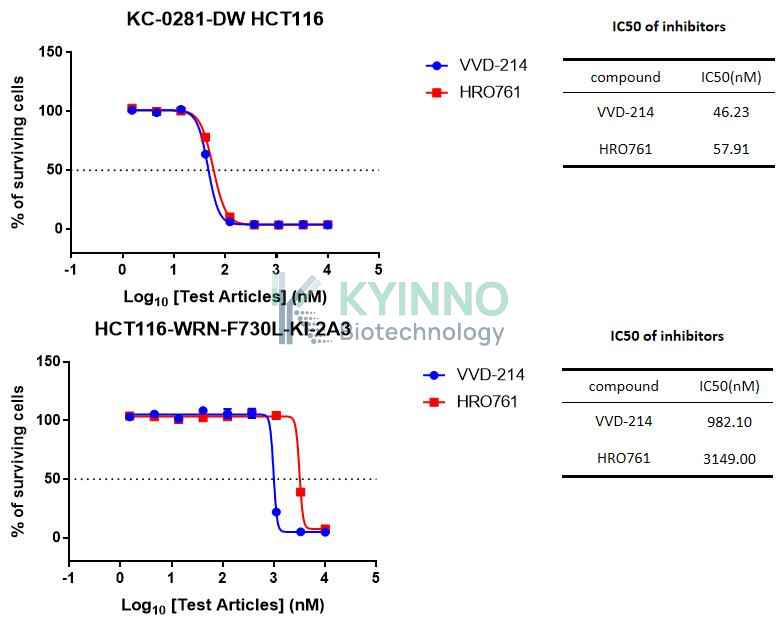
Figure 3: Characterization of Dose-response curves and IC50 values for HCT116 and HCT116-WRN-F730L-KI cells treated with VVD-214 and HRO761 over 5 days.

Cell Resuscitation

  1. Prewarm culture medium (RPMI1640+10% FBS)in a 37°C water bath.
  2. Thaw the frozen vial in a 37°C water bath for 1-2 minutes.
  3. Transfer the vial into biosafety cabinet, and wipe the surface with 70% ethanol.
  4. Unscrew the top of the vial and transfer the cell suspension gently into a sterile centrifuge tube containing 9.0mL complete culture medium.
  5. Spin at ~ 125 × g for 5-7 minutes at room temperature, and discard the supernatant without disturbing the pellet.
  6. Resuspend cell pellet with the appropriate volume of complete medium and transfer the cell suspension into a T25 culture flask.
  7. Incubate the flask at 37°C, 5% CO2 incubator.
  8. Split saturated culture 1:4-1:5 every 2-3 days; seed out at about 1-3 × 10⁵ cells/mL.

Cell Freezing

  1. Prepare the freezing medium (70% RPMI1640 + 20% FBS + 10% DMSO) fresh immediately before use.
  2. Keep the freezing medium on ice and label cryovials.
  3. Transfer cells to a sterile, conical centrifuge tube, and count the cells.
  4. Centrifuge the cells at 250×g for 5 minutes at room temperature and carefully aspirate off the medium.
  5. Resuspend the cells at a density of at least 3×10⁶ cells/mL in chilled freezing medium.
  6. Aliquot 1 mL of the cell suspension into each cryovial.
  7. Freeze cells in the CoolCell freezing container overnight in a -80°C freezer.
  8. Transfer vials to liquid nitrogen for long-term storage.

References

  1. Croteau DL, Popuri V, Opresko PL, Bohr VA. (2014). Human RecQ helicases in DNA repair, recombination, and replication. Annu Rev Biochem, 83, 519-52. PMID: 24606147.
  2. Oshima J, Sidorova JM, Monnat RJ Jr. (2017). Werner syndrome: Clinical features, pathogenesis and potential therapeutic interventions. Ageing Res Rev, 33, 105-114. PMID: 27312357.
  3. Huang S, Li B, Gray MD, Oshima J, Mian IS, Campisi J. (2006). The premature ageing syndrome protein, WRN, is a 3′→5′ exonuclease. Nat Genet, 20(2), 114-6. PMID: 9771702.
Please enable JavaScript in your browser to complete this form.