

In 2025, research on the STEAP protein family achieved pivotal breakthroughs in both mechanistic understanding and clinical translation. Structural biology studies directly demonstrated for the first time that the intracellular domain of STEAP2 binds reduced NADPH, elucidating the core mechanism of its electron transfer activity. At the same time, STEAP1 was shown to function through forming a complex with cytochrome b5 reductase. In prostate cancer, STEAP1 and STEAP2 can assemble into homo- or hetero-trimeric complexes, a property that significantly influences the efficacy of targeted therapeutic agents.
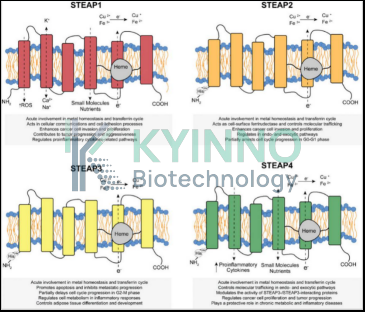
STEAP 家族是一组哺乳动物特异性的六跨膜蛋白,包括 STEAP1、STEAP2、STEAP3 和 STEAP4 四个核心成员。在结构上,它们具有共同特征:每个成员均包含六个跨膜螺旋,且 N 端和 C 端均位于细胞质内。这种独特的膜拓扑结构使 STEAP 蛋白能够跨越细胞膜,并参与底物转运和电子传递等功能。
尽管 STEAP 家族名称中包含“前列腺”相关含义,但其成员具有广泛且组织特异性的表达模式,并不局限于前列腺组织。STEAP1 在前列腺癌中高表达(正常前列腺中表达较低),也可在膀胱癌和乳腺癌中检测到。STEAP2 主要表达于前列腺,并在前列腺癌中过表达。STEAP3 在造血组织和肝脏中表达较高,但在前列腺癌中表达降低。STEAP4 在脂肪组织和肝脏中高表达,并广泛分布于多种肿瘤类型。
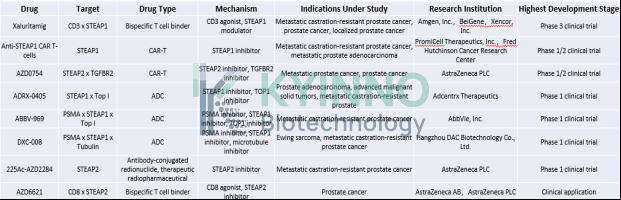
这种组织特异性表达特征使 STEAP 家族成员成为肿瘤治疗的重要靶点。尤其是 STEAP1 和 STEAP2 在前列腺癌中的高表达,使其成为前列腺癌靶向治疗的领先靶点;而 STEAP3 和 STEAP4 在其他肿瘤类型中也显示出治疗潜力。目前,STEAP 靶向药物开发已取得重要进展,包括安进的 STEAP1/CD3 双特异性抗体 AMG 509 已进入 III 期临床试验,阿斯利康的 STEAP2 抗体偶联药物 AZD0516 已启动 I/II 期临床研究,为肿瘤治疗开辟了新路径。
The core function of STEAP proteins is to act as metal reductases, catalyzing the reduction of ferric iron (Fe³⁺) and cupric copper (Cu²⁺). This process is essential for maintaining intracellular metal ion homeostasis and directly influences cellular energy metabolism and redox balance. From an evolutionary perspective, STEAP proteins belong to the ferric reductase superfamily and share structural and functional similarities with NADPH oxidases.
不同 STEAP 家族成员在功能上存在分化:STEAP3 在生理性铁摄取和周转中发挥关键作用,而 STEAP4 则更密切参与营养和炎症应激反应,以及脂肪酸和葡萄糖代谢。
针对 STEAP 家族的药物开发目前主要集中于 STEAP1,并已布局多种治疗平台,包括双特异性抗体、抗体偶联药物(ADC)、CAR-T 细胞疗法和小分子抑制剂,其中 STEAP1 相关项目进展较快。随着对 STEAP 家族生物学功能理解不断加深,这些蛋白在肿瘤诊断和治疗中的重要性日益凸显。
从金属还原酶到肿瘤生物标志物,再到治疗靶点,STEAP 家族的多样化功能为精准肿瘤治疗打开了新的可能性。目前,针对 STEAP 家族成员的在研候选药物包括:
表 1. STEAP 家族成员的功能特征及其与肿瘤的关系
|
成员 |
核心功能 |
在肿瘤中的典型作用 |
主要表达组织 |
|
STEAP1 |
细胞间通讯;离子调节 |
在前列腺癌及多种其他癌症中高表达;与侵袭性相关 |
主要为前列腺 |
|
STEAP2 |
蛋白转运;配体相互作用 |
与前列腺癌中的雄激素受体活性相关 |
主要为前列腺 |
|
STEAP3 |
铁代谢;对红系成熟至关重要 |
可通过 p53 激活上调;可促进癌细胞死亡 |
肝脏;造血组织 |
|
STEAP4 |
炎症反应;代谢调控 |
在类风湿关节炎中高表达;与肿瘤的关系较为复杂 |
脂肪组织;胎盘 |
To accelerate the development of STEAP family–targeted therapeutics in cancer treatment, Kyinno Biotechnology has established engineered cell lines with overexpression of STEAP1, STEAP2, STEAP3, and STEAP4, as well as knockout cell lines for STEAP1, STEAP2, and STEAP3. These models support the entire drug discovery and development pipeline—from early target validation and compound screening to pharmacology/efficacy evaluation and late-stage resistance mechanism studies—thereby substantially reducing the risk of failure in subsequent clinical trials and facilitating the translation of safe and effective STEAP-targeted therapies into the clinic.
除定制细胞系构建外,康源博创还提供抗体发现、抗体表达、脱靶筛选以及体内外药理学评价等一体化服务。欢迎联系我们了解更多信息。
产品与服务列表:
|
序号 |
细胞编号 |
细胞名称 |
|
1 |
KC-4227 |
293T-STEAP1 |
|
2 |
KC-4781 |
CHOK1-STEAP1 |
|
3 |
KC-5141 |
CT26-STEAP1 |
|
4 |
KC-4306 |
MC38-STEAP1-low |
|
5 |
KC-5361 |
BxPC3-STEAP1 |
|
6 |
KC-5163 |
293T-STEAP1B1 |
|
7 |
KC-5165 |
293T-STEAP1B2 |
|
8 |
KC-4295 |
CHOK1-STEAP1B2 |
|
9 |
KC-4765 |
293T-cyno-STEAP1 |
|
10 |
KC-4780 |
CHOK1-cyno-STEAP1 |
|
11 |
KC-4215 |
293T-mouse-STEAP1 |
|
12 |
KC-5090 |
CHOK1-mouse-STEAP1 |
|
13 |
KC-4197 |
HCT116-STEAP1-KO |
|
14 |
KC-4198 |
HCT116-STEAP1-KO |
|
15 |
KC-4277 |
LNCap-STEAP1-KO |
|
序号 |
细胞编号 |
细胞名称 |
|
1 |
KC-4186 |
293T-STEAP2 |
|
2 |
KC-4776 |
CHOK1-STEAP2 |
|
3 |
KC-5234 |
293T-STEAP2-ECD |
|
4 |
KC-5170 |
CHOK1-STEAP2-ECD |
|
5 |
KC-4766 |
293T-cyno-STEAP2 |
|
6 |
KC-4824 |
CHOK1-cyno-STEAP2 |
|
7 |
KC-5299 |
293T-cyno-STEAP2-ECD |
|
8 |
KC-4667 |
CHOK1-cyno-STEAP2-ECD |
|
9 |
KC-5380 |
293T-mouse-STEAP2-ECD |
|
10 |
KC-5470 |
CHOK1-mouse-STEAP2-ECD |
|
11 |
KC-5277 |
293T-STEAP2-KO |
|
12 |
KC-5278 |
293T-STEAP2-KO |
|
13 |
KC-5017 |
LNcap-STEAP2-KO |
|
序号 |
细胞编号 |
细胞名称 |
|
1 |
KC-4829 |
293T-STEAP3 |
|
2 |
KC-4734 |
CHOK1-STEAP3 |
|
3 |
KC-5539 |
293T-STEAP3-KO-cyno-STEAP3 |
|
4 |
KC-5244 |
CHOK1-cyno-STEAP3 |
|
5 |
KC-5275 |
293T-STEAP3-KO |
|
6 |
KC-5276 |
293T-STEAP3-KO |
|
7 |
KC-4874 |
LNcap-STEAP3-KO-1A3 |
|
序号 |
细胞编号 |
细胞名称 |
|
1 |
KC-5164 |
293T-STEAP4 |
|
2 |
KC-4617 |
CHOK1-STEAP4 |
