KC-6271

293T-NFκB-Luc2-BCMA-Cell-Line

×
Please enable JavaScript in your browser to complete this form.
61043
Home » 293T-NFκB-Luc2-BCMA-Cell-Line

Background of 293T-NFκB-Luc2-BCMA-Cell-Line

NF-kappa-B is a pleiotropic transcription factor present in almost all cell types and is the endpoint of a series of signal transduction events that are initiated by a vast array of stimuli related to many biological processes such as inflammation, immunity, differentiation, cell growth, tumorigenesis and apoptosis. NF-kappa-B is a homo- or heterodimeric complex formed by the Rel-like domain-containing proteins RELA/p65, RELB, NFKB1/p105, NFKB1/p50, REL and NFKB2/p52 and the heterodimeric p65-p50 complex appears to be most abundant one. The dimers bind at kappa-B sites in the DNA of their target genes and the individual dimers have distinct preferences for different kappa-B sites that they can bind with distinguishable affinity and specificity. Different dimer combinations act as transcriptional activators or repressors, respectively. NF-kappa-B is controlled by various mechanisms of post-translational modification and subcellular compartmentalization as well as by interactions with other cofactors or corepressors. NF-kappa-B complexes are held in the cytoplasm in an inactive state complexed with members of the NF-kappa-B inhibitor (I-kappa-B) family. The protein encoded by BCMA is a member of the TNF-receptor superfamily. This receptor is preferentially expressed in mature B lymphocytes, and may be important for B cell development and autoimmune response. This receptor has been shown to specifically bind to the tumor necrosis factor (ligand) superfamily, member 13b (TNFSF13B/TALL-1/BAFF), and to lead to NF-kappaB and MAPK8/JNK activation. This receptor also binds to various TRAF family members, and thus may transduce signals for cell survival and proliferation.

Specifications

Catalog NumberKC-6271
Cell Line Name293T-NFκB-Luc2-BCMA-Cell-Line
Clone Number4B3
Host Cell Line293T-NFκB-Luc2
DescriptionStable 293T cell line expressing exogenous luciferase gene under the control of BCMA signaling pathway.
QuantityTwo vials of frozen cells (≥2-106/vial)
StabilityStable in culture over a minimum of 10 passages
ApplicationDrug screening and biological assays
Freezing Medium70% DMEM+20% FBS+10% DMSO
Propagation MediumDMEM+10% FBS+150µg/mL Hygromycin B+1µg/mL Puromycin
Selection MarkerPuromycin | Hygromycin B
MorphologyEpithelial
SubcultureSplit saturated culture 1:4-1:5 every 2-3 days; seed out at about 1-3 × 10⁵ cells/mL
Incubation37 °C with 5% CO2
StorageLiquid nitrogen immediately upon receiving
Doubling TimeApproximately 30 hours
Mycoplasma StatusNegative

Cell Line Generation

293T-NFκB-Luc2-BCMA Cell Line was generated using a lentiviral vector expressing BCMA sequence.

Characterization

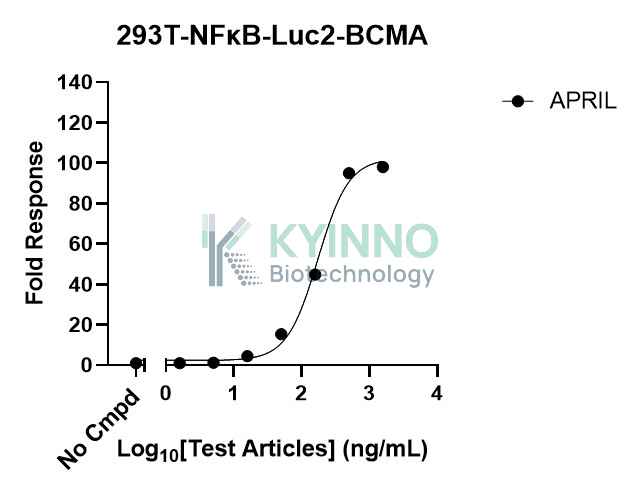
Figure 1. 293T-NFκB-Luc2-BCMA cell line was seed into the 96-well plate, and treated with APRIL at a maximum concentration 1584 ng/mL diluted 3.16-fold for 16 hours, then readout with Bright-Glo system.

Cell Resuscitation

1. Prewarm culture medium (DMEM supplemented with 10% FBS, 150µg/mL Hygromycin B and 1µg/mL Puromycin)in a 37°C water bath.
2. Thaw the frozen vial in a 37°C water bath for 1-2 minutes.
3. Transfer the vial into biosafety cabinet, and wipe the surface with 70% ethanol.
4. Unscrew the top of the vial and transfer the cell suspension gently into a sterile centrifuge tube containing 9.0mL complete culture medium.
5. Spin at ~ 125 × g for 5-7 minutes at room temperature, and discard the supernatant without disturbing the pellet.
6. Resuspend cell pellet with the appropriate volume of complete medium and transfer the cell suspension into a T25 culture flask.
7. Incubate the flask at 37°C, 5% CO2 incubator.
8. Split saturated culture 1:4-1:5 every 2-3 days; seed out at about 1-3 × 10⁵ cells/mL.

Cell Freezing

1. Prepare the freezing medium (70% DMEM + 20% FBS + 10% DMSO) fresh immediately before use.
2. Keep the freezing medium on ice and label cryovials.
3. Transfer cells to a sterile, conical centrifuge tube, and count the cells.
4. Centrifuge the cells at 250×g for 5 minutes at room temperature and carefully aspirate off the medium.
5. Resuspend the cells at a density of at least 3×10⁶ cells/mL in chilled freezing medium.
6. Aliquot 1 mL of the cell suspension into each cryovial.
7. Freeze cells in the CoolCell freezing container overnight in a -80°C freezer.
8. Transfer vials to liquid nitrogen for long-term storage.

References

1.Yu B, Jiang T, Liu D. BCMA-targeted immunotherapy for multiple myeloma. J Hematol Oncol. 2020 Sep 17;13(1):125. doi: 10.1186/s13045-020-00962-7. PMID: 32943087; PMCID: PMC7499842.
2. Yao Y, Yuan M, Shi M, Li W, Sha Y, Zhang Y, Yuan C, Luo J, Li Z, Liao C, Xu K, Niu M. Halting multiple myeloma with MALT1 inhibition: suppressing BCMA-induced NF-κB and inducing immunogenic cell death. Blood Adv. 2024 Aug 13;8(15):4003-4016. doi: 10.1182/bloodadvances.2023012394. PMID: 38820414; PMCID: PMC11339052.
3. Yu H, Lin L, Zhang Z, Zhang H, Hu H. Targeting NF-κB pathway for the therapy of diseases: mechanism and clinical study. Signal Transduct Target Ther. 2020 Sep 21;5(1):209. doi: 10.1038/s41392-020-00312-6. PMID: 32958760; PMCID: PMC7506548.

Please enable JavaScript in your browser to complete this form.