KC-6644

293T-MLLT3-HiBiT-KI Cell Line

×
请在浏览器中启用JavaScript来完成此表单。
65477
Home » 293T-MLLT3-HiBiT-KI Cell Line

Background of 293T-MLLT3-HiBiT-KI Cell Line

MLLT3 (MLLT3 super elongation complex subunit), also known as AF9 or YEATS3, is a nuclear protein and core component of the super elongation complex (SEC) that plays a critical role in transcriptional regulation. The gene is located on chromosome 9p21.3 and encodes a protein containing an N-terminal YEATS domain and an intrinsically disordered ANC1 homology domain . As a multifaceted epigenetic "reader," the YEATS domain of MLLT3 recognizes acylated histone H3 with a marked preference for crotonylated lysine residues (H3K9cr and H3K18cr) over acetylated forms, thereby linking chromatin state to active transcription . Notably, recent studies have demonstrated that the MLLT3 YEATS domain also binds to the noncoding RNA 7SK in a sequence-dependent manner with high affinity (Kd ≈ 42 nM), establishing MLLT3 as a dual reader of histone marks and ncRNA . Within the SEC complex, MLLT3 recruits DOT1L to deposit H3K79 methylation, promoting transcriptional elongation by RNA polymerase II . MLLT3 plays an essential role in hematopoietic stem cell (HSC) maintenance and regulates early cell fate decisions, favoring erythroid and megakaryocytic lineages . In oncogenesis, chromosomal translocation t(9;11)(p22;q23) generates the KMT2A-MLLT3 (MLL-AF9) fusion protein, a driver of aggressive acute leukemias with diverse lineage phenotypes . Given its critical functions in hematopoiesis and leukemogenesis, MLLT3 represents an emerging therapeutic target.

Specifications

Catalog NumberKC-6644
Cell Line Name293T-MLLT3-HiBiT-KI Cell Line
Clone Number1A1
Host Cell Line293T
DescriptionStable 293T cell clone expressing endogenous C-terminal HiBiT tagged MLLT3
QuantityTwo vials of frozen cells (≥2-106/vial)
StabilityStable in culture over a minimum of 10 passages
ApplicationDrug screening and biological assays
Freezing Medium70% DMEM+20% FBS+10% DMSO
Propagation MediumDMEM+10%FBS
Selection MarkerNA
MorphologyEpithelial
SubcultureSplit saturated culture 1:3-1:6 every 2-3 days; seed out at about 1-3 × 10⁵ cells/mL
Incubation37 °C with 5% CO2
StorageLiquid nitrogen immediately upon receiving
Doubling TimeApproximately 30 hours
Mycoplasma StatusNegative

Cell Line Generation

293T-MLLT3-HiBiT-KI cell line was generated using the CRISPR method.

Characterization

Figure 1: Characterization of 293T-MLLT3-HiBiT-KI cell line stable clone using PCR sequencing.

Figure 2: Characterization of 293T-MLLT3-HiBiT-KI cell line stable clone using RT-PCR sequencing.

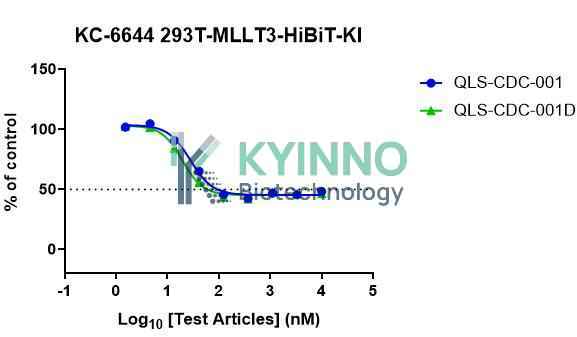
Figure 3. Characterization of HiBiT degradation by MLLT3 Degrader.

Cell Resuscitation

  1. Prewarm culture medium (DMEM+10%FBS)in a 37°C water bath.
  2. Thaw the frozen vial in a 37°C water bath for 1-2 minutes.
  3. Transfer the vial into biosafety cabinet, and wipe the surface with 70% ethanol.
  4. Unscrew the top of the vial and transfer the cell suspension gently into a sterile centrifuge tube containing 9.0mL complete culture medium.
  5. Spin at ~ 125 × g for 5-7 minutes at room temperature, and discard the supernatant without disturbing the pellet.
  6. Resuspend cell pellet with the appropriate volume of complete medium and transfer the cell suspension into a T25 culture flask.
  7. Incubate the flask at 37°C, 5% CO2 incubator.
  8. Split saturated culture 1:3-1:6 every 2-3 days; seed out at about 1-3 × 10⁵ cells/mL.

Cell Freezing

  1. Prepare the freezing medium (70% DMEM+20% FBS+10% DMSO) fresh immediately before use.
  2. Keep the freezing medium on ice and label cryovials.
  3. Transfer cells to a sterile, conical centrifuge tube, and count the cells.
  4. Centrifuge the cells at 250×g for 5 minutes at room temperature and carefully aspirate off the medium.
  5. Resuspend the cells at a density of at least 3×10⁶ cells/mL in chilled freezing medium.
  6. Aliquot 1 mL of the cell suspension into each cryovial.
  7. Freeze cells in the CoolCell freezing container overnight in a -80°C freezer.
  8. Transfer vials to liquid nitrogen for long-term storage

References

  1. Kabra A, Bushweller J. (2022). "The intrinsically disordered proteins MLLT3 (AF9) and MLLT1 (ENL) - multimodal transcriptional switches with roles in normal hematopoiesis, MLL fusion leukemia, and kidney cancer." Journal of Molecular Biology, 434(1), 167117.
  2. Preprint (2025). "The MLLT3 YEATS domain is a dual reader of histone marks (H3K9/18/27ac/cr) and ncRNA (7SK), linking epigenetic and RNA signaling to regulate hematopoiesis." bioRxiv, 2025.09.01.673558.

Use License Agreement

Research Use Only.
Not for use in diagnostic procedures or therapeutic applications.
Redistribution of the cell line or its derivatives is prohibited without prior written permission from Kyinno Biotechnology.
请在浏览器中启用JavaScript来完成此表单。