Antibody-based therapeutics have transformed the treatment landscape for cancer, autoimmune diseases, and infectious conditions. Behind every approved monoclonal antibody lies a meticulous antibody discovery process—a stepwise scientific journey that translates biological insights into targeted therapies.
What Is the Antibody Discovery Process?
The antibody discovery process refers to the set of laboratory methods used to identify, screen, and validate antibodies that bind to a specific disease-related target. These antibodies are then engineered and optimized for therapeutic use.
This process is foundational in antibody drug discovery, forming the bridge between early research and clinical application. It relies on a combination of wet lab and computational approaches to ensure the resulting candidate is specific, effective, and safe for downstream development.
Step-by-Step Overview of the Antibody Discovery Workflow
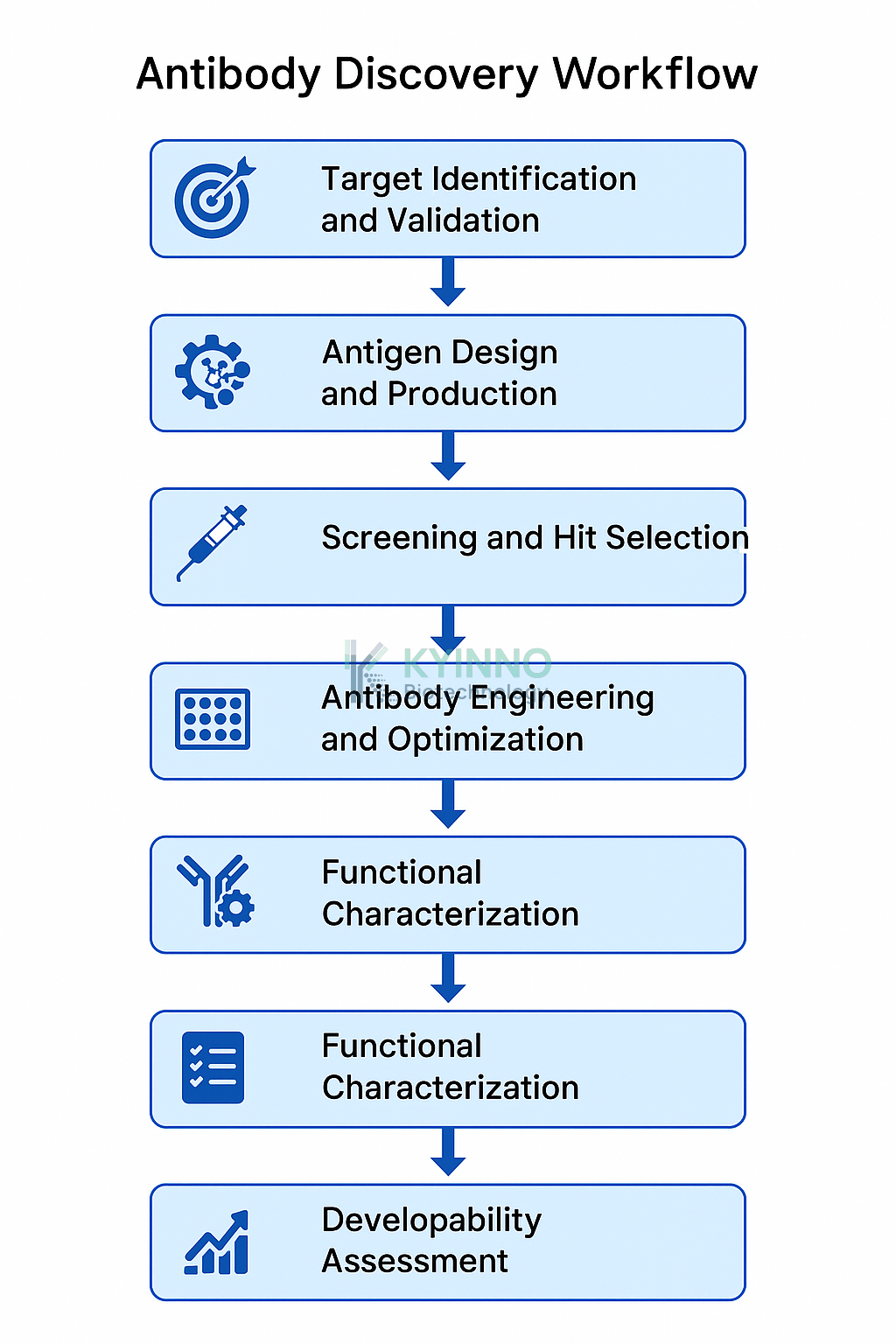
The antibody discovery workflow is a structured, multi-phase process designed to identify and optimize antibodies for therapeutic development. Each stage builds on the previous one, progressively narrowing down candidates to those best suited for clinical success.
1. Target Identification and Validation
The process begins with identifying a disease-associated molecular target—typically a protein critical to disease progression, such as a receptor or cytokine. These are often located on the cell surface or secreted extracellularly, making them accessible to antibodies.
Validation involves confirming the target’s biological relevance using tools such as gene knockdown studies, tissue expression profiling, and pathway analyses. This step ensures that modulating the target will yield therapeutic benefit and reduces the risk of failure in later phases.
2. Antigen Design and Production
Once the target is selected, researchers must generate an antigen that mimics the natural form of the molecule. Antigen design considers factors such as:
- Protein folding and post-translational modifications
- Structural epitopes and conformational stability
- Expression system compatibility (e.g., mammalian vs. bacterial)
Purified recombinant proteins, cell lysates, or peptide fragments may be used. For difficult targets such as transmembrane proteins, specialized approaches like virus-like particles or DNA immunization are employed to retain native structure.
3. Antibody Generation
At this stage, a diverse pool of antibodies is created through two primary approaches:
- In vivo immunization, where animals such as mice, rabbits, or alpacas are immunized with the antigen. This approach is commonly used in hybridoma or single B cell screening workflows.
- In vitro display technologies, including phage, yeast, or ribosome display, where vast synthetic or naïve libraries are screened for binders in a cell-free system. These technologies are scalable and particularly useful for targets with low immunogenicity.
The goal is to generate a broad range of antibody candidates capable of binding to the target antigen.
4. Screening and Hit Selection
The antibody candidates are screened for binding using high-throughput techniques such as:
- ELISA for measuring antigen-antibody binding
- Flow cytometry for detecting binding on cell surfaces
- Surface plasmon resonance (SPR) for assessing kinetics and affinity
Hits are selected based on affinity, specificity, cross-reactivity, and epitope diversity. This stage may also include preliminary functional screens if the biological activity is known.
5. Antibody Engineering and Optimization
Promising leads undergo molecular engineering to improve their drug-like properties. This includes:
- Affinity maturation through site-directed mutagenesis or library rescreening
- Humanization of non-human sequences to reduce immunogenicity
- Fc engineering to modify effector functions such as ADCC or CDC
- Codon optimization for improved expression in mammalian systems
This phase ensures that the antibody is both functionally effective and manufacturable.
6. Functional Characterization
Selected antibodies are evaluated in cell-based assays to confirm their biological function. Depending on the mechanism of action, assays may include:
- Receptor blocking or agonism
- Cytotoxicity (e.g., ADCC or apoptosis induction)
- Immune modulation or checkpoint inhibition
This step helps determine which candidates are most likely to be effective in disease models and ultimately in patients.
7. Developability Assessment
Before progressing to preclinical studies, each candidate is assessed for its developability profile, which includes:
- Aggregation propensity
- Viscosity under formulation conditions
- Solubility and stability over time and temperature ranges
- Expression yield in production systems
Tools such as computational predictors, thermal shift assays, and analytical ultracentrifugation are used to evaluate these parameters. Candidates that meet developability criteria are prioritized for scale-up and preclinical validation.
Modern Technologies in Antibody Discovery
Antibody discovery has undergone significant transformation in recent years, driven by technological innovation. Traditional methods have been augmented—or in some cases replaced—by advanced tools that improve speed, accuracy, and scalability throughout the antibody discovery workflow.
Single B Cell Screening
Single B cell antibody discovery enables the isolation and analysis of individual B cells directly from immunized animals or human donors. Using microfluidics and droplet-based technologies, researchers can rapidly obtain naturally paired heavy and light chain sequences. This reduces the time required for hit identification and helps preserve the native immune repertoire, offering high-affinity and functionally relevant antibody candidates.
This technology is especially valuable when targeting complex antigens such as viral envelope proteins or tumor-associated markers, where natural immune responses offer an advantage over synthetic libraries.
High-Throughput Sequencing
Next-generation sequencing (NGS) plays a key role in characterizing antibody libraries and immune repertoires. It allows for:
- Assessment of sequence diversity
- Monitoring of clonal expansion
- Tracking of somatic hypermutation and affinity maturation
Integrating NGS data early in the antibody development process, researchers can make informed decisions about which candidates to advance, reducing redundancy and improving downstream efficiency.
Machine Learning and Predictive Modeling
AI-driven tools are increasingly used to evaluate key developability metrics, including:
- Aggregation propensity
- Solubility under formulation conditions
- Immunogenicity predictions
These models are trained on large datasets of historical antibody sequences and outcomes, enabling in silico screening before committing to lab resources. Machine learning also supports antibody optimization, helping scientists identify beneficial mutations for affinity or expression without trial-and-error.
Integration with Multi-Omics Data
Combining antibody discovery platforms with transcriptomics, proteomics, and single-cell sequencing enhances target validation and functional screening. For example, researchers can profile tumor-infiltrating B cells or immune responses in infectious disease models to uncover novel antibody leads with therapeutic potential.
Together, these technologies redefine the antibody discovery process, allowing for faster timelines, better candidate selection, and greater alignment with clinical success metrics. Drug developers who adopt these modern platforms are better positioned to generate high-quality antibody therapeutics in a competitive market.

From Antibody Discovery to Drug Development Process
The antibody discovery process does not end with the identification of a promising candidate. Once an optimized lead is selected, it must undergo rigorous preclinical testing to evaluate safety, pharmacokinetics, and efficacy in relevant disease models. Only after passing these benchmarks can it advance to regulatory submission—beginning with an Investigational New Drug (IND) application—and eventually, clinical trials.
Success in the antibody drug discovery process depends on more than scientific merit. It requires close collaboration across functional teams—including discovery scientists, CMC (chemistry, manufacturing, and controls) experts, and clinical strategists—to ensure that each stage aligns with regulatory expectations and therapeutic goals.
Adopting advanced antibody discovery technologies and following a structured antibody discovery workflow, developers can accelerate timelines, reduce attrition, and improve the likelihood of clinical success. Understanding this end-to-end process is essential for translating a molecular target into a viable therapeutic option.
Ready to Discover Your Next Lead Antibody?
Are you moving from target selection to therapeutic candidate? Kyinno Bio delivers expert-led antibody discovery services engineered for speed, precision, and seamless alignment with your development goals.