KC-4157

293T-CALCR-Low-Cell-Line

×
Please enable JavaScript in your browser to complete this form.
42372
Home » 细胞系 » 293T-CALCR-Low-Cell-Line

Background of 293T-CALCR-Low-Cell-Line

CALCR encodes a high affinity receptor for the peptide hormone calcitonin and belongs to a subfamily of seven transmembrane-spanning G protein-coupled receptors. The encoded protein is involved in maintaining calcium homeostasis and in regulating osteoclast-mediated bone resorption. Polymorphisms in this gene have been associated with variations in bone mineral density and onset of osteoporosis.

Specifications

Catalog NumberKC-4157
Cell Line Name293T-CALCR-Low-Cell-Line
Host Cell Line293T
DescriptionStable 293T clone expressing exogenous CALCR gene in low level
QuantityTwo vials of frozen cells (≥2-106/vial)
StabilityStable in culture over a minimum of 10 passages
ApplicationDrug screening and biological assays
Freezing Medium70% DMEM + 20% FBS + 10% DMSO
Propagation MediumDMEM + 10% FBS + 1μg/mL Puromycin
Selection MarkerPuromycin
MorphologyEpithelial
SubcultureSplit saturated culture 1:4-1:8 every 2-3 days; seed out at about 1-3 × 10⁵ cells/mL
Incubation37 °C with 5% CO2
StorageLiquid nitrogen immediately upon receiving
Doubling TimeApproximately 30 hours
Mycoplasma StatusNegative
In Vivo ValidationNA

Cell Line Generation

293T-CALCR-Low-cell-line was generated using a lentiviral vector expressing the CALCR sequence.

Characterization

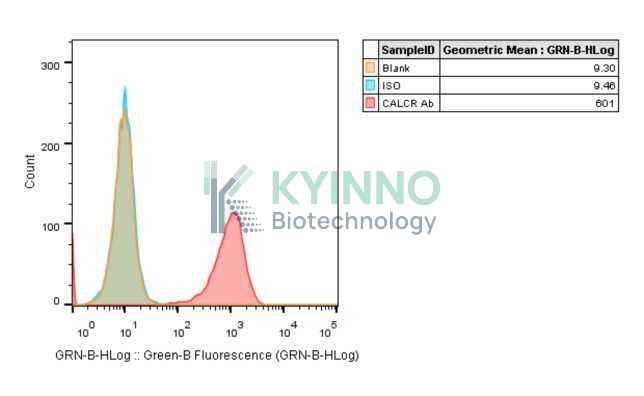
Figure 1: Characterization of CALCR overexpression in the 293T-CALCR-Low stable clone using FACS.

Figure 2: Characterization of CALCR in the 293T-CALCR-Low stable clone using PCR sequencing.

Cell Resuscitation

1. Prewarm culture medium (DMEM supplemented with 10% FBS and 1μg/mL puromycin)in a 37°C water bath. 2. Thaw the frozen vial in a 37°C water bath for 1-2 minutes. 3. Transfer the vial into biosafety cabinet, and wipe the surface with 70% ethanol. 4. Unscrew the top of the vial and transfer the cell suspension gently into a sterile centrifuge tube containing 9.0mL complete culture medium. 5. Spin at ~ 125 × g for 5-7 minutes at room temperature, and discard the supernatant without disturbing the pellet. 6. Resuspend cell pellet with the appropriate volume of complete medium and transfer the cell suspension into a T25 culture flask. 7. Incubate the flask at 37°C, 5% CO2 incubator. 8. Split saturated culture 1:4-1:8 every 2-3 days; seed out at about 1-3 × 10⁵ cells/mL.

Cell Freezing

1. Prepare the freezing medium (70% DMEM + 20% FBS + 10% DMSO) fresh immediately before use. 2. Keep the freezing medium on ice and label cryovials. 3. Transfer cells to a sterile, conical centrifuge tube, and count the cells. 4. Centrifuge the cells at 250×g for 5 minutes at room temperature and carefully aspirate off the medium. 5. Resuspend the cells at a density of at least 3×10⁶ cells/mL in chilled freezing medium. 6. Aliquot 1 mL of the cell suspension into each cryovial. 7. Freeze cells in the CoolCell freezing container overnight in a -80°C freezer. 8. Transfer vials to liquid nitrogen for long-term storage.

References

1.Litvinova MM, Khafizov K, Korchagin VI, Speranskaya AS, Asanov AY, Matsvay AD, Kiselev DA, Svetlichnaya DV, Nuralieva SZ, Moskalev AA, Filippova TV. Association of CASR, CALCR, and ORAI1 Genes Polymorphisms With the Calcium Urolithiasis Development in Russian Population. Front Genet. 2021 May 12;12:621049. doi: 10.3389/fgene.2021.621049. PMID: 34054913; PMCID: PMC8153711. 2.Ali FT, El-Azeem EMA, Hekal HFA, El-Gizawy MM, Sayed MS, Mandoh AY, Soliman AF. Association of TRPV5, CASR, and CALCR genetic variants with kidney stone disease susceptibility in Egyptians through main effects and gene-gene interactions. Urolithiasis. 2022 Dec;50(6):701-710. doi: 10.1007/s00240-022-01360-z. Epub 2022 Sep 11. PMID: 36088585; PMCID: PMC9584976. 3. He T, Ling F. CALCR knockdown inhibits the development and progression of non-small-cell lung cancer. Carcinogenesis. 2021 Nov 12;42(11):1390-1398. doi: 10.1093/carcin/bgab076. PMID: 34417812.

Please enable JavaScript in your browser to complete this form.