KC-0992

293T-CD33-Cell-Line

×
Please enable JavaScript in your browser to complete this form.
21343
Home » 293T-CD33-Cell-Line

Background of 293T-CD33-Cell-Line

CD33, also known as siglec-3, is transmembrane protein belonging to the SIGLEC family of lectins, which is mainly expressed on the surface of myeloid cells. CD33 can inhibits tyrosine phosphorylation and calcium mobilization, suggesting Siglec-3 can mediate inhibitory signals in immune response. CD33 is also the target of several antibodies in tumor therapy, including gemtuzumab ozogamicin approved in 2017, and vadastuximab talirine.

Specifications

Catalog NumberKC-0992
Cell Line Name293T-CD33-Cell-Line
Host Cell Line293T
DescriptionStable 293T clone expressing exogenous CD33 gene
QuantityTwo vials of frozen cells (≥2-106/vial)
StabilityStable in culture over a minimum of 10 passages
ApplicationDrug screening and biological assays
Freezing Medium70% DMEM + 20% FBS + 10% DMSO
Propagation MediumDMEM + 10% FBS + 1μg/mL Puromycin
Selection MarkerPuromycin
MorphologyEpithelial
SubcultureSplit saturated culture 1:4-1:8 every 2-3 days; seed out at about 1-3 × 10⁵ cells/mL
Incubation37 °C with 5% CO2
StorageLiquid nitrogen immediately upon receiving
Doubling TimeApproximately 30 hours
Mycoplasma StatusNegative
In Vivo ValidationNA

Cell Line Generation

293T-CD33-cell-line was generated using a lentiviral vector expressing the CD33 sequence.

Characterization

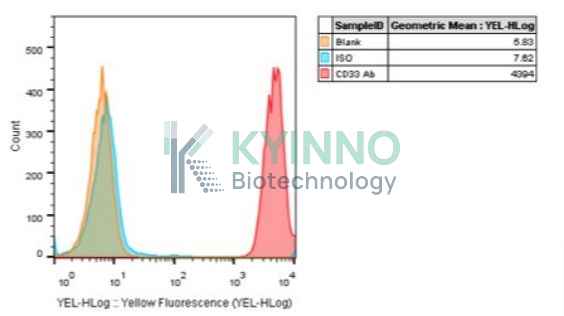
Figure 1: Characterization of CD33 overexpression in the 293T-CD33 stable clone using FACS.

Cell Resuscitation

  1. Prewarm culture medium (DMEM supplemented with 10% FBS and 1μg/mL puromycin)in a 37°C water bath.
  2. Thaw the frozen vial in a 37°C water bath for 1-2 minutes.
  3. Transfer the vial into biosafety cabinet, and wipe the surface with 70% ethanol.
  4. Unscrew the top of the vial and transfer the cell suspension gently into a sterile centrifuge tube containing 9.0mL complete culture medium.
  5. Spin at ~ 125 × g for 5-7 minutes at room temperature, and discard the supernatant without disturbing the pellet.
  6. Resuspend cell pellet with the appropriate volume of complete medium and transfer the cell suspension into a T25 culture flask.
  7. Incubate the flask at 37°C, 5% CO2 incubator.
  8. Split saturated culture 1:4-1:8 every 2-3 days; seed out at about 1-3 × 10⁵ cells/mL.

Cell Freezing

  1. Prepare the freezing medium (70% DMEM + 20% FBS + 10% DMSO) fresh immediately before use.
  2. Keep the freezing medium on ice and label cryovials.
  3. Transfer cells to a sterile, conical centrifuge tube, and count the cells.
  4. Centrifuge the cells at 250×g for 5 minutes at room temperature and carefully aspirate off the medium.
  5. Resuspend the cells at a density of at least 3×10⁶ cells/mL in chilled freezing medium.
  6. Aliquot 1 mL of the cell suspension into each cryovial.
  7. Freeze cells in the CoolCell freezing container overnight in a -80°C freezer.
  8. Transfer vials to liquid nitrogen for long-term storage

References

  1. Garnache-Ottou, Francine, Laurence Chaperot, Sabeha Biichle, Christophe Ferrand, Jean-Paul Remy-Martin, Eric Deconinck, Patrick Darodes de Tailly, et al. 2005. “Expression of the Myeloid-Associated Marker CD33 Is Not an Exclusive Factor for Leukemic Plasmacytoid Dendritic Cells.” Blood 105 (3). American Society of Hematology: 1256–64. doi:10.1182/blood-2004-06-2416.
  2. Hernández-Caselles, Trinidad, María Martínez-Esparza, Ana B Pérez-Oliva, Ana M Quintanilla-Cecconi, Ana García-Alonso, D María Rocío Alvarez-López, and Pilar García-Peñarrubia. 2006. “A Study of CD33 (SIGLEC-3) Antigen Expression and Function on Activated Human T and NK Cells: Two Isoforms of CD33 Are Generated by Alternative Splicing.” Journal of Leukocyte Biology 79 (1). Wiley-Blackwell: 46–58. doi:10.1189/jlb.0205096.
  3. Walter, Roland B, Ted A Gooley, Vincent H J van der Velden, Michael R Loken, Jacques J M van Dongen, David A Flowers, Irwin D Bernstein, and Frederick R Appelbaum. 2007. “CD33 Expression and P-Glycoprotein- Mediated Drug Efflux Inversely Correlate and Predict Clinical Outcome in Patients with Acute Myeloid Leukemia Treated with Gemtuzumab Ozogamicin Monotherapy.” Blood 109 (10). American Society of
  4. Hematology: 4168–70. doi:10.1182/blood-2006-09-047399.
Please enable JavaScript in your browser to complete this form.