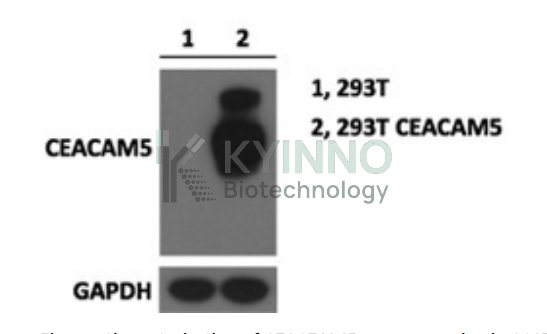
CEACAM-5, also known as CEA and CD66e, belongs to the large family of CEACAM and pregnancy specific glycoproteins. CEACAM-5 is expressed primarily by epithelial cells, consists of an N-terminal Ig-like V-set domain followed by six Ig-like C2-set domains and a GPI anchor. CEACAM-5 functions as a calcium-independent adhesion molecule through homophilic and heterophilic interactions with CEACAM-1. CEACAM-5 is upregulated in a wide variety of human tumors and is a commonly used cancer marker. It promotes tumor cell migration, invasion, adhesion, and metastasis). It also contributes to tumor formation by maintaining cellular proliferation in the presence of differentiation stimuli, and by blocking apoptosis following loss of ECM anchorage (anoikis)