KC-6287

293T-CD98HC Cell Line

×
Please enable JavaScript in your browser to complete this form.
60921
Home » 293T-CD98HC Cell Line

Background of 293T-CD98HC Cell Line

The eukaryotic protein CD98hc (also known as 4F2, FRP-1, or SLC3A2) is a membrane glycoprotein and one of the heavy chains of the family of heterodimeric amino acids transporters. It can associate with any of 6 different light chains to form distinct amino acid transporters. CD98hc is also involved in mediation of intracellular integrin signaling. Besides its physiological roles in the development of the placenta and the immune system, CD98hc is important during pathological processes such as tumorigenesis and host-pathogen interaction. CD98 heavy chain (CD98hc) forms heteromeric amino acid (AA) transporters by interacting with different light chains. Cancer cells overexpress CD98hc-transporters in order to meet their increased nutritional and antioxidant demands, since they provide branched-chain AA (BCAA) and aromatic AA (AAA) availability while protecting cells from oxidative stress.

Specifications

Catalog NumberKC-6287
Cell Line Name293T-CD98HC Cell Line
NCBI/UniProt Accession NumberNM_002394.6
Clone Number5#
Host Cell Line293T
DescriptionStable 293T clone expressing exogenous human CD98HC gene
QuantityTwo vials of frozen cells (≥2-106/vial)
StabilityStable in culture over a minimum of 10 passages
ApplicationDrug screening and biological assays
Freezing Medium70% DMEM + 20% FBS + 10% DMSO
Propagation MediumDMEM + 10% FBS + 1μg/mL Puromycin
Selection MarkerPuromycin
MorphologyEpithelial
SubcultureSplit saturated culture 1:4-1:5 every 2-3 days; seed out at about 1-3 × 10⁵ cells/mL
Incubation37 °C with 5% CO2
StorageLiquid nitrogen immediately upon receiving
Doubling TimeApproximately 30 hours
Mycoplasma StatusNegative

Cell Line Generation

293T-CD98HC cell line was generated using a lentiviral vector expressing the human CD98HC sequence.

Characterization

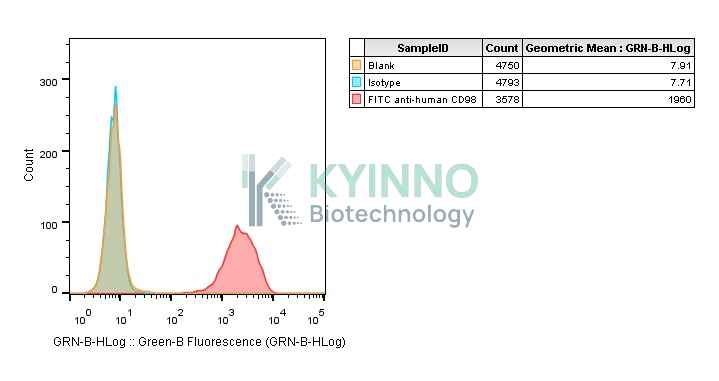
Figure 1: Characterization of human CD98HC overexpression in the 293T-CD98HC stable clone using FACS.

Figure 2: Characterization of human CD98HC in the 293T stable clone using PCR sequencing.

Cell Resuscitation

1. Prewarm culture medium (DMEM + 10% FBS + 1μg/mL Puromycin)in a 37°C water bath.
2. Thaw the frozen vial in a 37°C water bath for 1-2 minutes.
3. Transfer the vial into biosafety cabinet, and wipe the surface with 70% ethanol.
4. Unscrew the top of the vial and transfer the cell suspension gently into a sterile centrifuge tube containing 9.0mL complete culture medium.
5. Spin at ~ 125 × g for 5-7 minutes at room temperature, and discard the supernatant without disturbing the pellet.
6. Resuspend cell pellet with the appropriate volume of complete medium and transfer the cell suspension into a T25 culture flask.
7. Incubate the flask at 37°C, 5% CO2 incubator.
8. Split saturated culture 1:4-1:5 every 2-3 days; seed out at about 1-3 × 10⁵ cells/mL.

Cell Freezing

1. Prepare the freezing medium (70% DMEM + 20% FBS + 10% DMSO) fresh immediately before use.
2. Keep the freezing medium on ice and label cryovials.
3. Transfer cells to a sterile, conical centrifuge tube, and count the cells.
4. Centrifuge the cells at 250×g for 5 minutes at room temperature and carefully aspirate off the medium.
5. Resuspend the cells at a density of at least 3×10⁶ cells/mL in chilled freezing medium.
6. Aliquot 1 mL of the cell suspension into each cryovial.
7. Freeze cells in the CoolCell freezing container overnight in a -80°C freezer.
8. Transfer vials to liquid nitrogen for long-term storage.

References

1. Cano-Crespo S, Chillarón J, Junza A, Fernández-Miranda G, García J, Polte C, R de la Ballina L, Ignatova Z, Yanes Ó, Zorzano A, Stephan-Otto Attolini C, Palacín M. CD98hc (SLC3A2) sustains amino acid and nucleotide availability for cell cycle progression. Sci Rep. 2019 Oct 1;9(1):14065. doi: 10.1038/s41598-019-50547-9. PMID: 31575908; PMCID: PMC6773781.
2. Kawasaki Y, Omori Y, Suzuki S, Yamada T. CD98hc as a marker of radiotherapy-resistant cancer stem cells in head and neck squamous cell carcinoma. Arch Med Sci. 2020 Feb 11;19(6):1859-1868. doi: 10.5114/aoms.2020.92872. PMID: 38058706; PMCID: PMC10696980.
3. Vection S, O'Callaghan D, Keriel A. CD98hc in host-pathogen interactions: roles of the multifunctional host protein during infections. FEMS Microbiol Rev. 2022 Sep 2;46(5):fuac023. doi: 10.1093/femsre/fuac023. PMID: 35595511.
4. Chew KS, Wells RC, Moshkforoush A, Chan D, Lechtenberg KJ, Tran HL, Chow J, Kim DJ, Robles-Colmenares Y, Srivastava DB, Tong RK, Tong M, Xa K, Yang A, Zhou Y, Akkapeddi P, Annamalai L, Bajc K, Blanchette M, Cherf GM, Earr TK, Gill A, Huynh D, Joy D, Knight KN, Lac D, Leung AW, Lexa KW, Liau NPD, Becerra I, Malfavon M, McInnes J, Nguyen HN, Lozano EI, Pizzo ME, Roche E, Sacayon P, Calvert MEK, Daneman R, Dennis MS, Duque J, Gadkar K, Lewcock JW, Mahon CS, Meisner R, Solanoy H, Thorne RG, Watts RJ, Zuchero YJY, Kariolis MS. CD98hc is a target for brain delivery of biotherapeutics. Nat Commun. 2023 Aug 19;14(1):5053. doi: 10.1038/s41467-023-40681-4. Erratum in: Nat Commun. 2023 Sep 7;14(1):5516. doi: 10.1038/s41467-023-41355-x. PMID: 37598178; PMCID: PMC10439950.

Please enable JavaScript in your browser to complete this form.