KC-1837

293T-CRE-Luc2 Cell Line

×
Please enable JavaScript in your browser to complete this form.
22897
Home » 293T-CRE-Luc2 Cell Line

Background of 293T-CRE-Luc2 Cell Line

Cyclic adenosine monophosphate (cAMP) plays a key role in signal transduction pathways as a second messenger. cAMP can regulate the transcription of various target genes, mainly through protein kinase A (PKA) and its downstream effectors such as cAMP-responsive element binding protein (CREB). In addition, PKA can phosphorylate many kinases such as Raf, GSK3 and FAK. Aberrant cAMP-PKA signaling is involved in various types of diseases, such as prefrontal cortex disorders, chronic inflammatory diseases, chronic lymphocytic leukemia (CLL) and human tumors. Especially, cAMP signaling may have both tumor-suppressive and tumor-promoting roles depending on the tumor types and context. cAMP-PKA signaling can regulate cancer cell growth, migration, invasion and metabolism.

Specifications

Catalog NumberKC-1837
Cell Line Name293T-CRE-Luc2 Cell Line
Host Cell LineHuman HEK293T cell line
DescriptionStable 293T cell line expressing exogenous luciferase gene under the control of a cAMPresponse element (CRE) promoter.
QuantityTwo vials of frozen cells (≥2-106/vial)
StabilityStable in culture over a minimum of 10 passages
ApplicationDrug screening and biological assays
Freezing Medium70% DMEM+20% FBS+10% DMSO
Propagation MediumDMEM+10%FBS+150µg/mL Hygromycin B
Selection MarkerHygromycinB
MorphologyEpithelial
SubcultureSplit saturated culture 1:3-1:6 every 3 days; seed out at about 1-3 × 10⁵ cells/mL
Incubation37 °C with 5% CO2
StorageLiquid nitrogen immediately upon receiving
Doubling TimeApproximately 30 hours
Mycoplasma StatusNegative
In Vivo ValidationNA

Cell Line Generation

293T-cAMP-luciferase cell line was generated using lentivirus methods.

Characterization

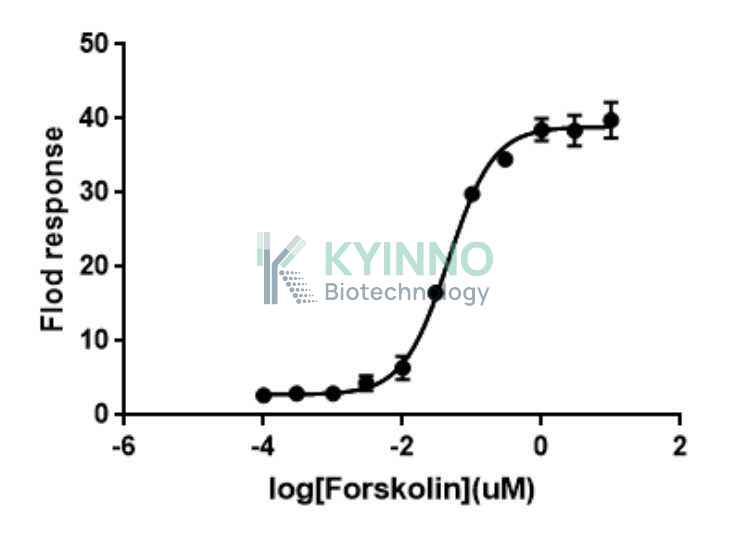
Figure 1. 293T-CRE-luc2 cell line was seed into the 96-well plate, 20000 cells each well, and treated with 25mM IBMX and 3.16-fold diluted Forskolin at a maximum concentration 10uM for 6 hours, then readout with Bright-Glo system, the EC50 of Forskolin was 0.45uM.

Cell Resuscitation

  1. Prewarm culture medium (DMEM + 10% FBS + 150µg/mL Hygromycin B)in a 37°C water bath.
  2. Thaw the frozen vial in a 37°C water bath for 1-2 minutes.
  3. Transfer the vial into biosafety cabinet, and wipe the surface with 70% ethanol.
  4. Unscrew the top of the vial and transfer the cell suspension gently into a sterile centrifuge tube containing 9.0mL complete culture medium.
  5. Spin at ~ 125 × g for 5-7 minutes at room temperature, and discard the supernatant without disturbing the pellet.
  6. Resuspend cell pellet with the appropriate volume of complete medium and transfer the cell suspension into a T25 culture flask.
  7. Incubate the flask at 37°C, 5% CO2 incubator.
  8. Split saturated culture 1:3-1:6 every 3 days; seed out at about 1-3 × 10⁵ cells/mL.

Cell Freezing

  1. Prepare the freezing medium (70% DMEM + 20% FBS + 10% DMSO) fresh immediately before use.
  2. Keep the freezing medium on ice and label cryovials.
  3. Transfer cells to a sterile, conical centrifuge tube, and count the cells.
  4. Centrifuge the cells at 250×g for 5 minutes at room temperature and carefully aspirate off the medium.
  5. Resuspend the cells at a density of at least 3×10⁶ cells/mL in chilled freezing medium.
  6. Aliquot 1 mL of the cell suspension into each cryovial.
  7. Freeze cells in the CoolCell freezing container overnight in a -80°C freezer.
  8. Transfer vials to liquid nitrogen for long-term storage

References

  1. Kim N, Shin S, Bae SW. cAMP Biosensors Based on Genetically Encoded Fluorescent/Luminescent Proteins. Biosensors (Basel), 2021.
  2. Zhang H, Kong Q, Wang J, Jiang Y, Hua H. Complex roles of cAMP-PKA-CREB signaling in cancer. Exp Hematol Oncol, 2020.
  3. Pacini ESA, Satori NA, Jackson EK, Godinho RO. Extracellular cAMP-Adenosine Pathway Signaling: A Potential Therapeutic Target in Chronic Inflammatory Airway Diseases, 2022.
  4. Murray F, Insel PA. Targeting cAMP in chronic lymphocytic leukemia: a pathway-dependent approach for the treatment of leukemia and lymphoma. Expert Opin Ther Targets, 2013.
Please enable JavaScript in your browser to complete this form.