KC-0234

293T-GITRL-Cell-Line

×
Please enable JavaScript in your browser to complete this form.
20067
Home » 细胞系 » 293T-GITRL-Cell-Line

Background of 293T-GITRL-Cell-Line

GITRL, also known as TNF superfamily member 18,a type II transmembrane protein, is a ligand for glucocorticoidinduced TNFR-related protein (GITR). It has been shown to modulate T lymphocyte survival in peripheral tissues. This cytokine is also found to be expressed in endothelial cells and is thought to be important for the interaction between T lymphocytes and endothelial cells. Recent evidence suggests that the GITR/GITRL system participates in the development of inflammatory responses, including shock, either due to the early response of neutrophils and macrophages or together with autoimmune/allergic pathogenesis.

Specifications

Catalog NumberKC-0234
Cell Line Name293T-GITRL-Cell-Line
Host Cell LineHuman HEK293T cell line
DescriptionStable HEK293T cell line expressing exogenous human GITRL gene
QuantityTwo vials of frozen cells (≥2-106/vial)
StabilityStable in culture over a minimum of 10 passages
ApplicationDrug screening and biological assays
Freezing Medium70% DMEM+20% FBS+10% DMSO
Propagation MediumDMEM+10%FBS+0.5µg/mL Puromycin
Selection MarkerPuromycin
MorphologyEpithelial
SubcultureSplit saturated culture 1:3-1:6 every 3 days; seed out at about 1-3 × 10⁵ cells/mL
Incubation37 °C with 5% CO2
StorageLiquid nitrogen immediately upon receiving
Doubling TimeApproximately 30 hours
Mycoplasma StatusNegative
In Vivo ValidationNA

Cell Line Generation

293T human GITRL cell line was generated using a lentiviral vector expressing the human GITRL sequence.

Characterization

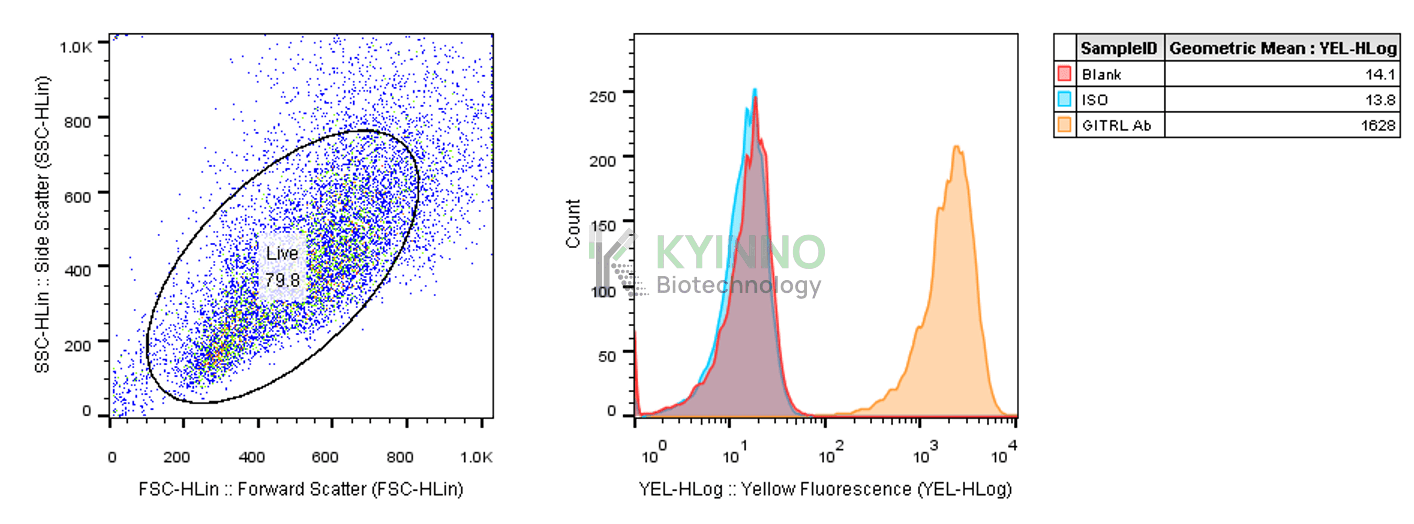
Figure: Characterization of GITRL overexpression in 293T stable clones using FACS.

Cell Resuscitation

  1. Prewarm culture medium (DMEM + 10% FBS + 0.5μg/mL puromycin)in a 37°C water bath.
  2. Thaw the frozen vial in a 37°C water bath for 1-2 minutes.
  3. Transfer the vial into biosafety cabinet, and wipe the surface with 70% ethanol.
  4. Unscrew the top of the vial and transfer the cell suspension gently into a sterile centrifuge tube containing 9.0mL complete culture medium.
  5. Spin at ~ 125 × g for 5-7 minutes at room temperature, and discard the supernatant without disturbing the pellet.
  6. Resuspend cell pellet with the appropriate volume of complete medium and transfer the cell suspension into a T25 culture flask.
  7. Incubate the flask at 37°C, 5% CO2 incubator.
  8. Split saturated culture 1:3-1:6 every 3 days; seed out at about 1-3 × 10⁵ cells/mL.

Cell Freezing

  1. Prepare the freezing medium (70% DMEM + 20% FBS + 10% DMSO) fresh immediately before use.
  2. Keep the freezing medium on ice and label cryovials.
  3. Transfer cells to a sterile, conical centrifuge tube, and count the cells.
  4. Centrifuge the cells at 250×g for 5 minutes at room temperature and carefully aspirate off the medium.
  5. Resuspend the cells at a density of at least 3×10⁶ cells/mL in chilled freezing medium.
  6. Aliquot 1 mL of the cell suspension into each cryovial.
  7. Freeze cells in the CoolCell freezing container overnight in a -80°C freezer.
  8. Transfer vials to liquid nitrogen for long-term storage

References

  1. Krausz LT, Bianchini R, Ronchetti S, Fettucciari K, Nocentini G, Riccardi C. GITR-GITRL System, A Novel Player in Shock and Inflammation .The Scientific World JOURNAL, (2007) 7, 533ÿ566
  2. Tang X, Tian J, Ma J, Wang J, Qi C, Rui K, Wang Y, Xu H, Lu L, Wang S. GITRL modulates the activities of p38 MAPK and STAT3 to promote Th17 cell differentiation in autoimmune arthritis. Oncotarget. 2016 Feb 23;7(8):8590- 600.
  3. Kim JD, Choi BK, Bae JS, Lee UH, Han IS, Lee HW, Youn BS, Vinay DS, Kwon BS. Cloning and characterization of GITR ligand. Genes Immun. 2003 Dec;4(8):564-9.
Please enable JavaScript in your browser to complete this form.