KC-4005

293T-mouse-TNFSF15 Cell Line

×
Please enable JavaScript in your browser to complete this form.
40468
Home » 细胞系 » 293T-mouse-TNFSF15 Cell Line

Background of 293T-mouse-TNFSF15 Cell Line

The protein encoded by this gene is a cytokine that belongs to the tumor necrosis factor (TNF) ligand family. This protein is abundantly expressed in endothelial cells, but is not expressed in either B or T cells. The expression of this protein is inducible by TNF and IL-1 alpha. This cytokine is a ligand for receptor TNFRSF25 and decoy receptor TNFRSF21/DR6. It can activate NF-kappaB and MAP kinases, and acts as an autocrine factor to induce apoptosis in endothelial cells. This cytokine is also found to inhibit endothelial cell proliferation, and thus may function as an angiogenesis inhibitor. Two transcript variants encoding different isoforms have been found for this gene.

Specifications

Catalog NumberKC-4005
Cell Line Name293T-mouse-TNFSF15 Cell Line
Clone Number3#
Host Cell Line293T
DescriptionStable 293T cell line expressing exogenous mouse-tnfsf15 gene
QuantityTwo vials of frozen cells (≥2-106/vial)
StabilityStable in culture over a minimum of 10 passages
ApplicationDrug screening and biological assays
Freezing Medium70% DMEM+20% FBS+10% DMSO
Propagation MediumDMEM+10% FBS +1μg/mL Puromycin
Selection MarkerPuromycin
MorphologyEpithelial
SubcultureSplit saturated culture 1:4-1:8 every 2-3 days; seed out at about 1-3 × 10⁵ cells/mL
Incubation37 °C with 5% CO2
StorageLiquid nitrogen immediately upon receiving
Doubling TimeApproximately 30 hours
Mycoplasma StatusNegative
In Vivo ValidationNA

Cell Line Generation

293T-mouse-TNFSF15 cell line was generated using lentivirus expressing mouse-GFRAL sequence.

Characterization

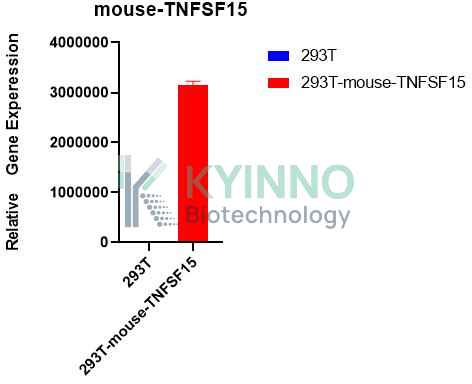
Figure 1. Characterization of mouse-TNFSF15 over-expression in the 293T-mouse-TNFSF15 stable clone using qPCR.

Figure 2. Characterization of mouse-TNFSF15 over-expression in the 293T-mouse-TNFSF15 stable clone using PCR.

Cell Resuscitation

  1. Prewarm culture medium (DMEM supplemented with 10% FBS, 1μg/mL Puromycin)in a 37°C water bath.
  2. Thaw the frozen vial in a 37°C water bath for 1-2 minutes.
  3. Transfer the vial into biosafety cabinet, and wipe the surface with 70% ethanol.
  4. Unscrew the top of the vial and transfer the cell suspension gently into a sterile centrifuge tube containing 9.0mL complete culture medium.
  5. Spin at ~ 125 × g for 5-7 minutes at room temperature, and discard the supernatant without disturbing the pellet.
  6. Resuspend cell pellet with the appropriate volume of complete medium and transfer the cell suspension into a T25 culture flask.
  7. Incubate the flask at 37°C, 5% CO2 incubator.
  8. Split saturated culture 1:4-1:8 every 2-3 days; seed out at about 1-3 × 10⁵ cells/mL.

Cell Freezing

  1. Prepare the freezing medium (70% DMEM + 20% FBS + 10% DMSO) fresh immediately before use.
  2. Keep the freezing medium on ice and label cryovials.
  3. Transfer cells to a sterile, conical centrifuge tube, and count the cells.
  4. Centrifuge the cells at 250×g for 5 minutes at room temperature and carefully aspirate off the medium.
  5. Resuspend the cells at a density of at least 3×10⁶ cells/mL in chilled freezing medium.
  6. Aliquot 1 mL of the cell suspension into each cryovial.
  7. Freeze cells in the CoolCell freezing container overnight in a -80°C freezer.
  8. Transfer vials to liquid nitrogen for long-term storage.

References

  1. Sun Y, Irwanto A, Toyo-Oka L, Hong M, Liu H, Andiappan AK, Choi H, Hitomi Y, Yu G, Yu Y, Bao F, Wang C, Fu X, Yue Z, Wang H, Zhang H, Kawashima M, Kojima K, Nagasaki M, Nakamura M, Yang SK, Ye BD, Denise Y, Rotzschke O, Song K, Tokunaga K, Zhang F, Liu J. Fine-mapping analysis revealed complex pleiotropic effect and tissue-specific regulatory mechanism of TNFSF15 in primary biliary cholangitis, Crohn\'s disease and leprosy. Sci Rep. 2016 Aug 10;6:31429. doi: 10.1038/srep31429. PMID: 27507062; PMCID: PMC4979016.
  2. Picornell Y, Mei L, Taylor K, Yang H, Targan SR, Rotter JI. TNFSF15 is an ethnic-specific IBD gene. Inflamm Bowel Dis. 2007 Nov;13(11):1333-8. doi: 10.1002/ibd.20223. PMID: 17663424; PMCID: PMC2552994.
Please enable JavaScript in your browser to complete this form.