KC-5341

293T-NFκB-Luc2-mouse-HVEM Cell Line

×
Please enable JavaScript in your browser to complete this form.
55776
Home » 293T-NFκB-Luc2-mouse-HVEM Cell Line

Background of 293T-NFκB-Luc2-mouse-HVEM Cell Line

This gene encodes a member of the TNF (tumor necrosis factor) receptor superfamily. The encoded protein functions in signal transduction pathways that activate inflammatory and inhibitory T-cell immune response. It binds herpes simplex virus (HSV) viral envelope glycoprotein D (gD), mediating its entry into cells. Alternative splicing results in multiple transcript variants.TNFRSF14 (TNF Receptor Superfamily Member 14) is a Protein Coding gene. Diseases associated with TNFRSF14 include Herpes Simplex and Leukemia, Chronic Lymphocytic. Among its related pathways are Akt Signaling and TNF Superfamily - Human Ligand-Receptor Interactions and their Associated Functions. Gene Ontology (GO) annotations related to this gene include ubiquitin protein ligase binding and tumor necrosis factor receptor activity.

Specifications

Catalog NumberKC-5341
Cell Line Name293T-NFκB-Luc2-mouse-HVEM Cell Line
Clone Number4A3
Host Cell Line293T-NFκB-Luc2
DescriptionStable Jurkat cell line expressing exogenous luciferase under the control of NFκB responsive element and mouse HVEM fusion sequence.
QuantityTwo vials of frozen cells (≥2-106/vial)
StabilityStable in culture over a minimum of 10 passages
ApplicationDrug screening and biological assays
Freezing Medium70% DMEM + 20% FBS + 10% DMSO
Propagation MediumDMEM + 10% FBS + 150μg/mL Hygromycin B + 1μg/mL puromycin
Selection MarkerHygromycin B and Puromycin
MorphologyEpithelial
SubcultureSplit saturated culture 1:4-1:6 every 2-3 days; seed out at about 1 × 10⁵ cells/mL
Incubation37 °C with 5% CO2
StorageLiquid nitrogen immediately upon receiving
Doubling TimeApproximately 30 hours
Mycoplasma StatusNegative

Cell Line Generation

293T-NFκB-Luc2-mouse-HVEM Cell Line was generated using a lentiviral vector expressing the mouse-HVEM sequence.

Characterization

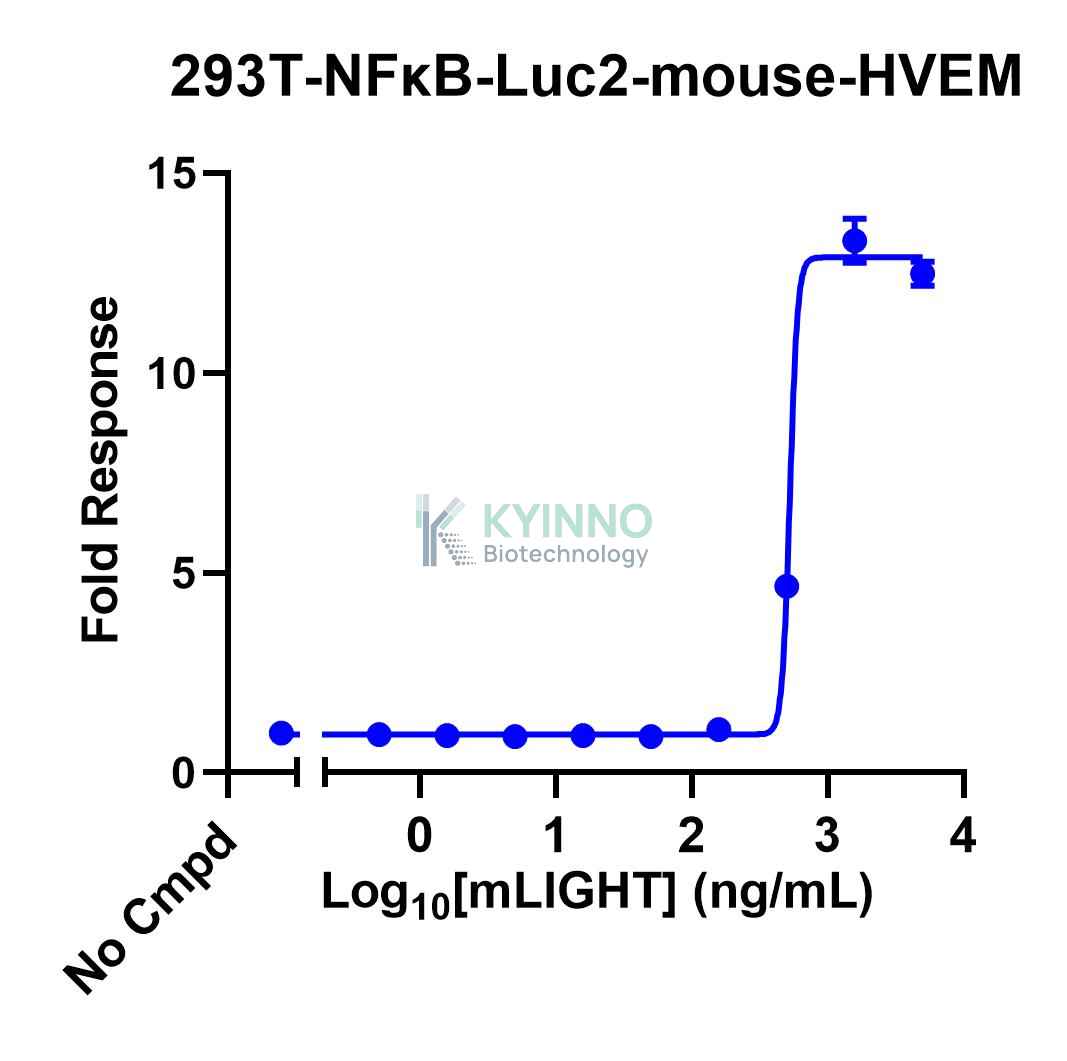
Figure 1: 293T-NFκB-Luc2-mouse-HVEM cell were seeded into 96-well plates, treated with Mouse LIGHT in different concentrations for 16 hours, and then read out using Bright-Glo Detection System.

Cell Resuscitation

  1. Prewarm culture medium (DMEM supplemented with 10% FBS, 150μg/mL Hygromycin B and 1μg/mL Puromycin) in a 37°C water bath.
  2. Thaw the frozen vial in a 37°C water bath for 1-2 minutes.
  3. Transfer the vial into biosafety cabinet, and wipe the surface with 70% ethanol.
  4. Unscrew the top of the vial and transfer the cell suspension gently into a sterile centrifuge tube containing 9.0mL complete culture medium.
  5. Spin at ~ 125 × g for 5-7 minutes at room temperature, and discard the supernatant without disturbing the pellet.
  6. Resuspend cell pellet with the appropriate volume of complete medium and transfer the cell suspension into a T25 culture flask.
  7. Incubate the flask at 37°C, 5% CO2 incubator.
  8. Split saturated culture 1:4-1:6 every 2-3 days; seed out at about 1 × 10⁵ cells/mL.

Cell Freezing

  1. Prepare the freezing medium (DMEM + 20% FBS + 10% DMSO) fresh immediately before use.
  2. Keep the freezing medium on ice and label cryovials.
  3. Transfer cells to a sterile, conical centrifuge tube, and count the cells.
  4. Centrifuge the cells at 250×g for 5 minutes at room temperature and carefully aspirate off the medium.
  5. Resuspend the cells at a density of at least 3×10⁶ cells/mL in chilled freezing medium.
  6. Aliquot 1 mL of the cell suspension into each cryovial.
  7. Freeze cells in the CoolCell freezing container overnight in a -80°C freezer.
  8. Transfer vials to liquid nitrogen for long-term storage.

References

1. Zhang T, Ye L, Han L, He Q, Zhu J. Knockdown of HVEM, a Lymphocyte Regulator Gene, in Ovarian Cancer Cells Increases Sensitivity to Activated T Cells. Oncol Res. 2016;24(3):189-96. doi: 10.3727/096504016X14641336229602. Erratum in: Oncol Res. 2017 Nov 2;25(9):1665. doi: 10.3727/096504017X15078984695565. PMID: 27458100; PMCID: PMC7838697.
2. Whitbeck JC, Connolly SA, Willis SH, Hou W, Krummenacher C, Ponce de Leon M, Lou H, Baribaud I, Eisenberg RJ, Cohen GH. Localization of the gD-binding region of the human herpes simplex virus receptor, HveA. J Virol. 2001 Jan;75(1):171-80. doi: 10.1128/JVI.75.1.171-180.2001. PMID: 11119586; PMCID: PMC113910.

Please enable JavaScript in your browser to complete this form.