KC-1148

293T-OS8-hPDL1-Cell-Line

×
Please enable JavaScript in your browser to complete this form.
21611
Home » 293T-OS8-hPDL1-Cell-Line

Background of 293T-OS8-hPDL1-Cell-Line

PD-L1, also called human programed cell death ligand 1, is a transmembrane protein that play a major role in suppressing the immune system during particular events such as pregnancy, tissue allografts, autoimmune disease, virus infection and cancer. PD-L1 binds to its receptor PD-1 on activated T cells, B cells, and myeloid cells, to modulate activation or inhibition. Upregulation of PD-L1 can allow cancer cell to evade the host immune system.

293T-OS8 stable cell was used as an artificial antigen presenting cells (APCs), OS8 could function as a membrane anchored T cell engager that directly activates TCR in T cell-based assay.

Specifications

Catalog NumberKC-1148
Cell Line Name293T-OS8-hPDL1-Cell-Line
Host Cell Line293T
DescriptionHEK293T cell line stable expressing exogenous membrane OKT3 scFV and human
PDL1 sequence
QuantityTwo vials of frozen cells (≥2-106/vial)
StabilityStable in culture over a minimum of 10 passages
ApplicationDrug screening and biological assays
Freezing Medium70% DMEM + 20% FBS + 10% DMSO
Propagation MediumDMEM+10%FBS+1µg/mL Puromycin+140µg/mL Hygromycin B
Selection MarkerPuromycin, Hygromycin B
MorphologyEpithelial
SubcultureSplit saturated culture 1:4-1:8 every 2-3 days; seed out at about 1-3 × 10⁵ cells/mL
Incubation37 °C with 5% CO2
StorageLiquid nitrogen immediately upon receiving
Doubling TimeApproximately 30 hours
Mycoplasma StatusNegative
In Vivo ValidationNA

Cell Line Generation

293T OS8 cell line was generated uisng lentiviral vector expessing a ScFV sequence of anti-human CD3 mAb OKT3 and a C-terminal domain of mouse CD8a which consisit of transmembrane and cytoplasmcic domains, and another lentiviral vector expessing human PDL1 molecules.

Characterization

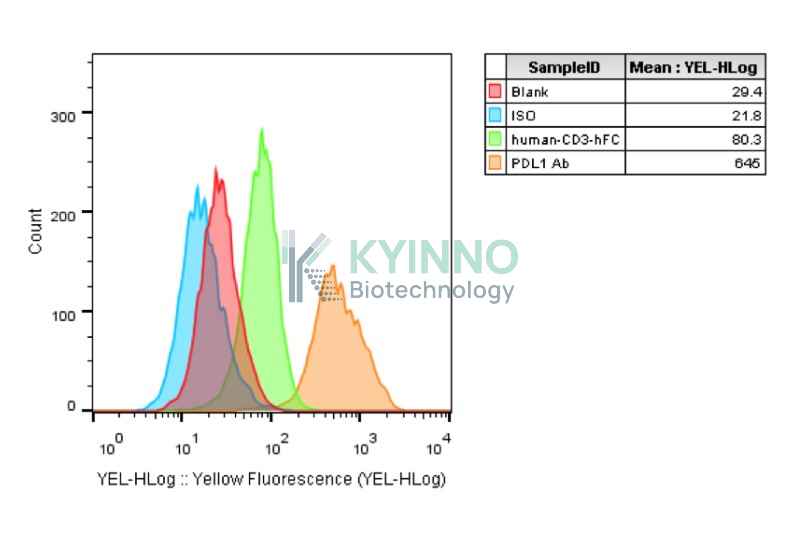
Figure: Characterization of OS8 and PDL1 overexpressing in 293T stable clones using FACS.

Cell Resuscitation

1. Prewarm culture medium (DMEM supplemented with 10% FBS, 1µg/mL Puromycin and 140µg/mL Hygromycin B)in a 37°C water bath.
2. Thaw the frozen vial in a 37°C water bath for 1-2 minutes.
3. Transfer the vial into biosafety cabinet, and wipe the surface with 70% ethanol.
4. Unscrew the top of the vial and transfer the cell suspension gently into a sterile centrifuge tube containing 9.0mL complete culture medium.
5. Spin at ~ 125 × g for 5-7 minutes at room temperature, and discard the supernatant without disturbing the pellet.
6. Resuspend cell pellet with the appropriate volume of complete medium and transfer the cell suspension into a T25 culture flask.
7. Incubate the flask at 37°C, 5% CO2 incubator.
8. Split saturated culture 1:4-1:8 every 2-3 days; seed out at about 1-3 × 10⁵ cells/mL.

Cell Freezing

1. Prepare the freezing medium (70% DMEM + 20% FBS + 10% DMSO) fresh immediately before use.
2. Keep the freezing medium on ice and label cryovials.
3. Transfer cells to a sterile, conical centrifuge tube, and count the cells.
4. Centrifuge the cells at 250×g for 5 minutes at room temperature and carefully aspirate off the medium.
5. Resuspend the cells at a density of at least 3×10⁶ cells/mL in chilled freezing medium.
6. Aliquot 1 mL of the cell suspension into each cryovial.
7. Freeze cells in the CoolCell freezing container overnight in a -80°C freezer.
8. Transfer vials to liquid nitrogen for long-term storage

References

1. Latouche, Jean-Baptiste; Sadelain, Michel (2000). Induction of human cytotoxic T lymphocytes by artificial antigen-presenting cells. Nature Biotechnology. 18 (4): 405–409.
2. Perica, Karlo; Kosmides, Alyssa K; Schneck, Jonathan P (2015). Linking form to function: Biophysical aspects of artificial antigen presenting cell design. Biochimica et Biophysica Acta (BBA) - Molecular Cell Research. 1853 (4): 781–790
3. Sunshine, J. & Taube, J. M. PD-1/PD-L1 inhibitors. Current Opinion in Pharmacology 23, 32–38 (2015).
4. Boussiotis, V. A. Molecular and Biochemical Aspects of the PD-1 Checkpoint Pathway. N Engl J Med 375, 1767– 1778 (2016).
5. Topalian, S. L. et al. Safety, activity, and immune correlates of anti-PD-1 antibody in cancer. N Engl J Med 366, 2443–2454 (2012).

Please enable JavaScript in your browser to complete this form.