KC-1057

293T-RSPO1-Cell-Line

×
Please enable JavaScript in your browser to complete this form.
21457
Home » 293T-RSPO1-Cell-Line

Background of 293T-RSPO1-Cell-Line

This gene encodes a secreted activator protein with two cysteine-rich, furin-like domains and one thrombospondin type 1 domain. The encoded protein is a ligand for leucine-rich repeat-containing G-protein coupled receptors (LGR proteins) and positively regulates the Wnt signaling pathway. In mice, the protein induces the rapid onset of crypt cell proliferation and increases intestinal epithelial healing, providing a protective effect against chemotherapy-induced adverse effects. Alternative splicing results in multiple transcript variants.

Specifications

Catalog NumberKC-1057
Cell Line Name293T-RSPO1-Cell-Line
Host Cell Line293T
DescriptionStable HEK293T clone expressing exogenous RSPO1 gene
QuantityTwo vials of frozen cells (≥2-106/vial)
StabilityStable in culture over a minimum of 10 passages
ApplicationDrug screening and biological assays
Freezing Medium70% DMEM + 20% FBS + 10% DMSO
Propagation MediumDMEM + 10% FBS + 1μg/mL Puromycin
Selection MarkerPuromycin
MorphologyEpithelial
SubcultureSplit saturated culture 1:4-1:5 every 2-3 days; seed out at about 1-3 × 10⁵ cells/mL
Incubation37 °C with 5% CO2
StorageLiquid nitrogen immediately upon receiving
Doubling TimeApproximately 30 hours
Mycoplasma StatusNegative
In Vivo ValidationNA

Cell Line Generation

293T RSPO1 cell line was generated using a lentiviral vector expressing the RSPO1 sequence.

Characterization

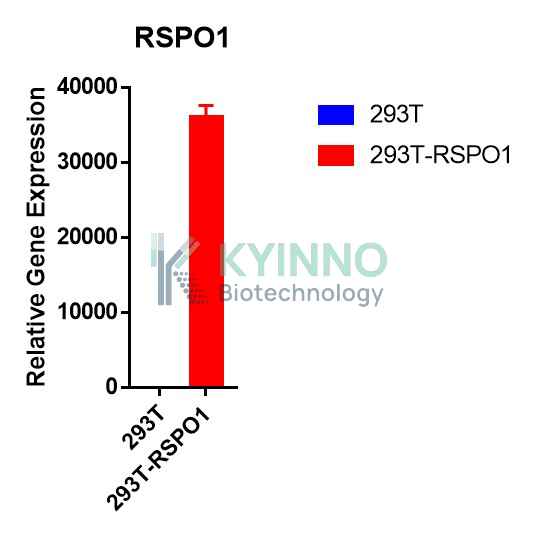
Figure 1: Characterization of RSPO1 overexpression in the 293T RSPO1 stable clone using qPCR.

Cell Resuscitation

  1. Prewarm culture medium (DMEM supplemented with 10% FBS and 1μg/mL puromycin)in a 37°C water bath.
  2. Thaw the frozen vial in a 37°C water bath for 1-2 minutes.
  3. Transfer the vial into biosafety cabinet, and wipe the surface with 70% ethanol.
  4. Unscrew the top of the vial and transfer the cell suspension gently into a sterile centrifuge tube containing 9.0mL complete culture medium.
  5. Spin at ~ 125 × g for 5-7 minutes at room temperature, and discard the supernatant without disturbing the pellet.
  6. Resuspend cell pellet with the appropriate volume of complete medium and transfer the cell suspension into a T25 culture flask.
  7. Incubate the flask at 37°C, 5% CO2 incubator.
  8. Split saturated culture 1:4-1:5 every 2-3 days; seed out at about 1-3 × 10⁵ cells/mL.

Cell Freezing

  1. Prepare the freezing medium (70% DMEM + 20% FBS + 10% DMSO) fresh immediately before use.
  2. Keep the freezing medium on ice and label cryovials.
  3. Transfer cells to a sterile, conical centrifuge tube, and count the cells.
  4. Centrifuge the cells at 250×g for 5 minutes at room temperature and carefully aspirate off the medium.
  5. Resuspend the cells at a density of at least 3×10⁶ cells/mL in chilled freezing medium.
  6. Aliquot 1 mL of the cell suspension into each cryovial.
  7. Freeze cells in the CoolCell freezing container overnight in a -80°C freezer.
  8. Transfer vials to liquid nitrogen for long-term storage.

References

  1. Liu Q, Zhao Y, Xing H, Li L, Li R, Dai J, Li Q, Fang S. The role of R-spondin 1 through activating Wnt/β-catenin in the growth, survival and migration of ovarian cancer cells. Gene. 2019 Mar 20;689:124-130. doi: 10.1016/j.gene.2018.11.098. Epub 2018 Dec 17. PMID: 30572097.
  2. Kang YE, Kim JM, Yi HS, Joung KH, Lee JH, Kim HJ, Ku BJ. Serum R-Spondin 1 Is a New Surrogate Marker for Obesity and Insulin Resistance. Diabetes Metab J. 2019 Jun;43(3):368-376. doi: 10.4093/dmj.2018.0066. Epub 2018 Oct 23. PMID: 30398036; PMCID: PMC6581548.
  3. Chang CF, Hsu LS, Weng CY, Chen CK, Wang SY, Chou YH, Liu YY, Yuan ZX, Huang WY, Lin H, Chen YH, Tsai JN. N-Glycosylation of Human R-Spondin 1 Is Required for Efficient Secretion and Stability but Not for Its Heparin Binding Ability. Int J Mol Sci. 2016 Jun 14;17(6):937. doi: 10.3390/ijms17060937. PMID: 27314333; PMCID: PMC4926470.
Please enable JavaScript in your browser to complete this form.