KC-4921

293T-UAS-Luc2-GAL4BD-ELK1-FGFR2b Cell Line

×
Please enable JavaScript in your browser to complete this form.
53659
Home » 293T-UAS-Luc2-GAL4BD-ELK1-FGFR2b Cell Line

Background of 293T-UAS-Luc2-GAL4BD-ELK1-FGFR2b Cell Line

The protein encoded by this gene is a member of the fibroblast growth factor receptor family, where amino acid sequence is highly conserved between members and throughout evolution. FGFR family members differ from one another in their ligand affinities and tissue distribution. A full-length representative protein consists of an extracellular region, composed of three immunoglobulin-like domains, a single hydrophobic membrane-spanning segment and a cytoplasmic tyrosine kinase domain. The extracellular portion of the protein interacts with fibroblast growth factors, setting in motion a cascade of downstream signals, ultimately influencing mitogenesis and differentiation. This particular family member is a high-affinity receptor for acidic, basic and/or keratinocyte growth factor, depending on the isoform. Mutations in this gene are associated with Crouzon syndrome, Pfeiffer syndrome, Craniosynostosis, Apert syndrome, Jackson-Weiss syndrome, Beare-Stevenson cutis gyrata syndrome, Saethre-Chotzen syndrome, and syndromic craniosynostosis. Multiple alternatively spliced transcript variants encoding different isoforms have been noted for this gene. FGFR2 (Fibroblast Growth Factor Receptor 2) is a Protein Coding gene. Diseases associated with FGFR2 include Pfeiffer Syndrome and Crouzon Syndrome. Among its related pathways are Apoptotic Pathways in Synovial Fibroblasts and GPCR Pathway.

Specifications

Catalog NumberKC-4921
Cell Line Name293T-UAS-Luc2-GAL4BD-ELK1-FGFR2b Cell Line
Host Cell Line293T-UAS-Luc2-GAL4BD-ELK1
DescriptionStable 293T cell line expressing exogenous luciferase under the control of FGFR2b signaling pathway.
QuantityTwo vials of frozen cells (≥2-106/vial)
StabilityStable in culture over a minimum of 10 passages
ApplicationDrug screening and biological assays
Freezing Medium70% DMEM + 20% FBS + 10% DMSO
Propagation MediumDMEM + 10% FBS + 75μg/mL Hygromycin B + 0.50μg/mL Puromycin + 10μg/mL Blasticidin S
Selection MarkerPuromycin, Hygromycin B, Blasticidin
MorphologyLymphoblast
SubcultureSplit saturated culture 1 : 10 every 3 days; seed out at about 1 × 10⁵ cells/mL
Incubation37 °C with 5% CO2
StorageLiquid nitrogen immediately upon receiving
Doubling TimeApproximately 30 hours
Mycoplasma StatusNegative

Cell Line Generation

293T-UAS-Luc2-GAL4BD-ELK1-FGFR2b Cell Line was generated using a lentiviral vector expressing the human FGFR2b sequence.

Characterization

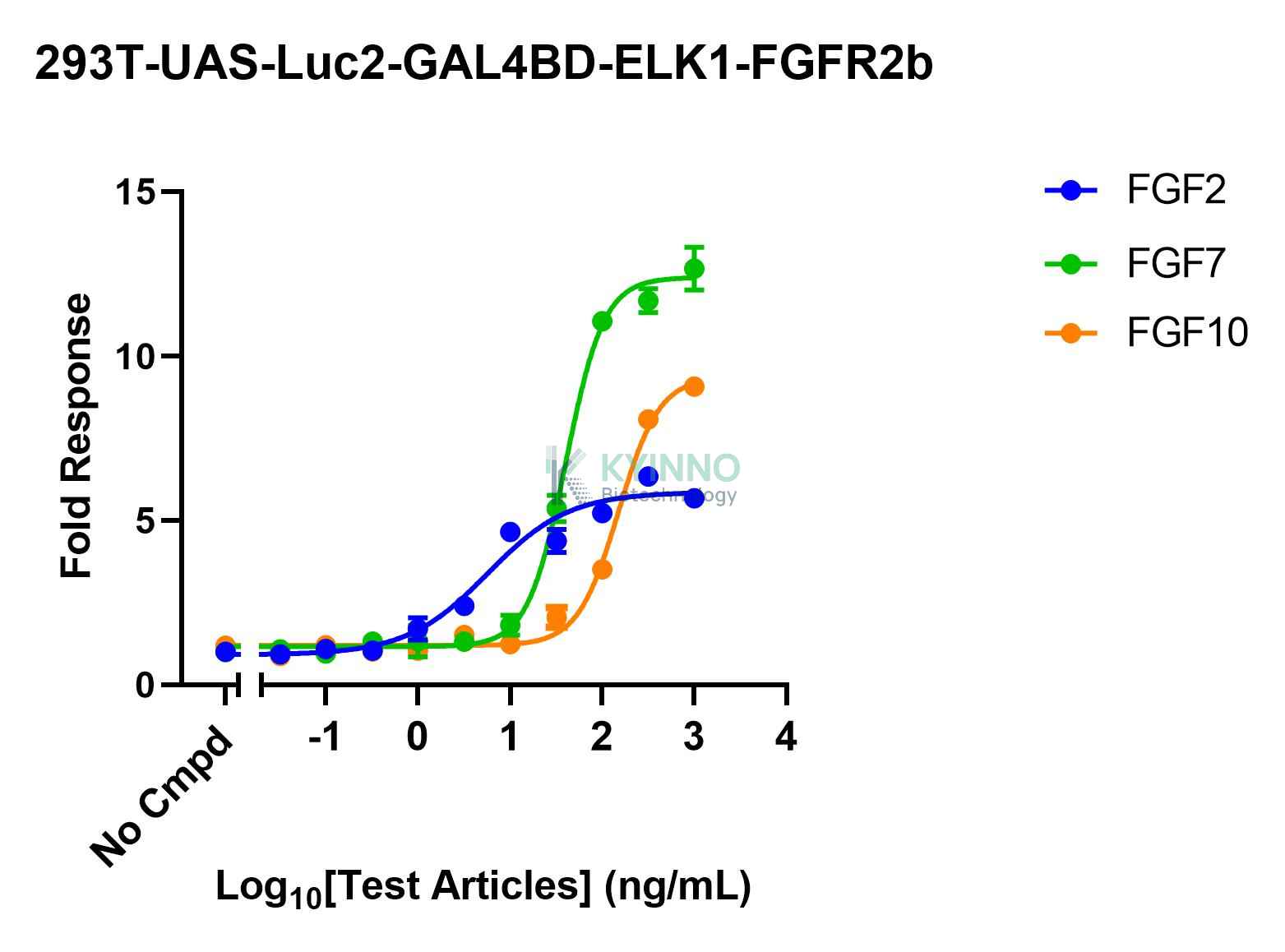
Figure1: 293T-UAS-Luc2-GAL4BD-ELK1-FGFR2b cells were seeded into 96-well plates, treated with FGF2, FGF7 and FGF10 for 16 hours, and then read out using Bright-Glo Detection System.

Cell Resuscitation

  1. Prewarm culture medium (DMEM supplemented with 10% FBS, 75µg/mL Hygromycin B + 0.50μg/mL Puromycin + 10μg/mL Blasticidin S) in a 37°C water bath.
  2. Thaw the frozen vial in a 37°C water bath for 1-2 minutes.
  3. Transfer the vial into biosafety cabinet, and wipe the surface with 70% ethanol.
  4. Unscrew the top of the vial and transfer the cell suspension gently into a sterile centrifuge tube containing 9.0mL complete culture medium.
  5. Spin at ~ 125 × g for 5-7 minutes at room temperature, and discard the supernatant without disturbing the pellet.
  6. Resuspend cell pellet with the appropriate volume of complete medium and transfer the cell suspension into a T25 culture flask.
  7. Incubate the flask at 37°C, 5% CO2 incubator.
  8. Split saturated culture 1 : 10 every 3 days; seed out at about 1 × 10⁵ cells/mL

Cell Freezing

  1. Prepare the freezing medium (70% DMEM + 20% FBS + 10% DMSO) fresh immediately before use.
  2. Keep the freezing medium on ice and label cryovials.
  3. Transfer cells to a sterile, conical centrifuge tube, and count the cells.
  4. Centrifuge the cells at 250×g for 5 minutes at room temperature and carefully aspirate off the medium.
  5. Resuspend the cells at a density of at least 3×10⁶ cells/mL in chilled freezing medium.
  6. Aliquot 1 mL of the cell suspension into each cryovial.
  7. Freeze cells in the CoolCell freezing container overnight in a -80°C freezer.
  8. Transfer vials to liquid nitrogen for long-term storage.

References

1. Byron SA, Chen H, Wortmann A, Loch D, Gartside MG, Dehkhoda F, Blais SP, Neubert TA, Mohammadi M, Pollock PM. The N550K/H mutations in FGFR2 confer differential resistance to PD173074, dovitinib, and ponatinib ATP-competitive inhibitors. Neoplasia. 2013 Aug;15(8):975-88. doi: 10.1593/neo.121106. PMID: 23908597; PMCID: PMC3730048.
2. Rutland P, Pulleyn LJ, Reardon W, Baraitser M, Hayward R, Jones B, Malcolm S, Winter RM, Oldridge M, Slaney SF, et al. Identical mutations in the FGFR2 gene cause both Pfeiffer and Crouzon syndrome phenotypes. Nat Genet. 1995 Feb;9(2):173-6. doi: 10.1038/ng0295-173. PMID: 7719345.
3.Steinberger D, Collmann H, Schmalenberger B, Müller U. A novel mutation (a886g) in exon 5 of FGFR2 in members of a family with Crouzon phenotype and plagiocephaly. J Med Genet. 1997 May;34(5):420-2. doi: 10.1136/jmg.34.5.420. PMID: 9152842; PMCID: PMC1050952.

Please enable JavaScript in your browser to complete this form.