

KC-4139

293T-STAT3-Luc2-IL6R-KO-1C3-Cell-Line

×
Please enable JavaScript in your browser to complete this form.
44898
Home » 293T-STAT3-Luc2-IL6R-KO-1C3-Cell-Line

Background of 293T-STAT3-Luc2-IL6R-KO-1C3-Cell-Line

The IL6R gene, encoding the interleukin-6 receptor (IL-6R), plays a pivotal role in regulating diverse physiological and pathological processes such as inflammatory responses, immune function, hematopoiesis, and the pathogenesis of various diseases. The IL-6 signaling pathway, mediated through both membrane-bound (classic signaling) and soluble receptors (trans-signaling), significantly influences cell proliferation, differentiation, and apoptosis. This extensive involvement implicates IL6R in chronic inflammatory conditions like rheumatoid arthritis, cardiovascular disorders, oncogenesis, and neurodegeneration.

Specifications

Catalog NumberKC-4139
Cell Line Name293T-STAT3-Luc2-IL6R-KO-1C3-Cell-Line
Host Cell Line293T-STAT3-Luc2
DescriptionStable 293T-STAT3-Luc2 clone with human IL6R gene knockout, No.1C3
QuantityTwo vials of frozen cells (≥2-106/vial)
StabilityStable in culture over a minimum of 10 passages
ApplicationDrug screening and biological assays
Freezing MediumDMEM+20% FBS+10% DMSO
Propagation MediumDMEM+10% FBS+150μg/mL Hygromycin B
Selection MarkerN/A
MorphologyEpithelial
SubcultureSplit saturated culture 1:3-1:6 every 2-3 days; seed out at about 1-3 × 10⁵ cells/mL
Incubation37 °C with 5% CO2
StorageLiquid nitrogen immediately upon receiving
Doubling TimeApproximately 30 hours
Mycoplasma StatusNegative
In Vivo ValidationNA

Cell Line Generation

293T-STAT3-Luc2-IL6R-KO-1C3 cell line was generated using the CRISPR method.

Characterization

Figure 1: Characterization of 293T-STAT3-Luc2-IL6R-KO-1C3 cell line stable clone using PCR sequencing.

Figure 2: Characterization of 293T-STAT3-Luc2-IL6R-KO-1C3 cell line stable clone using RT-PCR sequencing.
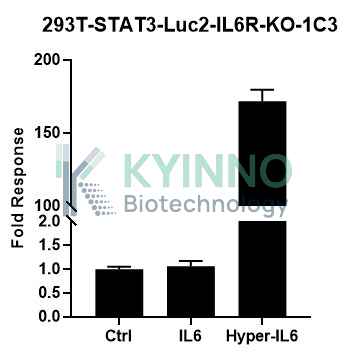
Figure 3: Characterization of the 293T-STAT3-Luc2-IL6R-KO-1C3 cell line stable clone treated by IL6 and Hyper-IL6 for 6h using Bright-Glo System.

Cell Resuscitation

  1. Prewarm culture medium (DMEM+10% FBS+150μg/mL Hygromycin B )in a 37°C water bath.
  2. Thaw the frozen vial in a 37°C water bath for 1-2 minutes.
  3. Transfer the vial into biosafety cabinet, and wipe the surface with 70% ethanol.
  4. Unscrew the top of the vial and transfer the cell suspension gently into a sterile centrifuge tube containing 9.0mL complete culture medium.
  5. Spin at ~ 125 × g for 5-7 minutes at room temperature, and discard the supernatant without disturbing the pellet.
  6. Resuspend cell pellet with the appropriate volume of complete medium and transfer the cell suspension into a T25 culture flask.
  7. Incubate the flask at 37°C, 5% CO2 incubator.
  8. Split saturated culture 1:3-1:6 every 2-3 days; seed out at about 1-3 × 10⁵ cells/mL.

Cell Freezing

  1. Prepare the freezing medium (70% DMEM + 20% FBS + 10% DMSO) fresh immediately before use.
  2. Keep the freezing medium on ice and label cryovials.
  3. Transfer cells to a sterile, conical centrifuge tube, and count the cells.
  4. Centrifuge the cells at 250×g for 5 minutes at room temperature and carefully aspirate off the medium.
  5. Resuspend the cells at a density of at least 3×10⁶ cells/mL in chilled freezing medium.
  6. Aliquot 1 mL of the cell suspension into each cryovial.
  7. Freeze cells in the CoolCell freezing container overnight in a -80°C freezer.
  8. Transfer vials to liquid nitrogen for long-term storage.

References

  1. Hirata, M., & Kishimoto, T. (2010). IL-6 family cytokines: Regulation of immune and inflammatory responses.Current Opinion in Immunology, 22(3), 373-378. https://doi.org/10.1016/j.coi.2010.03.0192.
  2. Scheller, J., Chalaris, A., Schmidt-Arras, D., & Rose-John, S. (2011). The pro- and anti-inflammatory properties of the cytokine interleukin-6.Biochimica et Biophysica Acta (BBA) - Molecular Cell Research, 1813(5), 878-888. https://doi.org/10.1016/j.bbamcr.2011.01.0043.
  3. Nishimoto, N., Kishimoto, T. (2016). Interleukin-6: From basic science to medicine.Immunity, 44(6), 1003-1019. https://doi.org/10.1016/j.immuni.2016.05.009.
Please enable JavaScript in your browser to complete this form.