
KC-4116

Ba/F3-NFκB-Luc2-UNC93B1-D34A-TLR7-Cell-Line

×
Please enable JavaScript in your browser to complete this form.
42137
Home » Ba/F3-NFκB-Luc2-UNC93B1-D34A-TLR7-Cell-Line

Background of Ba/F3-NFκB-Luc2-UNC93B1-D34A-TLR7-Cell-Line

TLR7 is endosomal receptor that plays a key role in innate and adaptive immunity. TLR7 senses single-stranded RNA oligonucleotides containing guanosine- and uridine-rich sequences from RNA viruses, a recognition occuring in the endosomes of plasmacytoid dendritic cells and B cells. Upon binding to agonists, undergoes dimerization that brings TIR domains from the two molecules into direct contact, leading to the recruitment of TIR-containing downstream adapter MYD88 through homotypic interaction. This gene is predominantly expressed in lung, placenta, and spleen, and is phylogenetically related and lies in close proximity to another family member, TLR8, on chromosome X.

Specifications

Catalog NumberKC-4116
Cell Line NameBa/F3-NFκB-Luc2-UNC93B1-D34A-TLR7-Cell-Line
Host Cell LineBa/F3-NFκB-Luc2
DescriptionStable Ba/F3 cell line expressing exogenous luciferase gene under the control of TLR7 signaling pathway
QuantityTwo vials of frozen cells (≥2-106/vial)
StabilityStable in culture over a minimum of 10 passages
ApplicationCell model for monitoring TLR7 signaling pathway
Freezing Medium70% RPMI640+20% FBS+10% DMSO
Propagation MediumRPMI1640 + 10% FBS+8ng/mL mIL-3+1mg/mL Hygromycin B+1μg/mL Puromycin
Selection MarkerHygromycin and Puromycin
MorphologyMostly single, round (some polymorph) cells in suspension
SubcultureSplit saturated culture 1:10 every 3 days; seed out at about 1-3 × 10⁵ cells/mL
Incubation37 °C with 5% CO2
StorageLiquid nitrogen immediately upon receiving
Doubling TimeApproximately 20 hours
Mycoplasma StatusNegative
In Vivo ValidationNA

Cell Line Generation

Ba/F3-NFκB-Luc2-UNC93B1-D34A-TLR7 cell line was generated using lentivirus expressing TLR7 sequence.

Characterization

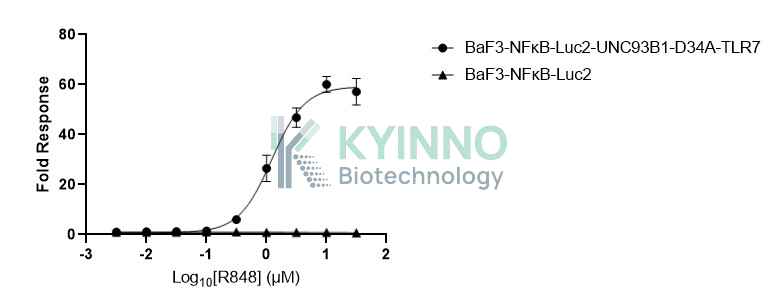
Figure 1. Ba/F3-NFκB-Luc2 and Ba/F3-NFκB-Luc2-UNC93B1-D34A-TLR7 cell line was seeded into the 96-well plate, and treated with R848 at a maximum concentration of 31.6μM for 6 hours, then readout with Bright-Glo system.
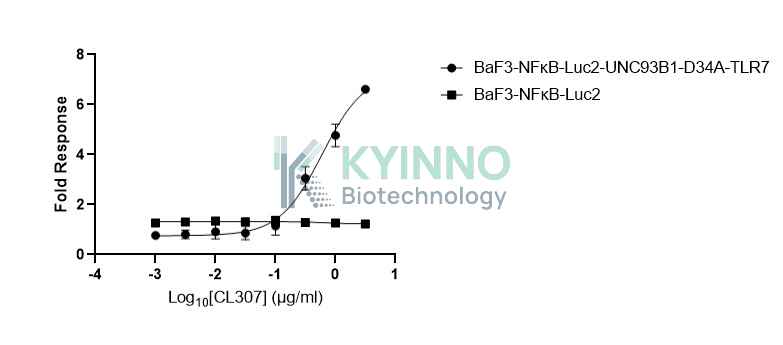
Figure 2. Ba/F3-NFκB-Luc2 and Ba/F3-NFκB-Luc2-UNC93B1-D34A-TLR7 cell line was seeded into the 96-well plate, and treated with CL307 at a maximum concentration of 3.16μg/mL for 6 hours, then readout with Bright-Glo system.

Cell Resuscitation

  1. Prewarm culture medium (RPMI1640 supplemented with 10% FBS, 8ng/ml mIL-3,1mg/ml Hygromycin and 1μg/ml Puromycin)in a 37°C water bath.
  2. Thaw the frozen vial in a 37°C water bath for 1-2 minutes.
  3. Transfer the vial into biosafety cabinet, and wipe the surface with 70% ethanol.
  4. Unscrew the top of the vial and transfer the cell suspension gently into a sterile centrifuge tube containing 9.0mL complete culture medium.
  5. Spin at ~ 125 × g for 5-7 minutes at room temperature, and discard the supernatant without disturbing the pellet.
  6. Resuspend cell pellet with the appropriate volume of complete medium and transfer the cell suspension into a T25 culture flask.
  7. Incubate the flask at 37°C, 5% CO2 incubator.
  8. Split saturated culture 1:10 every 3 days; seed out at about 1-3 × 10⁵ cells/mL.

Cell Freezing

  1. Prepare the freezing medium (70% RPMI1640 + 20% FBS + 10% DMSO) fresh immediately before use.
  2. Keep the freezing medium on ice and label cryovials.
  3. Transfer cells to a sterile, conical centrifuge tube, and count the cells.
  4. Centrifuge the cells at 250×g for 5 minutes at room temperature and carefully aspirate off the medium.
  5. Resuspend the cells at a density of at least 3×10⁶ cells/mL in chilled freezing medium.
  6. Aliquot 1 mL of the cell suspension into each cryovial.v
  7. Freeze cells in the CoolCell freezing container overnight in a -80°C freezer.
  8. Transfer vials to liquid nitrogen for long-term storage

References

  1. Heinz LX, Lee J, Kapoor U, Kartnig F, Sedlyarov V, Papakostas K, César-Razquin A, Essletzbichler P, Goldmann U, Stefanovic A, Bigenzahn JW, Scorzoni S, Pizzagalli MD, Bensimon A, Müller AC, King FJ, Li J, Girardi E, Mbow ML, Whitehurst CE, Rebsamen M, Superti-Furga G. TASL is the SLC15A4-associated adaptor for IRF5 activation by TLR7-9. Nature. 2020 May;581(7808):316-322. doi: 10.1038/s41586-020-2282-0. Epub 2020 May 13. PMID: 32433612; PMCID: PMC7610944.
  2. Diebold SS, Kaisho T, Hemmi H, Akira S, Reis e Sousa C. Innate antiviral responses by means of TLR7-mediated recognition of single-stranded RNA. Science. 2004 Mar 5;303(5663):1529-31. doi: 10.1126/science.1093616. Epub 2004 Feb 19. PMID: 14976261.
  3. Zhang Z, Ohto U, Shibata T, Krayukhina E, Taoka M, Yamauchi Y, Tanji H, Isobe T, Uchiyama S, Miyake K, Shimizu T. Structural Analysis Reveals that Toll-like Receptor 7 Is a Dual Receptor for Guanosine and Single-Stranded RNA. Immunity. 2016 Oct 18;45(4):737-748. doi: 10.1016/j.immuni.2016.09.011. Epub 2016 Oct 11. PMID: 27742543.
Please enable JavaScript in your browser to complete this form.