KC-3521

A431-CCKBR Cell Line

×
Please enable JavaScript in your browser to complete this form.
34458
Home » A431-CCKBR Cell Line

Background of A431-CCKBR Cell Line

The cholecystokinin2 receptor (CCK2 receptor, CCK-B receptor) is a member of the cholecystokinin receptor group of G-protein-coupled receptors that also includes CCK1. This protein is a type B gastrin receptor, which has a high affinity for both sulfated and nonsulfated CCK analogs and is found principally in the central nervous system and the gastrointestinal tract. Expression of gastrin and cholecystokinin 2 (CCK(2)) receptor splice variants (CCK(2)R and CCK(2i4sv)R) are upregulated in human colonic adenomas where they are thought to contribute to tumor growth and progression. They are located primarily in the brain, spinal cord and stomach and influence neurotransmission. Diseases associated with CCKBR include treatment of salt-sensitive hypertension.

Specifications

Catalog NumberKC-3521
Cell Line NameA431-CCKBR Cell Line
Host Cell LineA431
DescriptionStable A431 clone expressing exogenous human CCKBR gene
QuantityTwo vials of frozen cells (≥2-106/vial)
StabilityStable in culture over a minimum of 10 passages
ApplicationDrug screening and biological assays
Freezing Medium70% DMEM + 20% FBS + 10% DMSO
Propagation MediumDMEM + 10% FBS + 1μg/mL Puromycin
Selection MarkerPuromycin
MorphologyEpithelial
SubcultureSplit saturated culture 1:2-1:3 every 2-3 days; seed out at about 1-3 × 10⁵ cells/mL
Incubation37 °C with 5% CO2
StorageLiquid nitrogen immediately upon receiving
Doubling TimeApproximately 80-100 hours
Mycoplasma StatusNegative
In Vivo ValidationNA

Cell Line Generation

A431-CCKBR cell line was generated using a lentiviral vector expressing the human CCKBR sequence.

Characterization

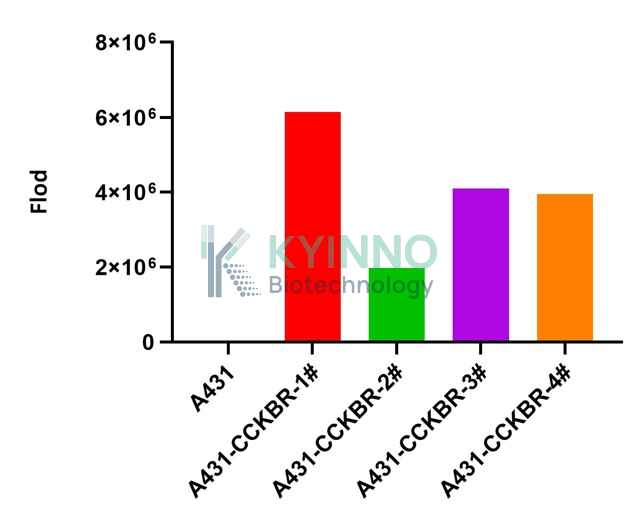
Figure 1: Characterization of human CCKBR overexpression in the A431-CCKBR stable clone using QPCR.

Figure 2: Characterization of human CCKBR in the A431-CCKBR stable clone using PCR sequencing.

Cell Resuscitation

  1. Prewarm culture medium (DMEM supplemented with 10% FBS and 1μg/mL puromycin)in a 37°C water bath.
  2. Thaw the frozen vial in a 37°C water bath for 1-2 minutes.
  3. Transfer the vial into biosafety cabinet, and wipe the surface with 70% ethanol.
  4. Unscrew the top of the vial and transfer the cell suspension gently into a sterile centrifuge tube containing 9.0mL complete culture medium.
  5. Spin at ~ 125 × g for 5-7 minutes at room temperature, and discard the supernatant without disturbing the pellet.
  6. Resuspend cell pellet with the appropriate volume of complete medium and transfer the cell suspension into a T25 culture flask.
  7. Incubate the flask at 37°C, 5% CO2 incubator.
  8. Split saturated culture 1:2-1:3 every 2-3 days; seed out at about 1-3 × 10⁵ cells/mL.

Cell Freezing

  1. Prepare the freezing medium (70% DMEM + 20% FBS + 10% DMSO) fresh immediately before use.
  2. Keep the freezing medium on ice and label cryovials.
  3. Transfer cells to a sterile, conical centrifuge tube, and count the cells.
  4. Centrifuge the cells at 250×g for 5 minutes at room temperature and carefully aspirate off the medium.
  5. Resuspend the cells at a density of at least 3×10⁶ cells/mL in chilled freezing medium.
  6. Aliquot 1 mL of the cell suspension into each cryovial.
  7. Freeze cells in the CoolCell freezing container overnight in a -80°C freezer.
  8. Transfer vials to liquid nitrogen for long-term storage

References

  1. Chao C, Han X, Ives K, Park J, Kolokoltsov AA, Davey RA, Moyer MP, Hellmich MR. CCK2 receptor expression transforms non-tumorigenic human NCM356 colonic epithelial cells into tumor forming cells. Int J Cancer. 2010 Feb 15;126(4):864-75. doi: 10.1002/ijc.24845. PMID: 19697327; PMCID: PMC2798930.
  2. Willard MD, Lajiness ME, Wulur IH, Feng B, Swearingen ML, Uhlik MT, Kinzler KW, Velculescu VE, Sjöblom T, Markowitz SD, Powell SM, Vogelstein B, Barber TD. Somatic mutations in CCK2R alter receptor activity that promote oncogenic phenotypes. Mol Cancer Res. 2012 Jun;10(6):739-49. doi: 10.1158/1541-7786.MCR-11-0483. Epub 2012 Apr 19. PMID: 22516348; PMCID: PMC3904773.
  3. Tan, Z., Pan, K., Sun, M. et al. CCKBR+ cancer cells contribute to the intratumor heterogeneity of gastric cancer and confer sensitivity to FOXO inhibition. Cell Death Differ 31, 1302–1317 (2024).
Please enable JavaScript in your browser to complete this form.