KC-1663

HT1080 mouse CD40 Cell Line

×
Please enable JavaScript in your browser to complete this form.
22569
Home » HT1080 mouse CD40 Cell Line

Background of HT1080 mouse CD40 Cell Line

CD40 is a member of the TNF-receptor superfamily. The encoded protein is a receptor on antigen-presenting cells of the immune system and is essential for mediating a broad variety of immune and inflammatory responses including T cell-dependent immunoglobulin class switching, memory B cell development, and germinal center formation. AT-hook transcription factor AKNA is reported to coordinately regulate the expression of this receptor and its ligand, which may be important for homotypic cell interactions. Adaptor protein TNFR2 interacts with this receptor and serves as a mediator of the signal transduction. The interaction of this receptor and its ligand is found to be necessary for amyloid-beta-induced microglial activation, and thus is thought to be an early event in Alzheimer disease pathogenesis.

Specifications

Catalog NumberKC-1663
Cell Line NameHT1080 mouse CD40 Cell Line
Host Cell LineHT1080
DescriptionStable HT1080 clone expressing exogenous mouse CD40 gene
QuantityTwo vials of frozen cells (≥2-106/vial)
StabilityStable in culture over a minimum of 10 passages
ApplicationDrug screening and biological assays
Freezing Medium70% RPMI 1640 + 20% FBS + 10% DMSO
Propagation MediumRPMI 1640 + 10% FBS + 1μg/mL Puromycin
Selection MarkerPuromycin
MorphologyEpithelial
SubcultureSplit saturated culture 1:4-1:8 every 3 days; seed out at about 1-3 × 10⁵ cells/mL
Incubation37 °C with 5% CO2
StorageLiquid nitrogen immediately upon receiving
Doubling TimeApproximately 48 hours
Mycoplasma StatusNegative
In Vivo ValidationNA

Cell Line Generation

HT1080-mouse-CD40-cell-line was generated using a lentiviral vector expressing the mouse CD40 sequence.

Characterization

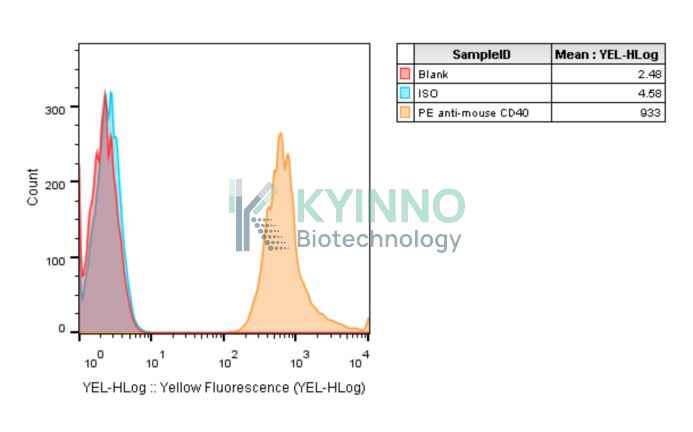
Figure 1: Characterization of mouse CD40 overexpression in the HT1080-mouse-CD40 stable clone using FACS.

Cell Resuscitation

  1. Prewarm culture medium (RPMI 1640 supplemented with 10% FBS and 1μg/mL puromycin)in a 37°C water bath.
  2. Thaw the frozen vial in a 37°C water bath for 1-2 minutes.
  3. Transfer the vial into biosafety cabinet, and wipe the surface with 70% ethanol.
  4. Unscrew the top of the vial and transfer the cell suspension gently into a sterile centrifuge tube containing 9.0mL complete culture medium.
  5. Spin at ~ 125 × g for 5-7 minutes at room temperature, and discard the supernatant without disturbing the pellet.
  6. Resuspend cell pellet with the appropriate volume of complete medium and transfer the cell suspension into a T25 culture flask.
  7. Incubate the flask at 37°C, 5% CO2 incubator.
  8. Split saturated culture 1:4-1:8 every 2-3 days; seed out at about 1-3 × 10⁵ cells/mL.

Cell Freezing

  1. Prepare the freezing medium (70% RPMI 1640 + 20% FBS + 10% DMSO) fresh immediately before use.
  2. Keep the freezing medium on ice and label cryovials.
  3. Transfer cells to a sterile, conical centrifuge tube, and count the cells.
  4. Centrifuge the cells at 250×g for 5 minutes at room temperature and carefully aspirate off the medium.
  5. Resuspend the cells at a density of at least 3×10⁶ cells/mL in chilled freezing medium.
  6. Aliquot 1 mL of the cell suspension into each cryovial.
  7. Freeze cells in the CoolCell freezing container overnight in a -80°C freezer.
  8. Transfer vials to liquid nitrogen for long-term storage.

References

  1. Levin-Piaeda O, Levin N, Pozner S, Danieli A, Weinstein-Marom H, Gross G. The Intracellular Domain of CD40 is a Potent Costimulatory Element in Chimeric Antigen Receptors. J Immunother. 2021 Jul-Aug 01;44(6):209-213. doi: 10.1097/CJI.0000000000000373. PMID: 34010245.
  2. Jiang H, Yuan FF, Wang HN, Liu W, Ye XP, Yang SY, Xie HJ, Yu SS, Ma YR, Zhang LL, Zhao SX, Song HD; China Consortium for the Genetics of Autoimmune Thyroid Disease. Compelling Evidence Linking CD40 Gene With Graves' Disease in the Chinese Han Population. Front Endocrinol (Lausanne). 2021 Nov 18;12:759597. doi: 10.3389/fendo.2021.759597. PMID: 34867801; PMCID: PMC8639283.
Please enable JavaScript in your browser to complete this form.