KC-1977

Jurkat-NFAT-Luc2-CTLA4-TIGIT Cell Line

×
Please enable JavaScript in your browser to complete this form.
23163
Home » Jurkat-NFAT-Luc2-CTLA4-TIGIT Cell Line

Background of Jurkat-NFAT-Luc2-CTLA4-TIGIT Cell Line

TIGHT (also called WUCAM, Vstm3, VSIG9) encodes a member of the PVR (poliovirus receptor) family of immunoglobin proteins. The product of TIGHT is expressed on several classes of T cells including follicular B helper T cells (TFH). The protein has been shown to bind PVR with high affinity; this binding is thought to assist interactions between TFH and dendritic cells to regulate T cell dependent B cell responses. It is inhibitory receptor that plays a role in the modulation of immune responses and suppresses T-cell activation by promoting the generation of mature immunoregulatory dendritic cells. CTLA4 is a member of the immunoglobulin superfamily and encodes a protein which transmits an inhibitory signal to T cells. TIGIT acts in Tregs to augment immunosuppressive function and stability. CTLA-4 is essential for Treg cell function and can mediate suppression by enabling Treg cells to compete with effector T cells for costimulatory signals on APCs and by inducing the production of indoleamine 2,3-dioxygenase (IDO) in APCs, thereby limiting T cell proliferation.

Specifications

Catalog NumberKC-1977
Cell Line NameJurkat-NFAT-Luc2-CTLA4-TIGIT Cell Line
Host Cell LineJurkat-NFAT-Luc2
DescriptionStable Jurkat-NFAT-Luc2 cell line expressing exogenous CTLA4-TIGIT fusion gene.
QuantityTwo vials of frozen cells (≥2-106/vial)
StabilityStable in culture over a minimum of 10 passages
ApplicationDrug screening and biological assays
Freezing Medium70% RPMI1640+20% FBS+10% DMSO
Propagation MediumRPMI1640+10%FBS +300ug/ml Hygromycin B+1ug/ml Puromycin
Selection MarkerPuromycin, Hygromycin B
Morphologylymphoblast
SubcultureSplit saturated culture 1:4-1:5 every 2-3 days; seed out at about 1-3 × 10⁵ cells/mL
Incubation37 °C with 5% CO2
StorageLiquid nitrogen immediately upon receiving
Doubling TimeApproximately 30 hours
Mycoplasma StatusNegative
In Vivo ValidationNA

Cell Line Generation

Jurkat-NFAT-Luc2-CTLA4-TIGIT cell line was generated using a lentiviral vector expressing CTLA4-TIGIT sequence.

Characterization

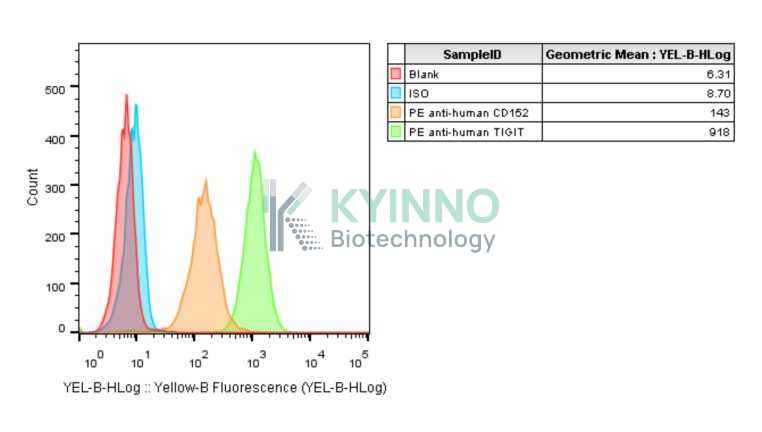
Figure 1. Characterization of human TIGIT overexpression in Jurkat-NFAT-luc2-CTLA4-TIGIT cell line using FCAS.

Cell Resuscitation

  1. Prewarm culture medium (RPMI1640 supplemented with 10%FBS, 300ug/ml Hygromycin B and 1µg/mL Puromycin)in a 37°C water bath.
  2. Thaw the frozen vial in a 37°C water bath for 1-2 minutes.
  3. Transfer the vial into biosafety cabinet, and wipe the surface with 70% ethanol.
  4. Unscrew the top of the vial and transfer the cell suspension gently into a sterile centrifuge tube containing 9.0mL complete culture medium.
  5. Spin at ~ 125 × g for 5-7 minutes at room temperature, and discard the supernatant without disturbing the pellet.
  6. Resuspend cell pellet with the appropriate volume of complete medium and transfer the cell suspension into a T25 culture flask.
  7. Incubate the flask at 37°C, 5% CO2 incubator.
  8. Split saturated culture 1:4-1:5 every 2-3 days; seed out at about 1-3 × 10⁵ cells/mL.

Cell Freezing

  1. Prepare the freezing medium (RPMI1640 + 20% FBS + 10% DMSO) fresh immediately before use.
  2. Keep the freezing medium on ice and label cryovials.
  3. Transfer cells to a sterile, conical centrifuge tube, and count the cells.
  4. Centrifuge the cells at 250×g for 5 minutes at room temperature and carefully aspirate off the medium.
  5. Resuspend the cells at a density of at least 3×10⁶ cells/mL in chilled freezing medium.
  6. Aliquot 1 mL of the cell suspension into each cryovial.
  7. Freeze cells in the CoolCell freezing container overnight in a -80°C freezer.
  8. Transfer vials to liquid nitrogen for long-term storage.

References

1.Yu X, Harden K, Gonzalez LC, Francesco M, Chiang E, Irving B, Tom I, Ivelja S, Refino CJ, Clark H, Eaton D, Grogan JL. The surface protein TIGIT suppresses T cell activation by promoting the generation of mature immunoregulatory dendritic cells. Nat Immunol. 2009 Jan;10(1):48-57. doi: 10.1038/ni.1674. Epub 2008 Nov 16. PMID: 19011627..
2.Chauvin JM, Zarour HM. TIGIT in cancer immunotherapy. J Immunother Cancer. 2020 Sep;8(2):e000957. doi: 10.1136/jitc-2020-000957. PMID: 32900861; PMCID: PMC7477968.
3.Joller N, Lozano E, Burkett PR, Patel B, Xiao S, Zhu C, Xia J, Tan TG, Sefik E, Yajnik V, Sharpe AH, Quintana FJ, Mathis D, Benoist C, Hafler DA, Kuchroo VK. Treg cells expressing the coinhibitory molecule TIGIT selectively inhibit proinflammatory Th1 and Th17 cell responses. Immunity. 2014 Apr 17;40(4):569-81. doi: 10.1016/j.immuni.2014.02.012. PMID: 24745333; PMCID: PMC4070748.
Please enable JavaScript in your browser to complete this form.