KC-1381

293T-cyno-IL4Ra-IL13Ra Cell Line

×
Please enable JavaScript in your browser to complete this form.
22027
Home » 293T-cyno-IL4Ra-IL13Ra Cell Line

Background of 293T-cyno-IL4Ra-IL13Ra Cell Line

This gene encodes the alpha chain of the interleukin-4 receptor, a type I transmembrane protein that can bind interleukin 4 and interleukin 13 to regulate IgE production. The encoded protein also can bind interleukin 4 to promote differentiation of Th2 cells. A soluble form of the encoded protein can be produced by proteolysis of the membrane-bound protein, and this soluble form can inhibit IL4-mediated cell proliferation and IL5 upregulation by T-cells. Allelic variations in this gene have been associated with atopy, a condition that can manifest itself as allergic rhinitis, sinusitus, asthma, or eczema. Polymorphisms in this gene are also associated with resistance to human immunodeficiency virus type-1 infection. Alternate splicing results in multiple transcript variants.

Specifications

Catalog NumberKC-1381
Cell Line Name293T-cyno-IL4Ra-IL13Ra Cell Line
NCBI/UniProt Accession NumberXM_005591517.4 & A0A2K5U4S7
Host Cell Line293T
DescriptionStable 293T cell line expressing exogenous cyno IL4Ra and IL13Ra1 gene
QuantityTwo vials of frozen cells (≥2-106/vial)
StabilityStable in culture over a minimum of 10 passages
ApplicationDrug screening and biological assays
Freezing Medium70% DMEM + 20% FBS + 10% DMSO
Propagation MediumDMEM + 10% FBS + 1μg/mL Puromycin
Selection MarkerPuromycin
MorphologyEpithelial
SubcultureSplit saturated culture 1:4-1:5 every 2-3 days; seed out at about 1-3 × 10⁵ cells/mL
Incubation37 °C with 5% CO2
StorageLiquid nitrogen immediately upon receiving
Doubling TimeApproximately 30 hours
Mycoplasma StatusNegative
In Vivo ValidationNA

Cell Line Generation

293T-cyno-IL4Ra-IL13Ra cell line was generated using a lentiviral vector expressing the cyno IL4R and IL13Ra1 sequence.

Characterization

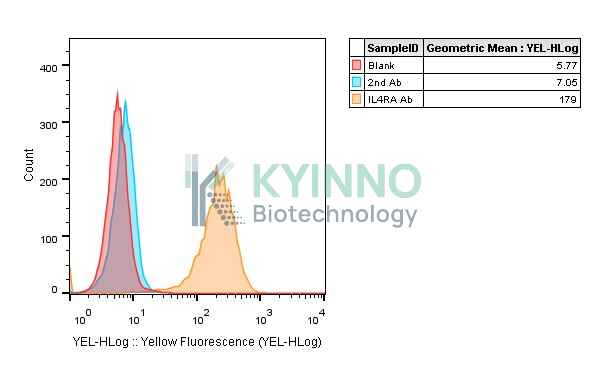
Figure 1: Characterization of cyno IL4R overexpression in the 293T-cyno-IL4Ra-IL13Ra stable clone using FACS.

Cell Resuscitation

  1. Prewarm culture medium (DMEM supplemented with 10% FBS and 1μg/mL Puromycin) in a 37°C water bath.
  2. Thaw the frozen vial in a 37°C water bath for 1-2 minutes.
  3. Transfer the vial into biosafety cabinet, and wipe the surface with 70% ethanol.
  4. Unscrew the top of the vial and transfer the cell suspension gently into a sterile centrifuge tube containing 9.0mL complete culture medium.
  5. Spin at ~ 125 × g for 5-7 minutes at room temperature, and discard the supernatant without disturbing the pellet.
  6. Resuspend cell pellet with the appropriate volume of complete medium and transfer the cell suspension into a T25 culture flask.
  7. Incubate the flask at 37°C, 5% CO2 incubator.
  8. Split saturated culture 1:4-1:5 every 2-3 days; seed out at about 1-3 × 10⁵ cells/mL.

Cell Freezing

  1. Prepare the freezing medium (70% DMEM + 20% FBS + 10% DMSO) fresh immediately before use.
  2. Keep the freezing medium on ice and label cryovials.
  3. Transfer cells to a sterile, conical centrifuge tube, and count the cells.
  4. Centrifuge the cells at 250×g for 5 minutes at room temperature and carefully aspirate off the medium.
  5. Resuspend the cells at a density of at least 3×10⁶ cells/mL in chilled freezing medium.
  6. Aliquot 1 mL of the cell suspension into each cryovial.
  7. Freeze cells in the CoolCell freezing container overnight in a -80°C freezer.
  8. Transfer vials to liquid nitrogen for long-term storage.

References

  1. Huang ZY, Cheng BJ, Cai GJ, Zhang BF. Association of the IL-4R Q576R polymorphism and asthma in the Chinese Han population: a meta-analysis. Genet Mol Res. 2015 Mar 31;14(1):2900-11. doi: 10.4238/2015.March.31.21. PMID: 25867440.
  2. Avlas S, Shani G, Rhone N, Itan M, Dolitzky A, Hazut I, Grisaru-Tal S, Gordon Y, Shoda T, Ballaban A, Ben-Baruch NM, Rochman M, Diesendruck Y, Nahary L, Bitton A, Halpern Z, Benhar I, Varol C, Rothenberg ME, Munitz A. Epithelial cell-expressed type II IL-4 receptor mediates eosinophilic esophagitis. Allergy. 2023 Feb;78(2):464-476. doi: 10.1111/all.15510. Epub 2022 Sep 13. PMID: 36070083; PMCID: PMC9892241.
Please enable JavaScript in your browser to complete this form.