KC-1760

293T-CXCR6 cell line

×
Please enable JavaScript in your browser to complete this form.
22753
Home » 细胞系 » 293T-CXCR6 cell line

Background of 293T-CXCR6 cell line

CXCR6 is the receptor of the chemokine CXCL16 and exists in membrane-bound or soluble forms. CXCR6 is a marker of resident memory T (TRM) cells and plays a role in immune surveillance through interactions with epithelial cells. The interaction between CXCR6 on certain CXCR6+ T cells and CXCL16 expressed on the membrane of a subset of tumor-infiltrating dendritic cells (DCs) called DC3s ideally positions these CXCR6+ T cells to receive proliferation signals from IL-15, which is also presented by DC3s.

Specifications

Catalog NumberKC-1760
Cell Line Name293T-CXCR6 cell line
Host Cell Line293T
DescriptionStable HEK293T clone expressing exogenous CXCR6 gene
QuantityTwo vials of frozen cells (≥2-106/vial)
StabilityStable in culture over a minimum of 10 passages
ApplicationDrug screening and biological assays
Freezing Medium70% DMEM + 20% FBS + 10% DMSO
Propagation MediumDMEM + 10% FBS + 1μg/mL Puromycin
Selection MarkerPuromycin
MorphologyEpithelial
SubcultureSplit saturated culture 1:4-1:8 every 2-3 days; seed out at about 1-3 × 10⁵ cells/mL
Incubation37 °C with 5% CO2
StorageLiquid nitrogen immediately upon receiving
Doubling TimeApproximately 30 hours
Mycoplasma StatusNegative
In Vivo ValidationNA

Cell Line Generation

293T CXCR6 cell line was generated using lentiviral vector expressing CXCR6 sequence

Characterization

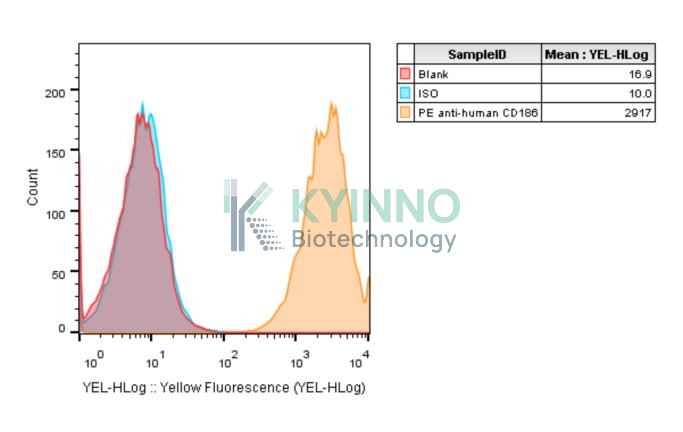
Figure 1: Characterization of CXCR6 overexpression in the 293T CXCR6 stable clone using FACS.

Cell Resuscitation

1. Prewarm culture medium (DMEM supplemented with 10% FBS and 1ug/ml puromycin) in a 37°C water bath. 2. Thaw the frozen vial in a 37°C water bath for 1-2 minutes. 3. Transfer the vial into biosafety cabinet, and wipe the surface with 70% ethanol. 4. Unscrew the top of the vial and transfer the cell suspension gently into a sterile centrifuge tube containing 9.0mL complete culture medium. 5. Spin at ~ 125 x g for 5~7 minutes at room temperature, and discard the supernatant without disturbing the pellet. 6. Resuspend cell pellet with the appropriate volume of complete medium and transfer the cell suspension into a T25 culture flask. 7. Incubate the flask at 37°C, 5% CO2 incubator. 8. Split saturated culture 1:4-1:8 every 2-3 days; seed out at about 1-3 × 10⁵ cells/mL.

Cell Freezing

1. Prepare the freezing medium (70% DMEM + 20% FBS + 10% DMSO) fresh immediately before use. 2. Keep the freezing medium on ice and label cryovials. 3. Transfer cells to a sterile, conical centrifuge tube, and count the cells. 4. Centrifuge the cells at 250 x g for 5 minutes at room temperature and carefully aspirate off the medium. 5. Resuspend the cells at a density of at least 3 x10⁶cells/ml in chilled freezing medium. 6. Aliquot 1 ml of the cell suspension into each cryovial. 7. Freeze cells in the CoolCell freezing container overnight in a −80°C freezer. 8. Transfer vials to liquid nitrogen for long-term storage.

References

1. Su W, Saravia J, Risch I, Rankin S, Guy C, Chapman NM, Shi H, Sun Y, Kc A, Li W, Huang H, Lim SA, Hu H, Wang Y, Liu D, Jiao Y, Chen PC, Soliman H, Yan KK, Zhang J, Vogel P, Liu X, Serrano GE, Beach TG, Yu J, Peng J, Chi H. CXCR6 orchestrates brain CD8+ T cell residency and limits mouse Alzheimer's disease pathology. Nat Immunol. 2023 Oct;24(10):1735-1747. doi:10.1038/s41590-023-01604-z. Epub 2023 Sep 7. PMID: 37679549; PMCID: PMC11102766. 2.Di Pilato M, Kfuri-Rubens R, Pruessmann JN, Ozga AJ, Messemaker M, Cadilha BL, Sivakumar R, Cianciaruso C, Warner RD, Marangoni F, Carrizosa E, Lesch S, Billingsley J, Perez-Ramos D, Zavala F, Rheinbay E, Luster AD, Gerner MY, Kobold S, Pittet MJ, Mempel TR. CXCR6 positions cytotoxic T cells to receive critical survival signals in the tumor microenvironment. Cell. 2021 Aug19;184(17):4512-4530.e22. doi: 10.1016/j.cell.2021.07.015. Epub 2021 Aug 2.PMID: 34343496; PMCID: PMC8719451. 3.Qu J, Wu B, Chen L, Wen Z, Fang L, Zheng J, Shen Q, Heng J, Zhou J, Zhou J. CXCR6-positive circulating mucosal-associated invariant T cells can identify patients with non-small cell lung cancer responding to anti-PD-1 immunotherapy.J Exp Clin Cancer Res. 2024 May 3;43(1):134. doi: 10.1186/s13046-024-03046-3.PMID: 38698468; PMCID: PMC11067263.

Please enable JavaScript in your browser to complete this form.