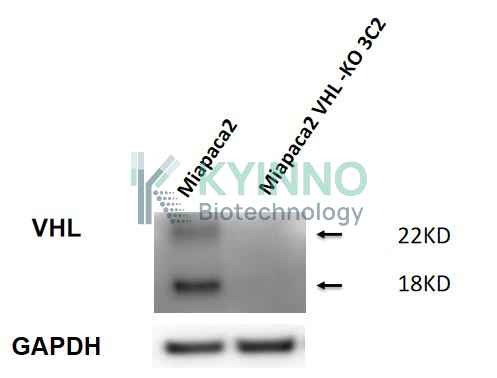
The von Hippel-Lindau (VHL) gene encodes a tumor suppressor protein that functions as the substrate recognition component of an E3 ubiquitin ligase complex. Its primary role is to target hypoxia-inducible factor alpha subunits (HIF-α) for proteasomal degradation under normoxic conditions. Loss-of-function mutations in VHL disrupt this process, leading to constitutive stabilization of HIF-α and subsequent transcriptional upregulation of hypoxia-responsive genes (e.g., VEGF, PDGF, GLUT1). This drives angiogenesis, cell proliferation, and metabolic adaptation, underpinning the pathogenesis of VHL disease—an autosomal dominant familial cancer syndrome characterized by hemangioblastomas, renal cell carcinomas, and pheochromocytomas. Somatic VHL inactivation is also a hallmark of the majority of sporadic clear cell renal cell carcinomas (ccRCC). Consequently, the VHL-HIF pathway is a major therapeutic target, with drugs inhibiting VEGF signaling (e.g., sunitinib, pazopanib) representing the cornerstone of treatment for advanced RCC. Research continues to explore HIF-2α-specific inhibitors (e.g., belzutifan) and combination strategies.