KC-2489

CHOK1-IL4Ra-High Cell Line

×
Please enable JavaScript in your browser to complete this form.
24164
Home » CHOK1-IL4Ra-High Cell Line

Background of CHOK1-IL4Ra-High Cell Line

Interleukin 4 Receptor (IL4R) also known as CD124, IL4Rα and BSF receptor, is a type I cytokine receptor produced by activated Th2 cells and mast cells, and plays an important role in Th2-­biased immune responses, alternative macrophage activation, mucosal immunity, allergic inflammation, tumor progression, and atherogenesis. Its monoclonal antibody, Dupilumab, is already approved for use in various allergic diseases.
Interleukin-2 receptor subunit gamma (IL2RG), also known as cytokine receptor common subunit gamma, CD antigen CD132, gammaC, p64, which belongs to the type I cytokine receptor family or type 5 subfamily. IL2RG is located on the surface of immature blood-forming cells in bone marrow. Defects in IL2RG are the cause of severe combined immunodeficiency X-linked T-cell-negative/B-cell-positive/NK-cell-negative (XSCID). Mb-107, IAP-0971, BNZ-1, Thor-707 and other drugs have entered phase II clinical trials.

Specifications

Catalog NumberKC-2489
Cell Line NameCHOK1-IL4Ra-High Cell Line
NCBI/UniProt Accession NumberNM_000418.4
Clone Number3#
Host Cell LineCHOK1
DescriptionStable CHOK1 cell line high expressing exogenous IL4Ra-IL2RG gene
QuantityTwo vials of frozen cells (≥2-106/vial)
StabilityStable in culture over a minimum of 10 passages
ApplicationDrug screening and biological assays
Freezing Medium70% RPMI1640 + 20% FBS + 10% DMSO
Propagation MediumRPMI1640 + 10% FBS + 10μg/mL Puromycin
Selection MarkerPuromycin
MorphologyEpithelial
SubcultureSplit saturated culture 1:4-1:8 every 2-3 days; seed out at about 1-3 × 10⁵ cells/mL
Incubation37 °C with 5% CO2
StorageLiquid nitrogen immediately upon receiving
Doubling TimeApproximately 30 hours
Mycoplasma StatusNegative
In Vivo ValidationNA

Cell Line Generation

CHOK1-IL4Ra cell line was generated using a lentiviral vector expressing the IL4Ra-IL2RG sequence.

Characterization

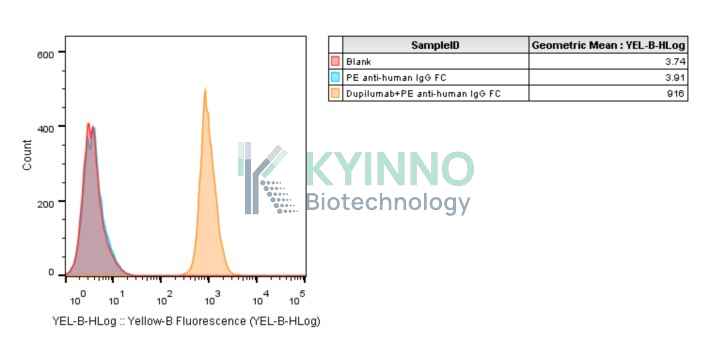
Figure : Characterization of IL4Ra overexpression in CHOK1 stable clone using FACS.

Cell Resuscitation

  1. Prewarm culture medium (RPMI1640 supplemented with 10% FBS and 10μg/mL Puromycin) in a 37°C water bath.
  2. Thaw the frozen vial in a 37°C water bath for 1-2 minutes.
  3. Transfer the vial into biosafety cabinet, and wipe the surface with 70% ethanol.
  4. Unscrew the top of the vial and transfer the cell suspension gently into a sterile centrifuge tube containing 9.0mL complete culture medium.
  5. Spin at ~ 125 × g for 5-7 minutes at room temperature, and discard the supernatant without disturbing the pellet.
  6. Resuspend cell pellet with the appropriate volume of complete medium and transfer the cell suspension into a T25 culture flask.
  7. Incubate the flask at 37°C, 5% CO2 incubator.
  8. Split saturated culture 1:4-1:8 every 2-3 days; seed out at about 1-3 × 10⁵ cells/mL.

Cell Freezing

  1. Prepare the freezing medium (70% RPMI1640 + 20% FBS + 10% DMSO) fresh immediately before use.
  2. Keep the freezing medium on ice and label cryovials.
  3. Transfer cells to a sterile, conical centrifuge tube, and count the cells.
  4. Centrifuge the cells at 250×g for 5 minutes at room temperature and carefully aspirate off the medium.
  5. Resuspend the cells at a density of at least 3×10⁶ cells/mL in chilled freezing medium.
  6. Aliquot 1 mL of the cell suspension into each cryovial.
  7. Freeze cells in the CoolCell freezing container overnight in a -80°C freezer.
  8. Transfer vials to liquid nitrogen for long-term storage.

References

  1. Harb H, Chatila TA. Mechanisms of Dupilumab. Clin Exp Allergy. 2020 Jan;50(1):5-14. doi: 10.1111/cea.13491. Epub 2019 Sep 30. PMID: 31505066; PMCID: PMC6930967.
  2. Matsunaga K, Katoh N, Fujieda S, Izuhara K, Oishi K. Dupilumab: Basic aspects and applications to allergic diseases. Allergol Int. 2020 Apr;69(2):187-196. Doi: 10.1016/j.alit.2020.01.002. Epub 2020 Jan 30. PMID: 32007360.
  3. Wang Z, Cormier RT. Golden Syrian Hamster Models for Cancer Research. Cells. 2022 Aug 3;11(15):2395. doi: 10.3390/cells11152395. PMID: 35954238; PMCID: PMC9368453.
Please enable JavaScript in your browser to complete this form.