
KC-3474

293T-UAS-Luc2-GAL4BD-ELK1-KLB Cell Line

×
Please enable JavaScript in your browser to complete this form.
34416
Home » 细胞系 » 293T-UAS-Luc2-GAL4BD-ELK1-KLB Cell Line

Background of 293T-UAS-Luc2-GAL4BD-ELK1-KLB Cell Line

Beta klotho (KLB) is a fundamental component in fibroblast growth factor receptor (FGFR) signaling as it serves as an obligatory coreceptor for the endocrine hormones fibroblast growth factor 19 (FGF19) and fibroblast growth factor 21 (FGF21). Through the development of FGF19 and FGF21 mimetics, KLB has emerged as a promising drug target for treating various metabolic diseases, such as type 2 diabetes (T2D), non-alcoholic fatty liver disease (NAFLD), and cardiovascular disease. As a non-canonical fibroblast growth factor, fibroblast growth factor 21 (FGF21) functions as an endocrine hormone that signals to distinct targets throughout the body. Interest in therapeutic applications for FGF21 was initially sparked by its ability to correct metabolic dysfunction and decrease body weight associated with diabetes and obesity.

Specifications

Catalog NumberKC-3474
Cell Line Name293T-UAS-Luc2-GAL4BD-ELK1-KLB Cell Line
Host Cell Line293T-UAS-Luc2
DescriptionStable 293T-UAS-Luc2 cell line expressing exogenous GAL4BD-ELK1 fusion sequence and KLB gene.
QuantityTwo vials of frozen cells (≥2-106/vial)
StabilityStable in culture over a minimum of 10 passages
ApplicationDrug screening and biological assays
Freezing Medium70% DMEM+20% FBS+10% DMSO
Propagation MediumDMEM+10%FBS+1µg/mL Puromycin+150µg/mL Hygromycin B
Selection MarkerPuromycin, Hygromycin B
MorphologyEpithelial
SubcultureSplit saturated culture 1:4-1:6 every 2-3 days; seed out at about 1-3 × 10⁵ cells/mL
Incubation37 °C with 5% CO2
StorageLiquid nitrogen immediately upon receiving
Doubling TimeApproximately 30 hours
Mycoplasma StatusNegative
In Vivo ValidationNA

Cell Line Generation

293T-UAS-Luc2-GAL4BD-ELK1-KLB cell line was generated using a lentiviral vector expressing GAL4BD-ELK1 fusion sequence and KLB sequence.

Characterization

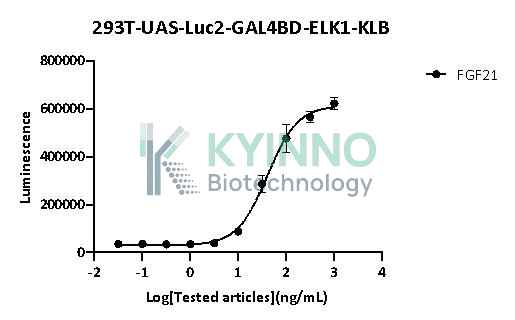
Figure 1. 293T-UAS-Luc2-GAL4BD-ELK1-KLB cells were seeded into a 96-well plate, and treated with FGF21 of 10 concentrations, which were 1μg/ml as the highest and 3.16-fold serial gradient dilution for the other 9 concentrations. Incubate cells at 37°C in a CO2 incubator for 16 hours and detect the expression of luciferase using Bright-lite™ Luciferase Assay system.
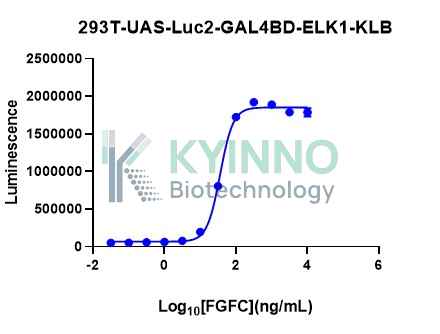
Figure 2. 293T-UAS-Luc2-GAL4BD-ELK1-KLB cells were seeded into a 96-well plate, serum starvation for 6 hours and treated with FGFC in different concentrations for 16 hours, and then read out using Bright-lite™ Luciferase Assay system.

Cell Resuscitation

1. Prewarm culture medium (DMEM supplemented with 10%FBS, 150µg/mL Hygromycin B and 1µg/mL Puromycin)in a 37°C water bath.
2. Thaw the frozen vial in a 37°C water bath for 1-2 minutes.
3. Transfer the vial into biosafety cabinet, and wipe the surface with 70% ethanol.
4. Unscrew the top of the vial and transfer the cell suspension gently into a sterile centrifuge tube containing 9.0mL complete culture medium.
5. Spin at ~ 125 × g for 5-7 minutes at room temperature, and discard the supernatant without disturbing the pellet.
6. Resuspend cell pellet with the appropriate volume of complete medium and transfer the cell suspension into a T25 culture flask.
7. Incubate the flask at 37°C, 5% CO2 incubator.
8. Split saturated culture 1:4-1:6 every 2-3 days; seed out at about 1-3 × 10⁵ cells/mL.

Cell Freezing

1. Prepare the freezing medium (DMEM + 20% FBS + 10% DMSO) fresh immediately before use.
2. Keep the freezing medium on ice and label cryovials.
3. Transfer cells to a sterile, conical centrifuge tube, and count the cells.
4. Centrifuge the cells at 250×g for 5 minutes at room temperature and carefully aspirate off the medium.
5. Resuspend the cells at a density of at least 3×10⁶ cells/mL in chilled freezing medium.
6. Aliquot 1 mL of the cell suspension into each cryovial.
7. Freeze cells in the CoolCell freezing container overnight in a -80°C freezer.
8. Transfer vials to liquid nitrogen for long-term storage.

References

1.Aaldijk AS, Verzijl CRC, Jonker JW, Struik D. Biological and pharmacological functions of the FGF19- and FGF21-coreceptor beta klotho. Front Endocrinol (Lausanne). 2023 May 16; 14: 1150222. doi: 10.3389/fendo.2023.1150222.
2.Flippo KH, Potthoff MJ. Metabolic Messengers: FGF21. Nat Metab. 2021 Mar;3(3):309-317. doi: 10.1038/s42255-021-00354-2.
Please enable JavaScript in your browser to complete this form.