Background of CHOK1-CRE-Luc2-RAMP3-CALCRL Cell Line
Cyclic adenosine monophosphate (cAMP) plays a key role in signal transduction pathways as a second messenger. cAMP can regulate the transcription of various target genes, mainly through protein kinase A (PKA) and its downstream effectors such as cAMP-responsive element binding protein (CREB).RAMPs are type I transmembrane proteins with an extracellular N terminus and a cytoplasmic C terminus. It is required to transport calcitonin-receptor-like receptor (CRLR) to the plasma membrane which a receptor with seven transmembrane domains, can function as either a calcitonin-gene-related peptide (CGRP) receptor or an adrenomedullin receptor. CALCRL enables adrenomedullin binding activity and calcitonin gene-related peptide receptor activity. It located in several cellular components, including endoplasmic reticulum; endosome; and lysosome. Three GPCR accessory proteins called receptor activity-modifying proteins (RAMPs) modify the ligand binding affinity of the receptor such that the CLR/RAMP1 heterodimer preferably binds CGRP, while CLR/RAMP2 and CLR/RAMP3 have a stronger affinity for AM.
Specifications
Catalog Number
KC-3701
Cell Line Name
CHOK1-CRE-Luc2-RAMP3-CALCRL Cell Line
Clone Number
14#
Host Cell Line
CHOK1-CRE-Luc2
Description
Stable CHOK1 cell line expressing exogenous luciferase gene under the control of CALCRL signaling pathway.
Quantity
One vial of frozen cells (≥2-106/vial)
Stability
Stable in culture over a minimum of 10 passages
Application
Drug screening and biological assays
Freezing Medium
70% RPMI1640+20% FBS+10% DMSO
Propagation Medium
RPMI1640+10%FBS+10µg/mL Puromycin+750µg/mL Hygromycin B
Selection Marker
Puromycin, Hygromycin B
Morphology
Epithelial
Subculture
Split saturated culture 1:4-1:8 every 2-3 days; seed out at about 1-3 × 10⁵ cells/mL
Incubation
37 °C with 5% CO2
Storage
Liquid nitrogen immediately upon receiving
Doubling Time
Approximately 30 hours
Mycoplasma Status
Negative
In Vivo Validation
NA
Cell Line Generation
CHOK1 cell line was generated using lentivirus expressing CALCRL sequence.
Characterization
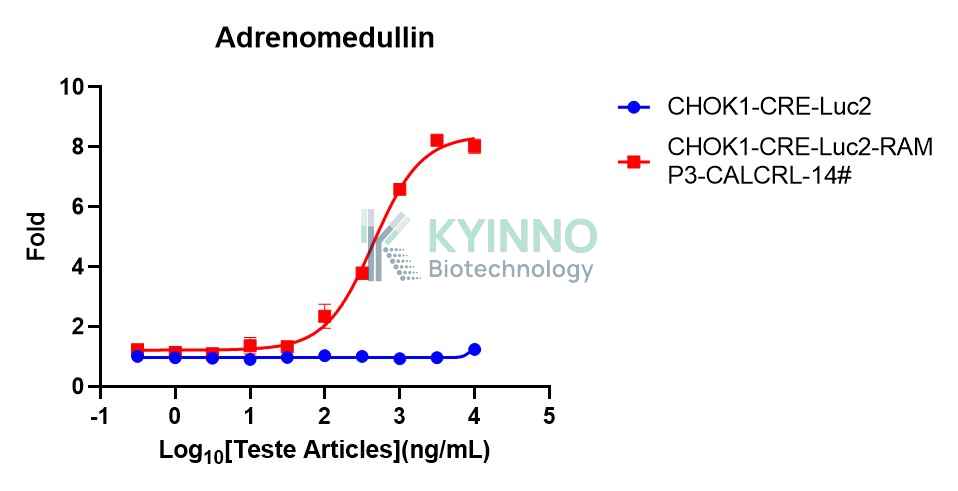
Figure 1. CHOK1-CRE-Luc2-RAMP3-CALCRL and CHOK1-CRE-Luc2 cell line were seeded into the 96-well plate, and treated with Adrenomedullin at a maximum concentration of 10µg/mL for 16 hours, then readout with Bright-Glo system.
Cell Resuscitation
1. Prewarm culture medium (RPMI1640 supplemented with 10%FBS, 750 µg/mL Hygromycin B and 10 µg/mL Puromycin)in a 37°C water bath.
2. Thaw the frozen vial in a 37°C water bath for 1-2 minutes.
3. Transfer the vial into biosafety cabinet, and wipe the surface with 70% ethanol.
4. Unscrew the top of the vial and transfer the cell suspension gently into a sterile centrifuge tube containing 9.0mL complete culture medium.
5. Spin at ~ 125 × g for 5-7 minutes at room temperature, and discard the supernatant without disturbing the pellet.
6. Resuspend cell pellet with the appropriate volume of complete medium and transfer the cell suspension into a T25 culture flask.
7. Incubate the flask at 37°C, 5% CO2 incubator.
8. Split saturated culture 1:4-1:8 every 2-3 days; seed out at about 1-3 × 10⁵ cells/mL.
Cell Freezing
1. Prepare the freezing medium (70% RPMI1640 + 20% FBS + 10% DMSO) fresh immediately before use.
2. Keep the freezing medium on ice and label cryovials.
3. Transfer cells to a sterile, conical centrifuge tube, and count the cells.
4. Centrifuge the cells at 250×g for 5 minutes at room temperature and carefully aspirate off the medium.
5. Resuspend the cells at a density of at least 3×10⁶ cells/mL in chilled freezing medium.
6. Aliquot 1 mL of the cell suspension into each cryovial.
7. Freeze cells in the CoolCell freezing container overnight in a -80°C freezer.
8. Transfer vials to liquid nitrogen for long-term storage.
References
1.Kim N, Shin S, Bae SW. cAMP Biosensors Based on Genetically Encoded Fluorescent/Luminescent Proteins. Biosensors (Basel), 2021.
2.Pawlak JB, Wetzel-Strong SE, Dunn MK, Caron KM. Cardiovascular effects of exogenous adrenomedullin and CGRP in Ramp and Calcrl deficient mice. Peptides. 2017 Feb;88:1-7. doi: 10.1016/j.peptides.2016.12.002. Epub 2016 Dec 8. PMID: 27940069; PMCID: PMC5706544.
Use License Agreement
Research Use Only.
Not for use in diagnostic procedures or therapeutic applications.
Redistribution of the cell line or its derivatives is prohibited without prior written permission from Kyinno Biotechnology.