KC-3836

293T-EGFR-cMet-KO-cyno-EGFR-Cell-Line

×
Please enable JavaScript in your browser to complete this form.
58310
Home » 293T-EGFR-cMet-KO-cyno-EGFR-Cell-Line

Background of 293T-EGFR-cMet-KO-cyno-EGFR-Cell-Line

EGFR (Epidermal Growth Factor Receptor) is a Protein Coding gene. Diseases associated with EGFR include Neonatal Nephrocutaneous Inflammatory Syndrome and Lung Cancer. Among its related pathways are Apoptotic Pathways in Synovial Fibroblasts and Signaling by EGFR in Cancer.MET (MET Proto-Oncogene, Receptor Tyrosine Kinase) is a Protein Coding gene. Diseases associated with MET include Renal Cell Carcinoma, Papillary, 1 and Arthrogryposis, Distal, Type 11. Among its related pathways are Apoptotic Pathways in Synovial Fibroblasts and GPCR Pathway. Gene Ontology (GO) annotations related to this gene include transferase activity, transferring phosphorus-containing groups and protein tyrosine kinase activity.

Specifications

Catalog NumberKC-3836
Cell Line Name293T-EGFR-cMet-KO-cyno-EGFR-Cell-Line
Clone Number293T
Host Cell Line18#
DescriptionStable 293T-EGFR-cMet-KO clone expressing exogenous cyno-EGFR gene
QuantityTwo vials of frozen cells (≥2-106/vial)
StabilityStable in culture over a minimum of 10 passages
ApplicationDrug screening and biological assays
Freezing Medium70% DMEM + 20% FBS + 10% DMSO
Propagation MediumDMEM + 10% FBS + 1μg/mL Puromycin
Selection MarkerPuromycin
MorphologyEpithelial
SubcultureSplit saturated culture 1:4-1:8 every 2-3 days; seed out at about 1-3 × 10⁵ cells/mL
Incubation37 °C with 5% CO2
StorageLiquid nitrogen immediately upon receiving
Doubling TimeApproximately 30 hours
Mycoplasma StatusNegative

Cell Line Generation

293T-EGFR-cMet-KO-cyno-EGFR-cell-line was generated using a lentiviral vector expressing the cyno-EGFR sequence.

Characterization

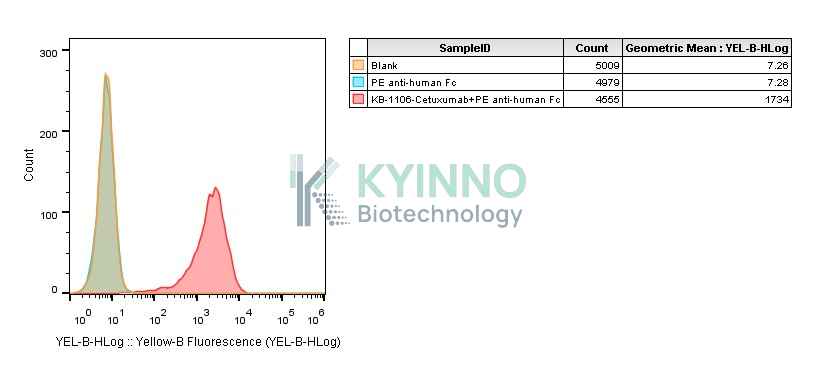
Figure 1: Characterization of cyno-EGFR overexpression in the 293T-EGFR-cMet-KO-cyno-EGFR stable clone using FACS.

Figure 2: Characterization of cyno-EGFR in the 293T-EGFR-cMet-KO-cyno-EGFR stable clone using PCR sequencing.

Cell Resuscitation

1. Prewarm culture medium (DMEM supplemented with 10% FBS and 1μg/mL puromycin)in a 37°C water bath.
2. Thaw the frozen vial in a 37°C water bath for 1-2 minutes.
3. Transfer the vial into biosafety cabinet, and wipe the surface with 70% ethanol.
4. Unscrew the top of the vial and transfer the cell suspension gently into a sterile centrifuge tube containing 9.0mL complete culture medium.
5. Spin at ~ 125 × g for 5-7 minutes at room temperature, and discard the supernatant without disturbing the pellet.
6. Resuspend cell pellet with the appropriate volume of complete medium and transfer the cell suspension into a T25 culture flask.
7. Incubate the flask at 37°C, 5% CO2 incubator.
8. Split saturated culture 1:4-1:8 every 2-3 days; seed out at about 1-3 × 10⁵ cells/mL.

Cell Freezing

1. Prepare the freezing medium (70% DMEM + 20% FBS + 10% DMSO) fresh immediately before use.
2. Keep the freezing medium on ice and label cryovials.
3. Transfer cells to a sterile, conical centrifuge tube, and count the cells.
4. Centrifuge the cells at 250×g for 5 minutes at room temperature and carefully aspirate off the medium.
5. Resuspend the cells at a density of at least 3×10⁶ cells/mL in chilled freezing medium.
6. Aliquot 1 mL of the cell suspension into each cryovial.
7. Freeze cells in the CoolCell freezing container overnight in a -80°C freezer.
8. Transfer vials to liquid nitrogen for long-term storage.

References

1. Campbell P, Morton PE, Takeichi T, Salam A, Roberts N, Proudfoot LE, Mellerio JE, Aminu K, Wellington C, Patil SN, Akiyama M, Liu L, McMillan JR, Aristodemou S, Ishida-Yamamoto A, Abdul-Wahab A, Petrof G, Fong K, Harnchoowong S, Stone KL, Harper JI, Irwin McLean WH, Simpson MA, Parsons M, McGrath JA. Epithelial inflammation resulting from an inherited loss-of-function mutation in EGFR. J Invest Dermatol. 2014 Oct;134(10):2570-2578. doi: 10.1038/jid.2014.164. Epub 2014 Apr 1. PMID: 24691054; PMCID: PMC4090136.
2.Kobayashi S, Boggon TJ, Dayaram T, Jänne PA, Kocher O, Meyerson M, Johnson BE, Eck MJ, Tenen DG, Halmos B. EGFR mutation and resistance of non-small-cell lung cancer to gefitinib. N Engl J Med. 2005 Feb 24;352(8):786-92. doi: 10.1056/NEJMoa044238. PMID: 15728811.
3.Schmidt L, Duh FM, Chen F, Kishida T, Glenn G, Choyke P, Scherer SW, Zhuang Z, Lubensky I, Dean M, Allikmets R, Chidambaram A, Bergerheim UR, Feltis JT, Casadevall C, Zamarron A, Bernues M, Richard S, Lips CJ, Walther MM, Tsui LC, Geil L, Orcutt ML, Stackhouse T, Lipan J, Slife L, Brauch H, Decker J, Niehans G, Hughson MD, Moch H, Storkel S, Lerman MI, Linehan WM, Zbar B. Germline and somatic mutations in the tyrosine kinase domain of the MET proto-oncogene in papillary renal carcinomas. Nat Genet. 1997 May;16(1):68-73. doi: 10.1038/ng0597-68. PMID: 9140397.
4. Zhou H, Lian C, Wang T, Yang X, Xu C, Su D, Zheng S, Huang X, Liao Z, Zhou T, Qiu X, Chen Y, Gao B, Li Y, Wang X, You G, Fu Q, Gurnett C, Huang D, Su P. MET mutation causes muscular dysplasia and arthrogryposis. EMBO Mol Med. 2019 Mar;11(3):e9709. doi: 10.15252/emmm.201809709. PMID: 30777867; PMCID: PMC6404111.

Please enable JavaScript in your browser to complete this form.