KC-5476

HT1080-EPHA2-Cell-Line

×
Please enable JavaScript in your browser to complete this form.
58368
Home » HT1080-EPHA2-Cell-Line

Background of HT1080-EPHA2-Cell-Line

EPHA2 belongs to the ephrin receptor subfamily of the protein-tyrosine kinase family. EPH and EPH-related receptors have been implicated in mediating developmental events, particularly in the nervous system. Receptors in the EPH subfamily typically have a single kinase domain and an extracellular region containing a Cys-rich domain and 2 fibronectin type III repeats. The ephrin receptors are divided into two groups based on the similarity of their extracellular domain sequences and their affinities for binding ephrin-A and ephrin-B ligands. This gene encodes a protein that binds ephrin-A ligands. Mutations in this gene are the cause of certain genetically-related cataract disorders.

Specifications

Catalog NumberKC-5476
Cell Line NameHT1080-EPHA2-Cell-Line
Clone Number1-17#
Host Cell LineHT1080
DescriptionStable HT1080 clone expressing exogenous EPHA2 gene
QuantityTwo vials of frozen cells (≥2-106/vial)
StabilityStable in culture over a minimum of 10 passages
ApplicationDrug screening and biological assays
Freezing Medium70% DMEM + 20% FBS + 10% DMSO
Propagation MediumDMEM + 10% FBS + 1μg/mL Puromycin
Selection MarkerPuromycin
MorphologyFibroblast
SubcultureSplit saturated culture 1:2-1:4 every 2-3 days; seed out at about 1-3 × 10⁵ cells/mL
Incubation37 °C with 5% CO2
StorageLiquid nitrogen immediately upon receiving
Doubling TimeApproximately 30 hours
Mycoplasma StatusNegative

Cell Line Generation

HT1080-EPHA2-cell-line was generated using a lentiviral vector expressing the EPHA2 sequence.

Characterization

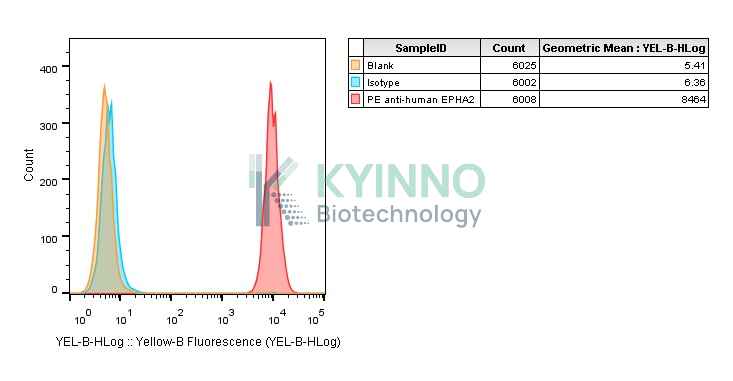
Figure 1: Characterization of EPHA2 overexpression in the HT1080-EPHA2 stable clone using FACS.

Figure 2: Characterization of EPHA2 in the HT1080-EPHA2 stable clone using PCR sequencing.

Cell Resuscitation

1. Prewarm culture medium (DMEM supplemented with 10% FBS and 1μg/mL puromycin)in a 37°C water bath.
2. Thaw the frozen vial in a 37°C water bath for 1-2 minutes.
3. Transfer the vial into biosafety cabinet, and wipe the surface with 70% ethanol.
4. Unscrew the top of the vial and transfer the cell suspension gently into a sterile centrifuge tube containing 9.0mL complete culture medium.
5. Spin at ~ 125 × g for 5-7 minutes at room temperature, and discard the supernatant without disturbing the pellet.
6. Resuspend cell pellet with the appropriate volume of complete medium and transfer the cell suspension into a T25 culture flask.
7. Incubate the flask at 37°C, 5% CO2 incubator.
8. Split saturated culture 1:2-1:4 every 2-3 days; seed out at about 1-3 × 10⁵ cells/mL.

Cell Freezing

1. Prepare the freezing medium (70% DMEM + 20% FBS + 10% DMSO) fresh immediately before use.
2. Keep the freezing medium on ice and label cryovials.
3. Transfer cells to a sterile, conical centrifuge tube, and count the cells.
4. Centrifuge the cells at 250×g for 5 minutes at room temperature and carefully aspirate off the medium.
5. Resuspend the cells at a density of at least 3×10⁶ cells/mL in chilled freezing medium.
6. Aliquot 1 mL of the cell suspension into each cryovial.
7. Freeze cells in the CoolCell freezing container overnight in a -80°C freezer.
8. Transfer vials to liquid nitrogen for long-term storage.

References

1.Zhou N, Zhao WD, Liu DX, Liang Y, Fang WG, Li B, Chen YH. Inactivation of EphA2 promotes tight junction formation and impairs angiogenesis in brain endothelial cells. Microvasc Res. 2011 Sep;82(2):113-21. doi: 10.1016/j.mvr.2011.06.005. Epub 2011 Jun 25. PMID: 21726568.
2.Sheng Y, Wei J, Zhang Y, Gao X, Wang Z, Yang J, Yan S, Zhu Y, Zhang Z, Xu D, Wang C, Zheng Y, Dong Q, Qin L. Mutated EPHA2 is a target for combating lymphatic metastasis in intrahepatic cholangiocarcinoma. Int J Cancer. 2019 May 15;144(10):2440-2452. doi: 10.1002/ijc.31979. Epub 2019 Jan 11. PMID: 30412282.

Please enable JavaScript in your browser to complete this form.