KC-5778

PC9-EGFR-Del19-T790M-C797S-KI Cell Line

×
Please enable JavaScript in your browser to complete this form.
61033
Home » PC9-EGFR-Del19-T790M-C797S-KI Cell Line

Background of PC9-EGFR-Del19-T790M-C797S-KI Cell Line

The EGFR-T790M-C797S mutation cascade epitomizes the ongoing battle against acquired resistance in EGFR-mutant non-small cell lung cancer (NSCLC). Primary activating EGFR mutations (e.g., exon 19 deletions, L858R) are effectively targeted by first- and second-generation tyrosine kinase inhibitors (TKIs). However, the emergence of the T790M ‘gatekeeper’ mutation in exon 20, which increases ATP affinity and sterically hinders drug binding, is the predominant resistance mechanism. The advent of third-generation, covalent EGFR TKIs like osimertinib revolutionized treatment by selectively inhibiting T790M-positive cells while sparing wild-type EGFR.
Despite high efficacy, resistance invariably develops, with the EGFR C797S mutation being a key on-target driver. This tertiary mutation abolishes the covalent binding of osimertinib to the kinase domain by substituting the critical cysteine residue with serine. When C797S occurs in cis with T790M (on the same allele), it confers resistance to all existing ATP-competitive EGFR TKIs, creating a formidable clinical challenge. This sequential evolution highlights the remarkable adaptability of tumors under therapeutic pressure. Current research is intensely focused on developing fourth-generation allosteric inhibitors, bispecific antibodies, and rational combination therapies (e.g., with MET or HER2 inhibitors) to overcome C797S-mediated resistance and extend survival for patients.

Specifications

Catalog NumberKC-5778
Cell Line NamePC9-EGFR-Del19-T790M-C797S-KI Cell Line
Clone Number7B1
Host Cell LinePC9
DescriptionStable PC9 clone expressing EGFR gene bearing the triple Del19, T790M, and C797S mutations
QuantityTwo vials of frozen cells (≥2-106/vial)
StabilityStable in culture over a minimum of 10 passages
ApplicationDrug screening and biological assays
Freezing Medium70% RPMI1640 + 20% FBS + 10% DMSO
Propagation MediumRPMI1640 + 10% FBS
Selection MarkerNA
MorphologyEpithelial
SubcultureSplit the saturated culture at a ratio of 1:4-1:5 every 2-3 days; seed out at about 1-3 x 10⁵ cells/mL
Incubation37 °C with 5% CO2
StorageLiquid nitrogen immediately upon receiving
Doubling TimeApproximately 30 hours
Mycoplasma StatusNegative

Cell Line Generation

PC9-EGFR-Del19-T790M-C797S-KI cell line was generated using the CRISPR method.

Characterization

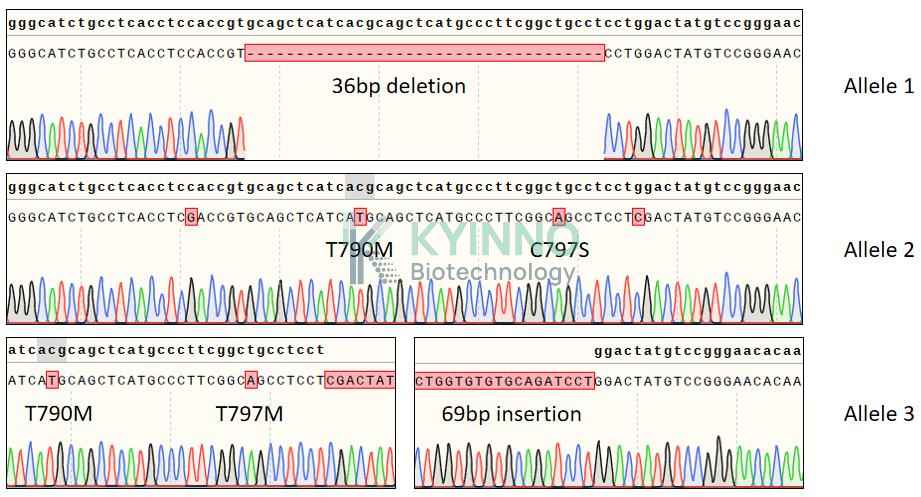
Figure 1: Characterization of PC9-EGFR-Del19-T790M-C797S-KI Cell Line stable clone using PCR sequencing.

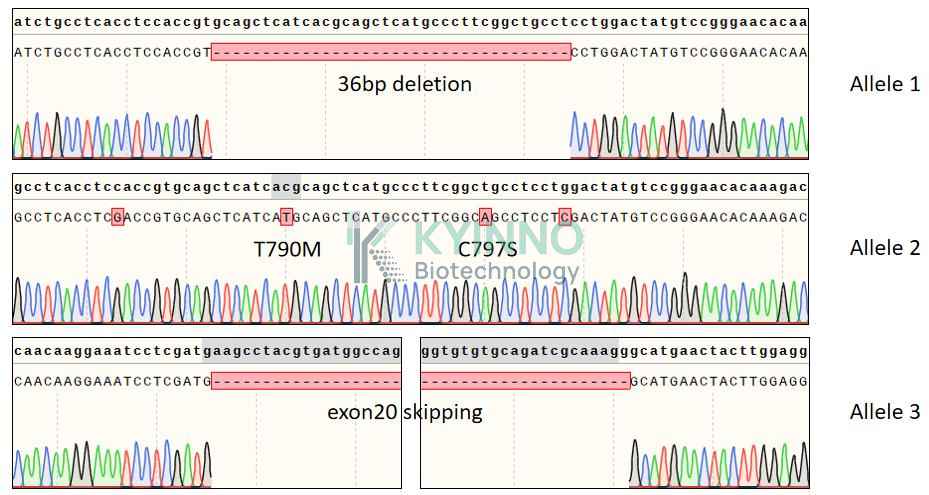
Figure 2: Characterization of PC9-EGFR-Del19-T790M-C797S-KI Cell Line stable clone using RT-PCR sequencing.

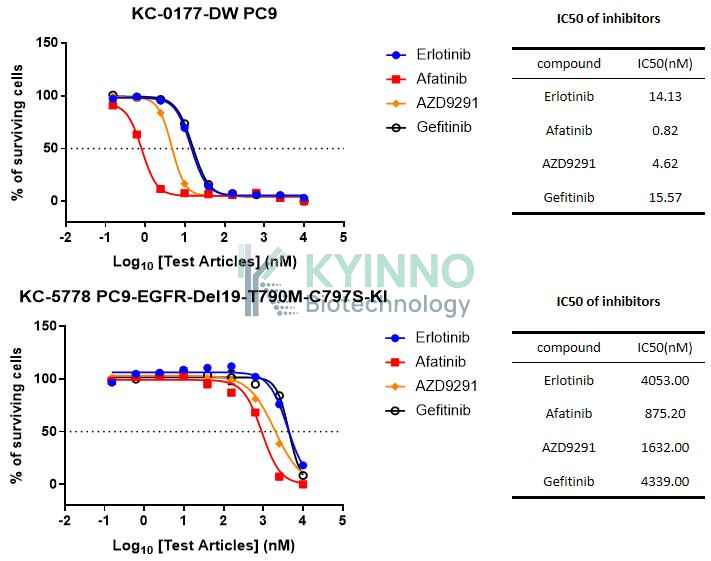
Figure 3: Characterization of Dose-response curves and IC50 values for PC9 and PC9-EGFR-Del19-T790M-C797S-KI cells treated with Erlotinib, Afatinib, AZD9291 and Gefitinib over 5 days.

Cell Resuscitation

  1. Prewarm culture medium (RPMI1640+10% FBS)in a 37°C water bath.
  2. Thaw the frozen vial in a 37°C water bath for 1-2 minutes.
  3. Transfer the vial into biosafety cabinet, and wipe the surface with 70% ethanol.
  4. Unscrew the top of the vial and transfer the cell suspension gently into a sterile centrifuge tube containing 9.0mL complete culture medium.
  5. Spin at ~ 125 × g for 5-7 minutes at room temperature, and discard the supernatant without disturbing the pellet.
  6. Resuspend cell pellet with the appropriate volume of complete medium and transfer the cell suspension into a T25 culture flask.
  7. Incubate the flask at 37°C, 5% CO2 incubator.
  8. Split saturated culture 1:4-1:5 every 2-3 days; seed out at about 1-3 × 10⁵ cells/mL.

Cell Freezing

  1. Prepare the freezing medium (70% RPMI1640 + 20% FBS + 10% DMSO) fresh immediately before use.
  2. Keep the freezing medium on ice and label cryovials.
  3. Transfer cells to a sterile, conical centrifuge tube, and count the cells.
  4. Centrifuge the cells at 250×g for 5 minutes at room temperature and carefully aspirate off the medium.
  5. Resuspend the cells at a density of at least 3×10⁶ cells/mL in chilled freezing medium.
  6. Aliquot 1 mL of the cell suspension into each cryovial.
  7. Freeze cells in the CoolCell freezing container overnight in a -80°C freezer.
  8. Transfer vials to liquid nitrogen for long-term storage.

References

  1. Passaro A, Mok T, Peters S, Popat S, Ahn MJ, de Marinis F. Recent Advances on the Role of EGFR Tyrosine Kinase Inhibitors in the Management of NSCLC With Uncommon, Non Exon 20 Insertions, EGFR Mutations. J Thorac Oncol. 2021 May;16(5):764-773. doi: 10.1016/j.jtho.2020.12.002. Epub 2020 Dec 14. PMID: 33333327.
  2. Wang S, Tsui ST, Liu C, Song Y, Liu D. EGFR C797S mutation mediates resistance to third-generation inhibitors in T790M-positive non-small cell lung cancer. J Hematol Oncol. 2016 Jul 22;9(1):59. doi: 10.1186/s13045-016-0290-1. PMID: 27448564; PMCID: PMC4957905.
  3. Thress KS, Paweletz CP, Felip E, Cho BC, Stetson D, Dougherty B, Lai Z, Markovets A, Vivancos A, Kuang Y, Ercan D, Matthews SE, Cantarini M, Barrett JC, Jänne PA, Oxnard GR. Acquired EGFR C797S mutation mediates resistance to AZD9291 in non-small cell lung cancer harboring EGFR T790M. Nat Med. 2015 Jun;21(6):560-2. doi: 10.1038/nm.3854. Epub 2015 May 4. PMID: 25939061; PMCID: PMC4771182.
Please enable JavaScript in your browser to complete this form.