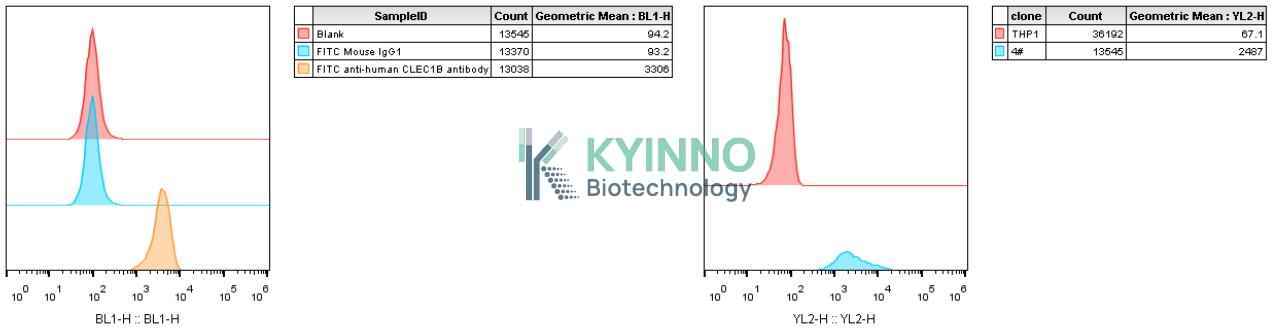
CLEC1B (C-Type Lectin Domain Family 1 Member B) is a Protein Coding gene. This gene encodes a member of the C-type lectin/C-type lectin-like domain (CTL/CTLD) superfamily. Members of this family share a common protein fold and have diverse functions, such as cell adhesion, cell-cell signalling, glycoprotein turnover, and roles in inflammation and immune response. The encoded type II transmembrane protein, also known as CLEC-2, is predominantly expressed on platelets and megakaryocytes, functioning as a platelet activation receptor. It signals through a hem-immunoreceptor tyrosine-based activation motif (hemITAM) and the recruitment of Syk kinase upon ligand binding. Its major endogenous ligand is podoplanin, a transmembrane protein expressed on lymphatic endothelial cells. CLEC1B plays essential roles in blood/lymphatic vessel separation during development, thrombus formation, and thromboinflammation. Alternative splice variants have been described but their full-length sequences have not been fully determined.
DsRed (Discosoma sp. red fluorescent protein) is a gene encoding a red fluorescent protein, and is also widely used as a genetically encoded fluorescent reporter tag. The native DsRed gene was cloned from a coral of the Discosoma genus (GenBank accession: AF168419), and encodes a 28 kDa protein belonging to the green fluorescent protein (GFP) family. DsRed shares similar overall topology with GFP but exhibits a dramatically red-shifted spectrum, with an excitation maximum at 558 nm and emission maximum at 583 nm. As a fluorescence reporter, DsRed has been widely applied in subcellular labeling, gene expression monitoring, protein-protein interaction studies, and multicolor live-cell imaging. The protein possesses high extinction coefficient and quantum yield, as well as excellent resistance to pH extremes and photobleaching. However, wild-type DsRed has notable drawbacks, including obligate tetramerization and extremely slow chromophore maturation. Directed evolution of DsRed has generated a series of improved variants, among which mRFP1 was the first true monomer, and subsequent engineering efforts have produced widely used variants such as mCherry and tdTomato.