KC-5171

KYSE-150-EGFR-L858R-KI Cell Line

×
Please enable JavaScript in your browser to complete this form.
55188
Home » KYSE-150-EGFR-L858R-KI Cell Line

Background of KYSE-150-EGFR-L858R-KI Cell Line

The epidermal growth factor receptor (EGFR) is a transmembrane tyrosine kinase that plays a pivotal role in regulating cell proliferation, survival, and differentiation. EGFR activation triggers downstream signaling pathways, including RAS/RAF/MEK/ERK and PI3K/AKT/mTOR, which are frequently dysregulated in cancers. EGFR overexpression or activating mutations (e.g., exon 19 deletions and L858R) are common in non-small cell lung cancer (NSCLC), glioblastoma, and colorectal cancer, making it a critical therapeutic target. Monoclonal antibodies (e.g., cetuximab and panitumumab) targeting EGFR extracellular domain are used in colorectal and head/neck cancers. Current research focuses on overcoming resistance mechanisms and developing next-generation inhibitors. Further exploration of EGFR\'s role in tumor microenvironment and immune modulation may provide novel therapeutic strategies.

Specifications

Catalog NumberKC-5171
Cell Line NameKYSE-150-EGFR-L858R-KI Cell Line
Clone Number1B4
Host Cell LineKYSE-150
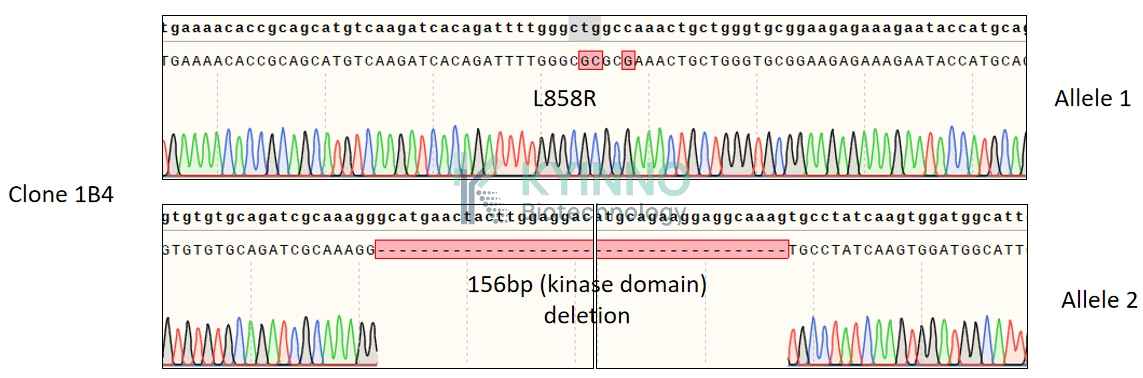
DescriptionStable KYSE-150 clone expressing endogenous EGFR gene bearing L858R mutations, No.1B4
QuantityTwo vials of frozen cells (≥2-106/vial)
StabilityStable in culture over a minimum of 10 passages
ApplicationDrug screening and biological assays
Freezing Medium70% RPMI1640+20% FBS+10% DMSO
Propagation MediumRPMI1640+10% FBS
Selection MarkerNA
MorphologyEpithelial
SubcultureSplit saturated culture 1:3-1:6 every 2-3 days; seed out at about 1-3 × 10⁵ cells/mL
Incubation37 °C with 5% CO2
StorageLiquid nitrogen immediately upon receiving
Doubling TimeApproximately 30 hours
Mycoplasma StatusNegative

Cell Line Generation

KYSE-150-EGFR-L858R-KI cell line was generated using the CRISPR method.

Characterization

Figure 1: Characterization of KYSE-150-EGFR-L858R-KI cell line stable clone using PCR sequencing.

Figure 2: Characterization of KYSE-150-EGFR-L858R-KI cell line stable clone using RT-PCR sequencing.

Cell Resuscitation

  1. Prewarm culture medium (RPMI1640 + 10% FBS)in a 37°C water bath.
  2. Thaw the frozen vial in a 37°C water bath for 1-2 minutes.
  3. Transfer the vial into biosafety cabinet, and wipe the surface with 70% ethanol.
  4. Unscrew the top of the vial and transfer the cell suspension gently into a sterile centrifuge tube containing 9.0mL complete culture medium.
  5. Spin at ~ 125 × g for 5-7 minutes at room temperature, and discard the supernatant without disturbing the pellet.
  6. Resuspend cell pellet with the appropriate volume of complete medium and transfer the cell suspension into a T25 culture flask.
  7. Incubate the flask at 37°C, 5% CO2 incubator.
  8. Split saturated culture 1:3-1:6 every 2-3 days; seed out at about 1-3 × 10⁵ cells/mL.

Cell Freezing

  1. Prepare the freezing medium (70% RPMI1640 + 20% FBS + 10% DMSO) fresh immediately before use.
  2. Keep the freezing medium on ice and label cryovials.
  3. Transfer cells to a sterile, conical centrifuge tube, and count the cells.
  4. Centrifuge the cells at 250×g for 5 minutes at room temperature and carefully aspirate off the medium.
  5. Resuspend the cells at a density of at least 3×10⁶ cells/mL in chilled freezing medium.
  6. Aliquot 1 mL of the cell suspension into each cryovial.
  7. Freeze cells in the CoolCell freezing container overnight in a -80°C freezer.
  8. Transfer vials to liquid nitrogen for long-term storage

References

  1. Yarden, Y., & Sliwkowski, M.X. (2001). Untangling the ErbB signalling network. Nature Reviews Molecular Cell Biology, 2(2), 127-137.
  2. Lynch, T.J., et al. (2004). Activating mutations in the epidermal growth factor receptor underlying responsiveness of non-small-cell lung cancer to gefitinib. New England Journal of Medicine, 350(21), 2129-2139.
  3. Roskoski, R. (2014). The ErbB/HER family of protein-tyrosine kinases and cancer. Pharmacological Research, 79, 34-74.
Please enable JavaScript in your browser to complete this form.