KC-5857

NCI-H2170-ERBB2-YVMA-KI cell line

×
请在浏览器中启用JavaScript来完成此表单。
64001
Home » NCI-H2170-ERBB2-YVMA-KI cell line

Background of NCI-H2170-ERBB2-YVMA-KI cell line

Human epidermal growth factor receptor 2 (HER2, encoded by ERBB2) exon 20 insertions are recognized as oncogenic drivers in a subset of non‑small cell lung cancer (NSCLC). Among these, the in‑frame insertion A775_G776insYVMA (p.A771_Y772insYVMA, also referred to as HER2‑YVMA) is the most prevalent alteration, accounting for approximately 70–83% of all HER2 exon 20 insertions, particularly in lung adenocarcinoma. This mutation occurs predominantly in younger, never‑ or light‑smoking female patients with adenocarcinoma histology.
The YVMA insertion introduces structural changes in the HER2 kinase domain, alters the secondary structure of the loop region, and creates steric hindrance that reduces the binding affinity of conventional HER2‑targeted tyrosine kinase inhibitors (TKIs) such as afatinib, while conferring partial sensitivity to newer agents like pyrotinib and poziotinib. Compared with non‑exon 20 HER2 alterations, tumors harboring exon 20 insertions exhibit a higher risk of metastasis (including brain metastases, which occur in ~50% of patients) and poorer prognosis, with chemotherapy historically showing limited efficacy. Recent advances have introduced novel HER2‑directed antibody–drug conjugates (e.g., trastuzumab deruxtecan) and more selective TKIs (zongertinib, sevabertinib), which are reshaping the treatment paradigm for this molecular subset.

Specifications

Catalog NumberKC-5857
Cell Line NameNCI-H2170-ERBB2-YVMA-KI cell line
Clone Number1B2
Host Cell LineNCI-H2170
DescriptionStable NCI-H2170 clone expressing endogenous ERBB2 gene bearing YVMA mutations
QuantityOne vial of frozen cells (≥2-106/vial)
StabilityStable in culture over a minimum of 10 passages
ApplicationDrug screening and biological assays
Freezing Medium70% RPMI1640 + 20% FBS + 10% DMSO
Propagation MediumRPMI1640 + 10% FBS
Selection MarkerNA
MorphologyFibroblastoid cells growing as a monolayer
SubcultureSplit the saturated culture at a ratio of 1:4-1:5 every 3-4 days; seed out at about 1-3 x 10⁵ cells/mL
Incubation37 °C with 5% CO2
StorageLiquid nitrogen immediately upon receiving
Doubling TimeApproximately 32 hours
Mycoplasma StatusNegative

Cell Line Generation

NCI-H2170-ERBB2-YVMA-KI cell line was generated using the CRISPR method.

Characterization

Figure 1: Characterization of NCI-H2170-ERBB2-YVMA-KI cell line stable clone using PCR sequencing.

Figure 2:Characterization of NCI-H2170-ERBB2-YVMA-KI cell line stable clone using RT-PCR sequencing.

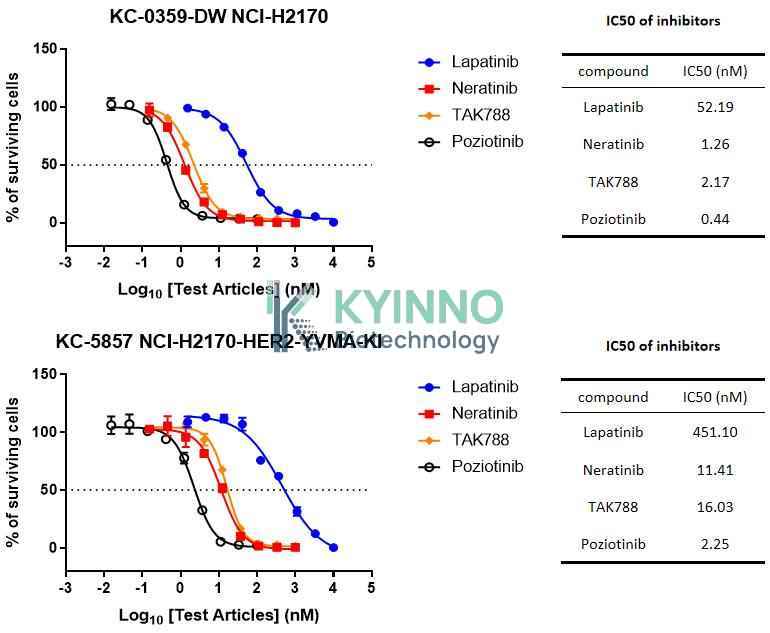
Figure 3: Characterization of Dose-response curves and IC50 values for NCI-H2170 and NCI-H2170-ERBB2-YVMA-KI cells treated with Lapatinib, Neratinib, TAK788 and Poziotinib over 5 days

Cell Resuscitation

  1. Prewarm culture medium (RPMI1640+10% FBS)in a 37°C water bath.
  2. Thaw the frozen vial in a 37°C water bath for 1-2 minutes.
  3. Transfer the vial into biosafety cabinet, and wipe the surface with 70% ethanol.
  4. Unscrew the top of the vial and transfer the cell suspension gently into a sterile centrifuge tube containing 9.0mL complete culture medium.
  5. Spin at ~ 125 × g for 5-7 minutes at room temperature, and discard the supernatant without disturbing the pellet.
  6. Resuspend cell pellet with the appropriate volume of complete medium and transfer the cell suspension into a T25 culture flask.
  7. Incubate the flask at 37°C, 5% CO2 incubator.
  8. Split saturated culture 1:4-1:5 every 3-4 days; seed out at about 1-3 × 10⁵ cells/mL.

Cell Freezing

  1. Prepare the freezing medium (70% RPMI1640 + 20% FBS + 10% DMSO) fresh immediately before use.
  2. Keep the freezing medium on ice and label cryovials.
  3. Transfer cells to a sterile, conical centrifuge tube, and count the cells.
  4. Centrifuge the cells at 250×g for 5 minutes at room temperature and carefully aspirate off the medium.
  5. Resuspend the cells at a density of at least 3×10⁶ cells/mL in chilled freezing medium.
  6. Aliquot 1 mL of the cell suspension into each cryovial.
  7. Freeze cells in the CoolCell freezing container overnight in a -80°C freezer.
  8. Transfer vials to liquid nitrogen for long-term storage.

References

  1. Yang G, Xu H, Hu J, Liu R, Hu P, Yang Y, Li W, Hao X, Zhang S, Xu F, Ai X, Li J, Wang Y. Specific HER2 Exon 20 Gly776 Deletion-Insertions in Non-Small Cell Lung Cancer: Structural Analysis and Sensitivity to HER2-Targeted Tyrosine Kinase Inhibitors. Front Pharmacol. 2022 Mar 7;13:806737. doi: 10.3389/fphar.2022.806737. PMID: 35330827; PMCID: PMC8940162.
  2. Hou Y, Xue X, Zhang Z, Mai D, Luo W, Zhou M, Liu Z, Huang Y. Genomic and clinical characterization of HER2 exon 20 mutations in non-small cell lung cancer: insights from a multicenter study in South China. BMC Cancer. 2025 Apr 22;25(1):752. doi: 10.1186/s12885-025-14125-9. PMID: 40264034; PMCID: PMC12012961.

Use License Agreement

Research Use Only.
Not for use in diagnostic procedures or therapeutic applications.
Redistribution of the cell line or its derivatives is prohibited without prior written permission from Kyinno Biotechnology.
请在浏览器中启用JavaScript来完成此表单。