KC-4313

RKO-WRN-C727S-1A1 Cell Line

×
Please enable JavaScript in your browser to complete this form.
44252
Home » RKO-WRN-C727S-1A1 Cell Line

Background of RKO-WRN-C727S-1A1 Cell Line

The WRN gene, encoding the Werner syndrome RecQ-like helicase (WRN), is a member of the RecQ helicase family. This protein plays a crucial role in maintaining genomic stability through its involvement in DNA repair, replication, and telomere maintenance. The WRN-C727S mutation involves the substitution of cysteine for serine at codon 727, altering the helicase domain of the WRN protein. This change can impact the enzyme's function, potentially leading to deficiencies in its ability to resolve complex DNA structures and maintain genomic integrity.Understanding the functional consequences of the WRN-C727S mutation is important for elucidating the pathogenesis of Werner syndrome and for developing potential therapeutic strategies aimed at mitigating the effects of this and similar mutations.

Specifications

Catalog NumberKC-4313
Cell Line NameRKO-WRN-C727S-1A1 Cell Line
Host Cell LineRKO
DescriptionStable RKO clone expressing exogenous WRN gene bearing C727S mutations, No.1A1
QuantityTwo vials of frozen cells (≥2-106/vial)
StabilityStable in culture over a minimum of 10 passages
ApplicationDrug screening and biological assays
Freezing MediumRPMI1640+20% FBS+10% DMSO
Propagation MediumRPMI1640+10% FBS
Selection MarkerN/A
MorphologyEpithelial
SubcultureSplit saturated culture 1:3-1:6 every 2-3 days; seed out at about 1-3 × 10⁵ cells/mL
Incubation37 °C with 5% CO2
StorageLiquid nitrogen immediately upon receiving
Doubling TimeApproximately 30 hours
Mycoplasma StatusNegative
In Vivo ValidationNA

Cell Line Generation

RKO-WRN-C727S-1A1 cell line was generated using the CRISPR method.

Characterization

Figure 1: Characterization of RKO-WRN-C727S-1A1 cell line stable clone using PCR sequencing.

Figure 2: Characterization of RKO-WRN-C727S-1A1 cell line stable clone using RT-PCR sequencing.

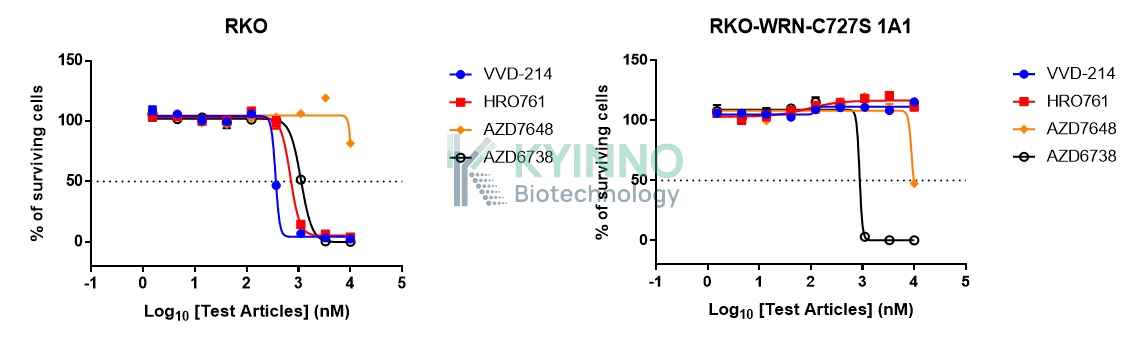
Figure 3. Characterization of dose-response curves for WRN inhibitors on RKO and RKO-WRN-C727S-1A1 cells.

Cell Resuscitation

  1. Prewarm culture medium (RPMI1640 + 10% FBS)in a 37°C water bath.
  2. Thaw the frozen vial in a 37°C water bath for 1-2 minutes.
  3. Transfer the vial into biosafety cabinet, and wipe the surface with 70% ethanol.
  4. Unscrew the top of the vial and transfer the cell suspension gently into a sterile centrifuge tube containing 9.0mL complete culture medium.
  5. Spin at ~ 125 × g for 5-7 minutes at room temperature, and discard the supernatant without disturbing the pellet.
  6. Resuspend cell pellet with the appropriate volume of complete medium and transfer the cell suspension into a T25 culture flask.
  7. Incubate the flask at 37°C, 5% CO2 incubator.
  8. Split saturated culture 1:3-1:6 every 2-3 days; seed out at about 1-3 × 10⁵ cells/mL.

Cell Freezing

  1. Prepare the freezing medium (70% RPMI1640 + 20% FBS + 10% DMSO) fresh immediately before use.
  2. Keep the freezing medium on ice and label cryovials.
  3. Transfer cells to a sterile, conical centrifuge tube, and count the cells.
  4. Centrifuge the cells at 250×g for 5 minutes at room temperature and carefully aspirate off the medium.
  5. Resuspend the cells at a density of at least 3×10⁶ cells/mL in chilled freezing medium.
  6. Aliquot 1 mL of the cell suspension into each cryovial.
  7. Freeze cells in the CoolCell freezing container overnight in a -80°C freezer.
  8. Transfer vials to liquid nitrogen for long-term storage.

References

  1. Opresko, P. L., et al. (2014). The Werner syndrome helicase and exonuclease cooperate to resolve telomeric D loops in a manner regulated by TRF1 and TRF2.Molecular Cell, 54(6), 1163-1174. https://doi.org/10.1016/j.molcel.2014.05.018
  2. Monnat, R. J., Jr. (2010). Human RECQ helicases: roles and mechanisms.Nature Reviews Molecular Cell Biology, 11(10), 721-733. https://doi.org/10.1038/nrm2970
  3. Masala, M. V., et al. (2012). Mutations in the RecQ family of helicases: impacts on genomic instability and cancer.Current Molecular Medicine, 12(4), 434-447. https://doi.org/10.2174/156652412800325137
Please enable JavaScript in your browser to complete this form.